
Last reviewed: July 28, 2026
If you have a PPO plan in New York and the treatment program you are considering is out-of-network, your plan may still pay a portion of the cost. Out-of-network does not mean uncovered. It means the provider has no pre-negotiated contract with your insurer, so a different set of benefits applies — usually a separate deductible, a different coinsurance split, and a separate out-of-pocket maximum. Whether those benefits apply to your situation, and at what level, is determined by verifying your specific policy.
That distinction matters because a large number of people stop looking the moment they hear “out-of-network.” This page explains what the term actually means on a New York PPO, how single case agreements work, what your plan reviews when it evaluates addiction treatment, and exactly what to have in hand before you call anyone. If you want your plan checked directly, you can call 888-500-2110 at any hour.
What “Out-of-Network” Means on a New York PPO
Insurance networks are contracts, not quality ratings. When a treatment provider is in-network, it has signed an agreement with the insurer accepting set rates and set rules. When it is out-of-network, no such agreement exists. The provider may be excellent, poorly run, or anywhere between — network status says nothing about that. It only describes a business relationship.
On a PPO, out-of-network care is normally a covered category with its own terms. Four numbers usually determine what you pay.
| Term | What it means for out-of-network care |
| Out-of-network deductible | What you pay before the plan pays anything toward out-of-network services. Usually separate from and higher than the in-network deductible. In most plans the two do not combine. |
| Coinsurance | The percentage split after the deductible is met. A plan paying 90% in-network may pay 60% or 70% out-of-network. |
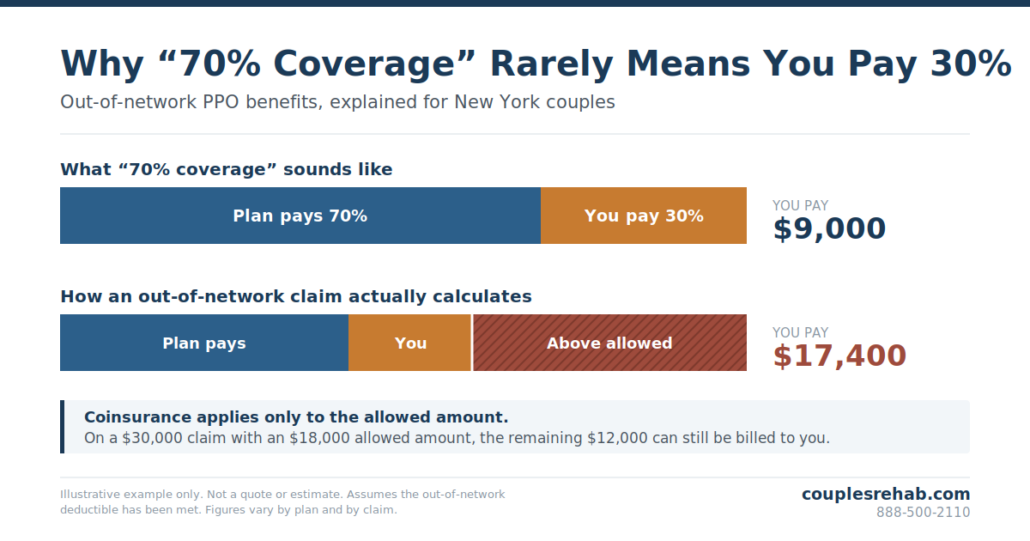
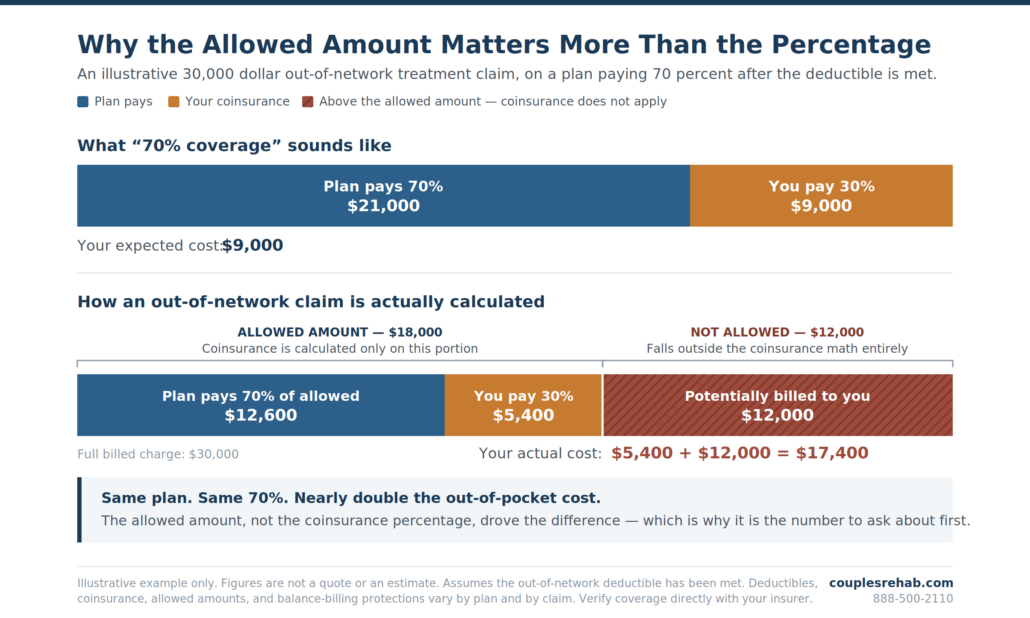
| Allowed amount | The figure your insurer treats as a reasonable price. Coinsurance is calculated against this number, not against the billed charge. This is often the number that matters most. |
| Out-of-network out-of-pocket maximum | The annual cap on covered out-of-network cost sharing. Usually higher than the in-network cap. Some plans do not have one at all. |
Why the allowed amount matters more than the percentage
People reasonably focus on the coinsurance percentage, but the allowed amount usually has the larger effect. Coinsurance applies to what the insurer decided the service is worth, not to what the provider charged. If those two numbers are far apart, the difference sits outside the coinsurance calculation entirely. When you verify benefits, ask how the plan determines the allowed amount for behavioral health services, not only what the coinsurance split is.
Balance billing
Balance billing is when a provider bills you for the gap between its charge and the insurer’s allowed amount. Federal and New York rules limit this in specific emergency and surprise-billing circumstances, but a scheduled, planned out-of-network admission is generally not one of them. Before admission anywhere, ask for a written statement of your expected financial responsibility. Any program that will not put that in writing has told you something useful.
Your Plan Type Decides What Is Possible
Before anything else, look at your member ID card. The plan type printed on it determines whether out-of-network benefits exist at all.
- PPO — Preferred Provider Organization. Out-of-network benefits normally exist. No referral typically required. This is the plan type most likely to support out-of-network treatment.
- POS — Point of Service. Out-of-network benefits often exist but may require a referral from a primary care physician to access at the better rate.
- EPO — Exclusive Provider Organization. Out-of-network care is generally not covered outside emergencies, despite EPOs otherwise resembling PPOs.
- HMO — Health Maintenance Organization. Out-of-network care is generally excluded outside emergencies. Some HMO members may request authorization for out-of-network care when the network lacks an appropriate provider.
If your card says EPO or HMO, the conversation changes but does not necessarily end. Verification will focus on whether any exception pathway applies to your plan.
What a Single Case Agreement Is
A single case agreement, often shortened to SCA, is a one-time contract between an insurance company and an out-of-network provider covering one member’s episode of care. It establishes the reimbursement rate and terms for that admission only.
An SCA is not a network contract. It does not add the provider to the insurer’s network, it does not apply to anyone else on the plan, and it does not carry forward to a future admission. It is a narrow, situational arrangement.
When an insurer may consider one
Insurers evaluate these individually, and outcomes vary widely by carrier and plan. Factors that commonly enter the analysis include:
- Whether comparable in-network care is reasonably available to the member within a reasonable distance and timeframe.
- The clinical documentation supporting the requested level of care, including assessment findings and treatment history.
- Whether the member has a documented history with the provider or clinical continuity considerations.
- The specific language of the plan contract, which for employer-sponsored plans may be governed by ERISA.
There is no guaranteed outcome. An insurer may decline. Anyone who tells you a single case agreement is assured has told you something that no one can know before the request is submitted and reviewed.
What a single case agreement does not do
An approved SCA sets a rate. It does not by itself resolve medical necessity for every subsequent day of care, it does not eliminate your deductible or coinsurance obligations unless the agreement specifically says so, and it does not prevent continued utilization review. Read what the agreement actually covers.
Using Your New York Plan for Treatment in California
Many PPO plans are not limited by state lines. Out-of-network benefits are generally defined by the plan contract rather than by geography, which is why a New York member may be able to apply out-of-network benefits to a program in another state. Whether your plan will do so depends on your policy language, the level of care requested, and the insurer’s medical necessity review.
Couples seeking treatment together face a practical constraint that drives a lot of out-of-state searching: programs that admit both partners and treat the relationship alongside the substance use are not evenly distributed. Southern California has a comparatively dense concentration of licensed programs offering couples-based tracks. That is a matter of where programs happen to be located, not a judgment about New York care — New York has a large and well-regulated treatment system, and for many people the right program is close to home.
Practical considerations worth weighing before deciding on out-of-state care:
- Travel logistics and who accompanies each partner, particularly if withdrawal management is needed first.
- Continuity of aftercare once you return to New York, including outpatient providers and support groups.
- Whether any existing prescribers or clinicians in New York should be coordinating with the treatment team.
- Family, employment, and childcare obligations during the treatment window.
These questions are worth answering before benefits are verified, not after.
Levels of Care Your Plan Reviews Separately
Insurers do not authorize “rehab” as a single unit. They evaluate each level of care on its own terms, and approval at one level does not carry automatically to the next. Understanding this prevents a common and stressful surprise partway through treatment.
- Medically supervised withdrawal management, commonly called detox. Typically the shortest authorization window and the one reviewed most frequently.
- Residential or inpatient treatment. Twenty-four-hour structured care with clinical staffing on site.
- Partial hospitalization, or PHP. Intensive daytime programming with the person residing off site or in supportive housing.
- Intensive outpatient, or IOP. Multiple sessions per week, structured around work or family obligations.
- Standard outpatient. Ongoing individual and couples therapy at a lower frequency.
Levels of care are commonly assessed against published clinical criteria such as the ASAM Criteria, which insurers and providers use to describe severity and match it to an appropriate setting. Withdrawal management in particular is medically driven — withdrawal from alcohol and from benzodiazepines can carry serious medical risk and should always be assessed by a clinician rather than attempted independently.
Mental Health and Dual Diagnosis
Substance use disorders frequently occur alongside mental health conditions including depression, anxiety disorders, PTSD, and bipolar disorder. Treating one while ignoring the other tends to produce poor results, which is why integrated care is standard practice rather than an add-on service.
For couples, this matters twice over. Two people in a relationship where substances are involved often present with different underlying conditions, different histories, and different clinical needs, even when the substance use looks similar from the outside. Each partner is assessed individually.
Most plans that cover substance use treatment also cover co-occurring mental health care, though the billing and authorization mechanics vary. Verification clarifies what your policy includes.
Protections That Apply to Your Behavioral Health Benefits
Federal parity
The Mental Health Parity and Addiction Equity Act generally requires that group health plans covering mental health and substance use disorder benefits not impose more restrictive financial requirements or treatment limitations on those benefits than they impose on comparable medical and surgical benefits. Parity does not require a plan to cover any particular provider or program. What it constrains is how differently a plan may treat behavioral health benefits relative to the rest of the plan.
New York external appeal rights
If your plan is regulated by New York State and issues a final adverse determination — including denials based on medical necessity, on treatment being experimental or investigational, or on out-of-network services — you generally have the right to an external appeal reviewed by an independent agent through the New York State Department of Financial Services. DFS states that the filing window is four months from the date of the final adverse determination. You normally must complete your plan’s internal appeal first, or have the internal appeal waived. The New York State Department of Health also publishes an overview of managed care external appeals, and DFS maintains broader consumer health insurance guidance covering coverage disputes and complaints.
A denial is a decision, not a verdict. Appeals are overturned regularly, and the process exists precisely because insurers get things wrong.
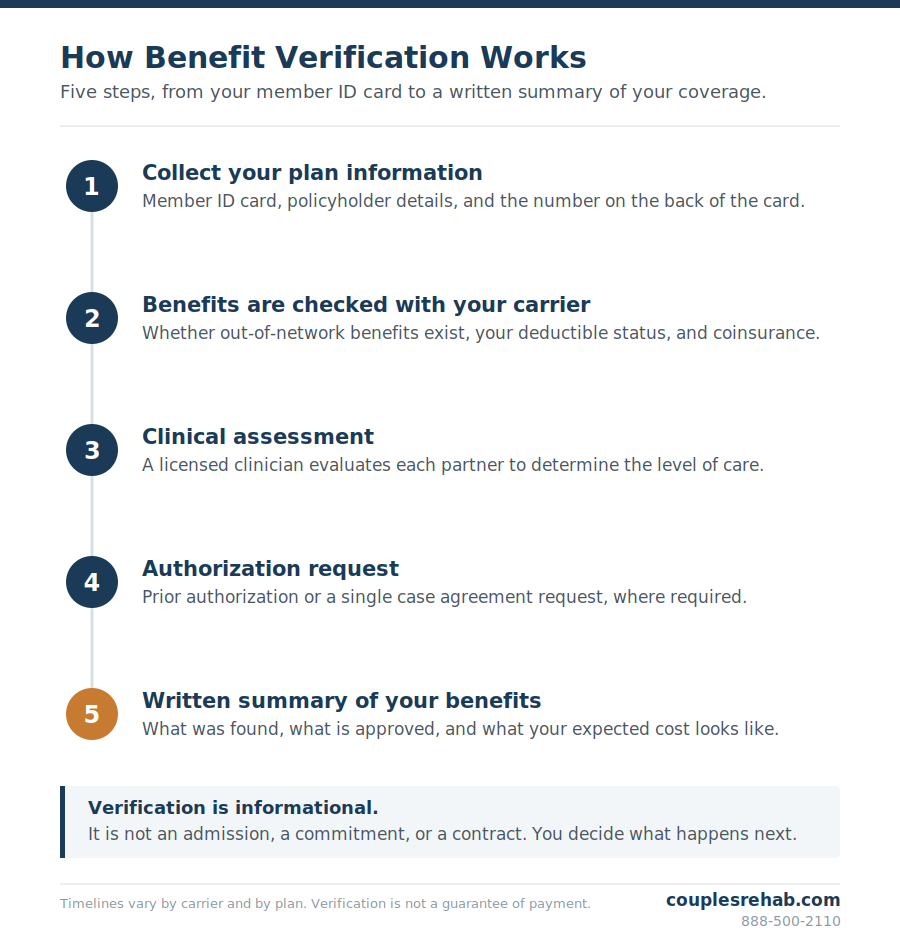
The Five-Step Verification Process
- Collect your plan information. Member ID card for each person seeking treatment, policyholder name and date of birth, and the member services number on the back of the card.
- Benefits are checked directly with the carrier. This confirms whether out-of-network benefits exist, the status of your deductible for the plan year, the coinsurance split, and any out-of-pocket maximum.
- Clinical assessment. A licensed clinician evaluates each partner to determine the appropriate level of care. Insurers authorize based on documented clinical need, so this step drives everything downstream.
- Authorization request. Where required, prior authorization or a single case agreement request is submitted with the supporting clinical documentation.
- Written summary of what your plan indicates. You receive a plain-language explanation of what was found, what is approved, what remains outstanding, and what your expected financial responsibility looks like.
Verification is informational. It is not an admission, not a commitment, and not a contract. You can verify benefits and then decide to do nothing at all, or take the information to a different program entirely.
What to Have Ready Before You Call
- Member ID card for each person seeking treatment — front and back.
- Policyholder’s full name and date of birth, if different from the person entering treatment.
- The plan type printed on the card: PPO, POS, EPO, or HMO.
- Whether coverage comes through an employer, a union, a public employee plan, or the individual marketplace.
- The name of any third-party administrator, if one appears on the card.
- A rough sense of substances involved, frequency, and time since last use — this shapes whether withdrawal management is needed first.
- Any prior treatment episodes, current prescriptions, and current mental health diagnoses.
- Any current prescribers or therapists who should be coordinated with.
If you do not have all of this, call anyway. Most of it can be gathered on the call, and waiting until the folder is complete is rarely the right trade.
Find Your Plan
The pages below cover plan-specific detail for the carriers most common among New York members, including how each plan type generally handles behavioral health benefits and what to expect during verification. Couples Rehab is not affiliated with any of these companies; the names appear only so members can find their plan.
- Empire BlueCross BlueShield — one of the most widely held commercial plans in New York, covering both employer-sponsored and individual market members.
- NYSHIP Empire Plan — the plan covering New York State employees, retirees, and many participating local government and school district employees.
- Aetna — common through employer-sponsored coverage, with behavioral health benefits frequently administered through a separate division.
- Cigna — often encountered on national employer plans, including plans administered for self-funded employers.
- UnitedHealthcare and Oxford — Oxford operates as part of UnitedHealthcare and remains widely held in the New York metropolitan area.
- Horizon BlueCross BlueShield — frequently held by members who live in New York and work in New Jersey, or who moved between the two states.
Do not see your carrier? The mechanics on this page apply to most PPO plans regardless of the name on the card. Call 888-500-2110 and your plan can be checked directly.
Serving Couples Across New York
Members contact us from across the state, and the questions differ by region — plan mix, network density, and travel logistics all vary. Our statewide New York resource is the starting point, with regional guidance for New York City, Long Island, Albany and the Capital Region, and Buffalo and Western New York.
New York also maintains a substantial in-state treatment system. The New York State Office of Addiction Services and Supports oversees roughly 1,700 prevention, treatment, and recovery programs, and its certified provider directory lets you search in-state programs directly. If in-state care is the better fit for your situation, that is a good outcome and we will tell you so.
Frequently Asked Questions
What does “out-of-network” actually mean on a PPO plan?
Out-of-network means the treatment provider has not signed a contract with your insurance company setting pre-negotiated rates. It does not automatically mean your plan pays nothing. Most PPO plans include a separate set of out-of-network benefits with their own deductible, coinsurance percentage, and out-of-pocket maximum. Whether those benefits apply to a specific program, and at what level, is determined when your plan is verified.
Does out-of-network mean my plan will not cover anything?
Not necessarily. On a PPO, out-of-network benefits usually exist but are structured differently than in-network benefits. On an HMO or EPO, out-of-network care is often excluded except in emergencies. The plan type printed on your member ID card is the first thing to check, and verification will confirm what your specific policy allows.
What is a single case agreement?
A single case agreement, sometimes abbreviated SCA, is a one-time contract between an insurance company and a treatment provider that is not in that insurer’s network. It sets the terms and reimbursement rate for one patient’s episode of care. It applies only to that person and that admission. It does not add the provider to the network and does not carry over to future treatment.
When would an insurer consider a single case agreement?
Insurers evaluate these case by case. Common factors include whether comparable in-network care is reasonably available to the member, the clinical documentation supporting the requested level of care, and the specifics of the plan contract. There is no guaranteed outcome, and an insurer may decline to enter one.
Can I use my New York plan for addiction treatment in California?
Many PPO plans are not restricted by state lines, because out-of-network benefits are generally defined by the plan contract rather than by geography. Whether your particular plan will apply benefits to an out-of-state program depends on your policy language, the level of care requested, and the insurer’s medical necessity review. Verification is the way to find out.
What is an out-of-network deductible?
It is the amount you pay toward out-of-network services before your plan begins paying its share. It is usually separate from and higher than your in-network deductible, and the two typically do not combine. Amounts you already paid in-network this year generally do not count toward the out-of-network deductible.
How does coinsurance work for out-of-network care?
Coinsurance is the percentage split between you and your plan after the deductible is met. A common in-network split might be 90/10, while the out-of-network split on the same plan might be 60/40 or 70/30. The percentage applies to the allowed amount, not necessarily to the full billed charge.
What is the “allowed amount” and why does it matter?
The allowed amount is the figure your insurer treats as the reasonable price for a service. Out-of-network coinsurance is calculated against this number rather than the provider’s billed charge. If the allowed amount is lower than what was billed, the gap is not covered by coinsurance, which is why the allowed amount often matters more than the coinsurance percentage.
What is balance billing?
Balance billing is when a provider bills you for the difference between the charge and the amount your insurer allowed. Federal and state rules limit this in certain emergency and surprise-billing situations, but those protections do not cover every scheduled out-of-network admission. Ask any program directly, in writing, what your expected financial responsibility is before admission.
Does my out-of-network out-of-pocket maximum protect me?
It caps what you pay in covered out-of-network cost sharing for the plan year, but it is usually a separate and higher cap than the in-network one. Amounts that are not covered at all, such as balance-billed differences or excluded services, generally do not count toward it. Some plans do not include an out-of-network cap.
Do HMO and EPO plans cover out-of-network treatment?
Generally these plans limit coverage to in-network providers except in emergencies, and out-of-network care is frequently excluded. Some HMO members may request an out-of-network authorization when the network lacks an appropriate provider. If your card says HMO or EPO, verification will focus on whether any exception pathway exists under your plan.
What is prior authorization?
Prior authorization is approval from your insurer before a service is provided. Most residential and inpatient behavioral health admissions require it, and receiving care without it can result in denial of payment even when the benefit otherwise exists. Prior authorization confirms medical necessity; it is not a guarantee of the final paid amount.
What is utilization review?
Utilization review is the ongoing process where an insurer evaluates whether continued care at the current level remains medically necessary. For residential treatment this often happens every few days. Clinical documentation from the treating team drives these determinations, which is why thorough assessment and record keeping matter to coverage.
Are detox and residential treatment authorized separately?
Usually yes. Insurers commonly review each level of care on its own terms, including withdrawal management, residential treatment, partial hospitalization, and intensive outpatient. Approval at one level does not automatically carry to the next, and a step down in level of care typically triggers a new review.
Can my partner and I both be covered?
Coverage is evaluated individually. Each person has their own plan, their own deductible status, and their own medical necessity determination, even when both partners are on the same policy. Two people on one family plan may still receive different authorization outcomes based on their clinical presentations.
What if my partner and I are on different insurance plans?
That is common and it is workable. Each plan is verified separately and each partner’s benefits are reviewed under their own policy. The results may differ, including different deductibles, different coinsurance, and different authorization decisions.
Does my plan cover mental health treatment alongside addiction treatment?
Many plans cover co-occurring mental health conditions, and integrated care for conditions such as depression, anxiety, PTSD, and bipolar disorder is standard practice in substance use treatment. How those services are billed and authorized varies by plan, and verification will clarify what your policy includes.
What is mental health parity and how does it help me?
The Mental Health Parity and Addiction Equity Act generally requires that group health plans covering mental health and substance use disorder benefits not apply more restrictive financial requirements or treatment limitations to those benefits than they apply to comparable medical and surgical benefits. It does not require a plan to cover any particular provider, but it does constrain how differently a plan may treat behavioral health benefits.
What can I do if my plan denies coverage?
You have the right to appeal. Start with your plan’s internal appeal process. If the plan issues a final adverse determination on grounds including medical necessity, experimental or investigational treatment, or out-of-network services, New York residents in state-regulated plans may then file an external appeal with the New York State Department of Financial Services. DFS states the filing window is four months from the final adverse determination.
How long does verification usually take?
It varies by carrier and by plan complexity. Some benefit checks return within the same business day, while others take longer if the insurer requires additional documentation or if the plan is administered by a third party. You will be told what was found and what remains outstanding.
What information do I need before I call?
Have the member ID card for each person seeking treatment, the policyholder’s name and date of birth, the plan type shown on the card, and the member services phone number on the back. If coverage is through an employer or union, knowing the plan administrator helps. If you do not have all of it, call anyway and bring what you have.
Is verifying benefits a commitment to enter treatment?
No. Verification is an informational step that tells you what your plan indicates about coverage. You are free to use that information however you choose, including deciding not to pursue treatment, or pursuing it somewhere else.
Is Couples Rehab affiliated with my insurance company?
No. Couples Rehab is an independent referral and information service. We are not affiliated with, endorsed by, or acting on behalf of any insurance carrier. Carrier names appear on this site only to help members identify their plan type.
Speak With Someone About Your Benefits
If you want to know what your plan actually says, the fastest path is to have it checked. Call 888-500-2110. Lines are staffed 24 hours a day, seven days a week. You can ask questions without giving your information, and verifying benefits commits you to nothing.
If you or someone you know is in immediate danger, call 911. For free, confidential, 24/7 treatment referral and information, SAMHSA’s National Helpline is 1-800-662-HELP (4357). In New York, the OASAS HOPEline is 1-877-846-7369, or text HOPENY to 467369. If you are in emotional distress or crisis, call or text 988.
Disclaimer
Couples Rehab is an independent referral and information service. We are not an insurance company, not a medical provider, and not affiliated with, endorsed by, or acting on behalf of Empire BlueCross BlueShield, the NYSHIP Empire Plan, Aetna, Cigna, UnitedHealthcare, Oxford, Horizon BlueCross BlueShield, or any other carrier. All trademarks are the property of their respective owners and are referenced solely to help members identify their plan. Information on this page is general education about how insurance benefits commonly work and is not insurance advice, legal advice, or medical advice. Coverage, cost, and eligibility depend entirely on your individual policy and on your insurer’s determinations. Verification of benefits is not a guarantee of payment. Always confirm coverage directly with your insurer before making treatment decisions.
