
Couples Therapy for Anxiety Disorders: How It Helps and When Individual Care Comes First
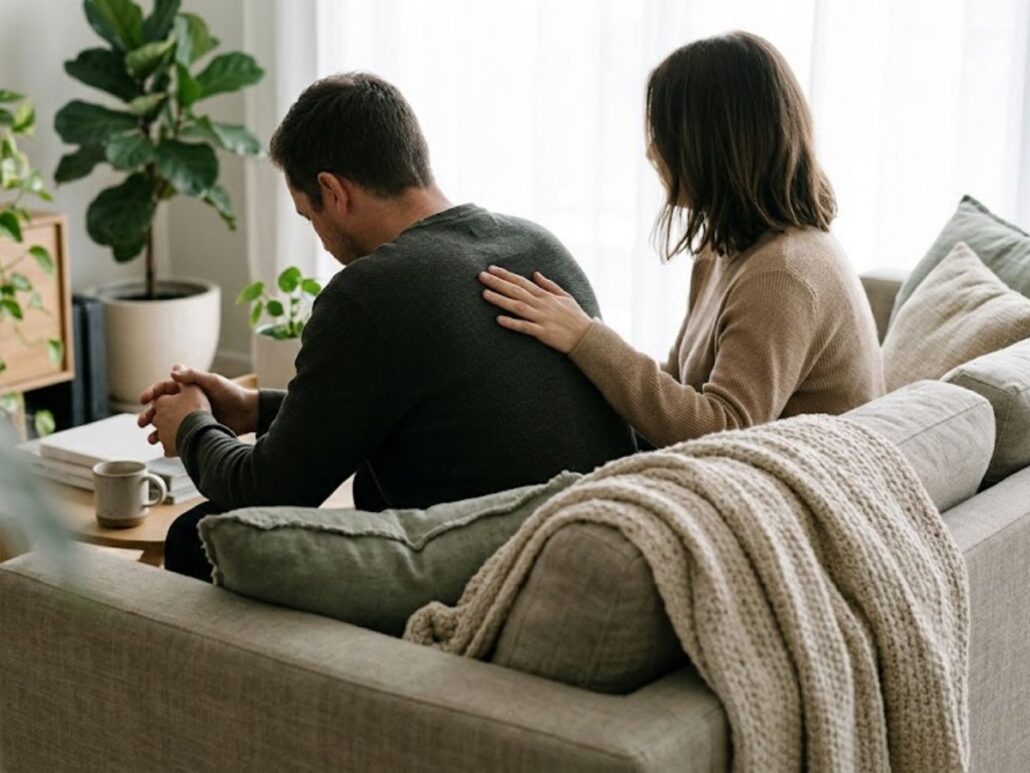
Anxiety rarely stays inside one person. It shows up in the questions one partner keeps asking and the other keeps answering, in the dinner invitation declined again, in the late-night “are we okay?” that never quite settles. Over time, both people can end up organizing their life around the worry — one trying not to trigger it, the other trying not to feel it.
Couples therapy for anxiety disorders can help partners understand those patterns, talk about anxiety without blame, and respond in ways that support recovery rather than accidentally feeding the fear. It is not, on its own, a treatment for every anxiety disorder. Many people benefit from individual anxiety treatment alongside — or before — joint sessions.
This guide explains how anxiety affects relationships, what couples-based approaches can and cannot do, when joint therapy may not be safe, and how to find qualified couples therapists for anxiety. CouplesRehab.com is an independent education and care-navigation resource; we do not provide therapy, diagnose, or prescribe.
Not Sure Whether Couples or Individual Care Fits?
Every couple’s situation is different. A short, confidential assessment can help you think through whether couples therapy, individual anxiety treatment, or both may be worth exploring.
The assessment is educational and is not a clinical evaluation. Licensed providers determine diagnosis and treatment fit.
How Anxiety Disorders Can Affect a Relationship
Anxiety disorders involve more than ordinary worry. According to the National Institute of Mental Health’s overview of anxiety disorders, the anxiety in these conditions does not go away, shows up across many situations, and can worsen over time — and NIMH lists relationships among the areas of daily life the symptoms can disrupt.
The connection runs in both directions. Anxiety symptoms can strain a relationship, and relationship stress can make symptoms harder to manage. That does not mean a relationship causes an anxiety disorder, or that a supportive partner can cure one. It means the relationship is part of the environment where anxiety either loosens its grip or tightens it.
A study that tracked couples day by day, in which one partner had a diagnosed anxiety disorder, found that on higher-anxiety days both partners rated the relationship lower — and the non-anxious partner’s own distress tended to rise alongside it. That link was stronger when the partner frequently accommodated the anxiety (Zaider, Heimberg & Iida, Journal of Consulting and Clinical Psychology). > [EDITOR NOTE] CLINICAL REVIEW FLAG 1: confirm characterization of Zaider et al. 2010 findings.
Worry That Becomes the Topic of Every Conversation
When worry spreads across health, money, work, family, and the future, it can crowd out everything else a couple talks about. One partner may feel they are constantly managing “what ifs”; the other may feel unheard when their concerns are met with frustration.
Reassurance-Seeking and the Partner Who Always Answers
Repeated questions — Are you mad at me? Did you lock the door? Are you sure the test results were fine? — are among the most common ways anxiety enters a relationship. Answering feels kind, and it brings brief relief. But the relief fades, the question returns, and both people can feel trapped in a loop neither chose.
Avoidance That Shrinks Shared Life
Skipped parties, canceled trips, routes chosen to avoid highways, a partner who always handles the phone calls. Avoidance can quietly reshape a couple’s social life, finances, and division of labor. The partner taking on more may not even notice until resentment surfaces.
Misreading Withdrawal, Irritability, or Silence
Anxiety often looks like something else. Irritability may read as anger at the partner. Withdrawal may read as loss of interest. A partner who goes quiet during conflict may be overwhelmed rather than indifferent. These misreadings can turn a symptom into an argument about the relationship itself.
Intimacy, Trust, and Decision-Making
Persistent tension, sleep disruption, and fear of rejection can affect closeness and sexual intimacy. Big decisions — moving, having children, changing jobs — may stall because uncertainty feels intolerable. Some couples find that trust erodes not because of betrayal, but because one partner’s fear keeps asking for proof.
The Partner Providing Support
The supporting partner’s experience matters in its own right. Many describe exhaustion, guilt for feeling frustrated, and a sense of walking on eggshells. Their wellbeing is not secondary to the anxious partner’s treatment; it is part of the picture any good clinician will consider.
Illustrative example — not a diagnostic checklist
Maya feels a surge of dread when Daniel is late coming home. She texts him several times. Daniel, in a meeting, replies quickly to calm her. She feels relief — briefly. The next evening, a slightly later arrival brings more texts. Daniel starts checking his phone constantly at work and feels resentful. Maya senses his irritation, reads it as distance, and her worry grows. Each step made sense in the moment. Together, they built a cycle that keeps the anxiety going and leaves both of them more tired.
Patterns like this are exactly what couples-based work aims to make visible — without casting either person as the problem.
Can Couples Therapy Help With Anxiety Disorders?
Yes, couples therapy can help many couples affected by anxiety disorders — particularly with communication, reassurance and avoidance cycles, and the strain anxiety places on both partners. It works best as part of a broader plan. For the anxiety disorder itself, individual evidence-based treatment such as cognitive behavioral therapy (CBT) remains the most established approach, and many people benefit from both.
Couples-based work may help partners:
- Identify interaction patterns that intensify distress, such as reassurance loops or shared avoidance
- Discuss anxiety without blame, so symptoms are treated as a shared problem rather than a character flaw
- Strengthen listening, communication, and collaborative problem-solving
- Separate support from responsibility — caring about a partner’s anxiety without becoming responsible for preventing it
- Set healthy boundaries that protect both people’s needs
- Practice responses that don’t reinforce fear, guided by a clinician
- Coordinate with individual treatment, so relationship work supports rather than competes with it
What the Research Shows — and Where It’s Limited
Research on partner involvement in anxiety treatment is encouraging but uneven. Couple-based cognitive-behavioral interventions — which integrate individual CBT with structured partner involvement — have been studied for several anxiety-related conditions, and reviews report symptom improvements that are often comparable to individual treatment, along with gains in relationship satisfaction. Other reviews describe the findings on adding family members to adult anxiety treatment as mixed, citing small studies and inconsistent methods. > [EDITOR NOTE] CLINICAL REVIEW FLAG 2: evidence summary drawn from Fischer & Baucom-line reviews (Hogrefe 2020s) and the family-involvement review at PMC8124087; reviewer to confirm wording and choose citations.
One area with growing support is partner accommodation — the well-intentioned ways partners change their own behavior to reduce the other person’s anxiety, such as providing repeated reassurance or taking over feared tasks. A 2024 study of adults with generalized anxiety disorder found that every participant reported some degree of partner accommodation, with reassurance the most common form, and that less reduction in accommodation during CBT was linked to poorer treatment outcomes. The authors described the finding as preliminary. > [EDITOR NOTE] CLINICAL REVIEW FLAG 3: Behavioural and Cognitive Psychotherapy, 2024 (S1352465824000213).
The practical takeaway: evidence and suitability vary by diagnosis, approach, relationship circumstances, and individual needs. Couples therapy should not replace an individualized evaluation or a recommended treatment plan for an anxiety disorder.
Types of Anxiety That May Affect Couples
Only a licensed clinician can diagnose an anxiety disorder. The descriptions below are educational; a partner observing these patterns should not attempt to diagnose the other. For condition-by-condition detail, see our anxiety disorders treatment hub.
Generalized Anxiety Disorder (GAD)
GAD involves persistent, hard-to-control worry across many areas of life. NIMH notes that a diagnosis requires difficulty controlling worry on most days for at least six months, along with symptoms such as restlessness, fatigue, poor concentration, irritability, muscle tension, or sleep problems (NIMH on generalized anxiety disorder). In couples, GAD can show up as constant planning for worst cases, difficulty making shared decisions, and frequent requests for reassurance.
Panic Disorder and Panic Attacks
A single panic attack is not the same as panic disorder. NIMH explains that panic disorder involves recurrent, unexpected attacks plus at least a month of ongoing worry about future attacks or changes in behavior to avoid them (NIMH on panic disorder). For a couple, fear of the next attack can limit travel, crowds, driving, or time alone — and the partner may become the designated “safe person.” Learn more about panic disorder treatment options.
Social Anxiety Disorder
Social anxiety disorder involves intense fear of being judged, embarrassed, or scrutinized. Couples may stop accepting invitations, avoid family gatherings, or rely on one partner to handle every social interaction. The non-anxious partner may feel isolated or torn between their own social needs and their partner’s comfort. See our overview of social anxiety.
Separation Anxiety and Relationship-Related Fears
Adults can experience separation anxiety — excessive distress about being apart from an attachment figure or fear that harm will come to them. This is different from ordinary insecurity or the normal uncertainty of a new relationship. A clinician distinguishes a clinical disorder from relationship concerns that respond to communication work alone. Our page on separation anxiety treatment for adults explains more.
OCD, Trauma-Related Symptoms, and Other Co-Occurring Conditions
Obsessive-compulsive disorder and post-traumatic stress disorder can involve intense anxiety, but they are distinct conditions with their own diagnostic criteria and treatment approaches — not simply subtypes of anxiety. Relationship-centered intrusive thoughts, checking, or trauma reactions call for condition-specific evaluation. Couples affected by these conditions may find our guides to OCD treatment for couples and couples therapy for PTSD more relevant.
Depression and substance use also commonly occur alongside anxiety disorders, and either can change what an appropriate plan looks like.
Signs a Couple May Benefit From Professional Support
Worry is a normal part of life, and every couple argues. These patterns are worth a conversation with a licensed professional when they persist or keep getting in the way:
- Anxiety repeatedly disrupts communication or shared routines
- One partner is avoiding more places, people, or activities over time
- Arguments keep centering on reassurance, uncertainty, or perceived danger
- A partner feels responsible for preventing every anxious episode
- The couple can’t discuss symptoms without blame or shutdown
- Anxiety is affecting sleep, work, parenting, intimacy, or friendships
- Efforts to manage it together haven’t been enough
None of these signs is a diagnosis, and none automatically means joint therapy is the answer. They suggest it may be time to get a professional opinion about what kind of support fits.
Couples Therapy vs. Individual Therapy for Anxiety
| Couples therapy | Individual anxiety therapy | |
|---|---|---|
| Primary focus | Relationship dynamics, communication, and shared responses to anxiety | The person’s symptoms, thought patterns, and coping behaviors |
| Typical concerns | Reassurance loops, avoidance that affects both partners, conflict, disconnection | Worry, panic, avoidance, physical symptoms, safety behaviors |
| How partners participate | Both partners attend most sessions | One person attends; a partner may join selected sessions if the clinician recommends it |
| Treats the anxiety disorder directly? | Not on its own, unless it is a disorder-specific couple-based protocol | Yes — this is the established first-line psychotherapy approach |
| May be considered when | The relationship is safe, both partners are willing, and relationship patterns are maintaining distress | Symptoms are significant, a partner is unavailable or unwilling, or joint sessions aren’t appropriate |
| How they complement each other | Can reinforce skills learned individually and reduce accommodation | Can make relationship work more productive by lowering symptom intensity |
Some couples start with individual treatment and add couples sessions later. Others begin together and refer one partner for individual care. A few need a different level of care entirely. A qualified clinician should help decide the sequence.
Therapeutic Approaches That May Be Relevant
Providers differ in training and methods, so not every therapist offers every approach below. These descriptions are educational, not recommendations.
Cognitive Behavioral Therapy (CBT)
NIMH describes CBT as a well-studied, research-supported psychotherapy for both GAD and panic disorder. It helps people notice automatic thoughts, test how accurate they are, and change behavior patterns that keep anxiety going. NIMH also notes that psychotherapy can be effective in person or via telehealth. In some cases, a clinician may invite a partner to selected sessions to learn the skills and reduce accommodation. For a broader look at individual approaches, see our guide to evidence-based anxiety treatment.
Exposure-Based Approaches
For certain anxiety conditions, gradual and structured exposure — approaching feared situations, sensations, or uncertainty in planned steps — is a core part of CBT. NIMH notes that exposure techniques, including interoceptive exposure to bodily sensations, are commonly used for panic disorder. Exposure should be designed and paced by a qualified professional. Partners should not create exposure exercises on their own or pressure someone into feared situations.
Couples Therapy and Communication Skills
General couples therapy focuses on listening, validation, collaborative problem-solving, and boundaries. For anxiety-affected couples, this can mean learning to name a reassurance cycle when it starts, agreeing on how to talk about worry, and redistributing responsibilities that avoidance has shifted. Our overview of marriage counseling explains how general relationship counseling works.
Psychoeducation and Partner Support
Understanding how anxiety works can change how a partner interprets behavior. Psychoeducation helps the supporting partner respond with empathy without becoming the other person’s therapist, making their decisions, or taking over all their responsibilities.
Medication and Psychiatric Support
Medication may be appropriate for some people with anxiety disorders, depending on a clinical assessment. NIMH lists antidepressants such as SSRIs and SNRIs, as well as other anti-anxiety medications, among the options health care providers may prescribe. Prescribing decisions belong to qualified prescribers such as psychiatrists, primary care physicians, or psychiatric nurse practitioners — not couples counselors. CouplesRehab.com does not provide medication or psychiatric services.
How to Support a Partner With Anxiety Without Reinforcing Unhelpful Patterns
These are general, educational suggestions — not clinical instructions. What helps differs by diagnosis and circumstance.
- Ask what helps. “What’s most useful when you’re feeling this way?” is often better than guessing.
- Listen without debating every fear. You don’t have to argue someone out of a worry to take their distress seriously.
- Validate the feeling, not the forecast. “I can see this is really hard” acknowledges distress without agreeing the feared outcome will happen.
- Bring reassurance and avoidance patterns to a clinician. Abruptly refusing reassurance can feel like rejection and backfire. A therapist can help you change these patterns gradually and kindly.
- Keep your own boundaries and responsibilities. Supporting a partner doesn’t mean giving up your friendships, work, or rest.
- Encourage professional help without threats or ultimatums. Share information, offer to attend an appointment, and respect their choice.
- Avoid making treatment decisions for them. Treatment works better when the person chooses it.
- Get support for yourself. Individual counseling or a support group is appropriate even if your partner isn’t ready.
When Couples Therapy May Not Be the Right First Step
Joint sessions are not appropriate for every relationship. A licensed provider may recommend individual care and safety planning instead when there is:
- Intimate partner violence or threats of harm
- Coercive control, intimidation, or monitoring
- Fear of retaliation for speaking honestly in a session
- Immediate risk of harm to self or others
- Severe psychiatric instability that needs urgent individual assessment
- A need for a different level of care, such as an intensive outpatient program
- Any dynamic that makes participation unsafe or involuntary
Anxiety never excuses abusive behavior, and keeping a relationship together is never more important than safety. Responsible providers screen each partner privately before recommending joint work. If you are afraid of your partner, you can reach confidential domestic violence advocates around the clock.
In immediate danger, call 911. In the U.S., you can call or text 988 for crisis support — but 988 is not a substitute for emergency services when someone is in immediate danger.
Anxiety, Substance Use, and Couples Therapy
Some people use alcohol, cannabis, or sedatives to quiet anxiety, and NIMH notes that both GAD and panic disorder are commonly associated with alcohol and substance misuse. When substance use is part of the picture, couples therapy alone is usually not enough. Each partner needs an individual assessment, and care typically needs to address both conditions in a coordinated way.
For couples navigating this overlap, our guide to couples rehab for anxiety and depression covers integrated care in depth, and our overview of dual diagnosis programs explains how mental health and substance use treatment are coordinated.
Questions About Therapists, Telehealth, or Coverage?
A care navigator can walk you through general questions, such as:
- The difference between outpatient couples therapy and a more structured program
- What to ask a therapist about anxiety training and safety screening
- Which insurance questions to confirm with your plan and the provider
Care navigators are available Mon–Fri, 9am–6pm PT. They are not clinicians and do not provide medical advice, diagnosis, or treatment. Coverage, availability, and costs must be confirmed with your plan and the provider.
Online vs. In-Person Couples Therapy for Anxiety
NIMH notes that psychotherapy can be effective delivered in person or virtually. The right format depends on the couple, the condition, and safety.
Online couples therapy may suit couples who:
- Face long travel times, rural distance, or tight schedules
- Have social or panic-related anxiety that makes an office visit a barrier at first
- Have a private, quiet space and a reliable connection
In-person care may be better when:
- Safety concerns, severe symptoms, or crisis risk call for in-person assessment
- One partner can’t speak freely at home
- The anxiety specifically involves leaving home, and a clinician recommends in-person work as part of treatment
Telehealth also has practical limits: therapists generally must be licensed in the state where the client is located during the session, and coverage for telehealth and couples sessions varies by plan. Experience with your specific anxiety condition matters regardless of format. Our page on online couples therapy options explains how virtual sessions typically work and when they may not be recommended.
How to Find the Right Couples Therapist for Anxiety Disorders
Not every couples counselor is trained in anxiety disorders, and not every anxiety specialist works with couples. When you compare couples therapists for anxiety, ask:
- Are you licensed in our state, and what is your credential?
- What experience do you have with anxiety disorders and relationship dynamics?
- How do you decide whether couples therapy, individual therapy, or both makes sense?
- How do you coordinate with an individual therapist or prescriber, with consent?
- How do you handle confidentiality and information one partner shares privately?
- How do you assess relationship safety before joint sessions?
- Do you offer in-person sessions, telehealth, or both?
- What are your fees, insurance policies, and cancellation terms?
- How will we review progress?
- What happens if one of us needs a different form or level of care?
Credentials such as LMFT, LCSW, LPC, psychologist (PhD or PsyD), and psychiatrist reflect different training and scopes of practice, which also vary by state. Our guide to what therapy credentials mean can help you compare. A therapist’s training, approach, and fit matter more than any marketing claim — be cautious of anyone promising guaranteed results.
Outpatient Therapy or a More Structured Program?
Most couples affected by anxiety start with outpatient therapy. When symptoms dominate daily life or weekly sessions aren’t enough, a clinician may suggest more structure, such as a mental health intensive outpatient program. Our overview of treatment levels explains the differences.
How CouplesRehab.com Can Help You Explore Care Options
CouplesRehab.com provides educational resources, a confidential couples assessment, and nonclinical care-navigation guidance. Our care navigators are not clinicians — they don’t diagnose anxiety, create treatment plans, or provide therapy.
Here is what the process typically looks like, as described in how the care-navigation process works:
- Share your concerns and preferences through the confidential couples assessment or a conversation with a care navigator.
- Explore possible care formats — such as couples therapy, individual anxiety treatment, telehealth, or more structured programs — and questions to discuss with a licensed professional.
- Review potential options or provider connections when appropriate and available. You can also explore couples treatment options on your own.
- Confirm the details directly with the provider: clinical fit, services, licensure, insurance, costs, and availability.
Exploring options carries no obligation, and completing the assessment does not establish eligibility for any particular treatment. Learn how we approach provider verification.
Frequently Asked Questions About Couples Therapy for Anxiety Disorders
Can couples therapy help with anxiety disorders?
It can help with how anxiety affects the relationship — reassurance cycles, avoidance, communication, and conflict. For the anxiety disorder itself, individual evidence-based treatment is usually central, and many people benefit from combining the two.
Can anxiety ruin a relationship?
Anxiety can put real strain on a relationship, but it doesn’t doom one. Many couples become closer once they understand the patterns involved and get appropriate support. Strain is a reason to seek help, not a verdict.
Should we try couples therapy or individual therapy first?
It depends on symptom severity, safety, and what’s driving the distress. When anxiety symptoms are significant, individual treatment often comes first or runs alongside couples work. A licensed clinician can help you decide the sequence.
Can couples therapy help if only one partner has anxiety?
Yes. Anxiety in one partner affects both, and couples work can help the supporting partner respond in useful ways while reducing their own stress. The partner with anxiety may still need individual treatment.
How can I support my partner with anxiety without reinforcing their fears?
Validate their feelings without agreeing feared outcomes will happen, keep your own boundaries, and talk with a clinician before changing reassurance or avoidance habits. Changing these patterns gradually, with guidance, tends to work better than stopping abruptly.
What types of anxiety disorders can affect relationships?
Generalized anxiety disorder, panic disorder, social anxiety disorder, specific phobias, and separation anxiety disorder can all affect relationships. OCD and PTSD also involve anxiety but are distinct conditions with their own treatment approaches.
Is CBT useful when anxiety affects a relationship?
CBT is one of the most studied treatments for anxiety disorders. Some clinicians involve a partner in selected sessions, and couple-based adaptations of CBT exist for certain conditions, though not every provider offers them.
Can couples therapy for anxiety be done online?
Often, yes. Many licensed therapists offer telehealth, and psychotherapy can be effective virtually. Online therapy may not be appropriate when there are safety concerns, a crisis, or a need for a higher level of care.
How do we know if joint therapy is appropriate?
A clinician typically assesses each partner, including private safety screening. Joint therapy is generally appropriate when both partners participate voluntarily, the relationship is safe, and relationship patterns are part of what keeps distress going.
Can anxiety and substance use be treated together?
Yes. Integrated care that addresses both conditions is generally preferred when anxiety and substance use co-occur. Each partner should be assessed individually, and couples work may be one part of a broader plan.
Does insurance cover couples therapy for anxiety?
Sometimes. Coverage depends on your plan, the provider’s network status, and how sessions are billed. Treatment for a diagnosed anxiety disorder and relationship counseling may be covered differently, so confirm benefits with your plan and the provider. Our insurance and coverage guide lists questions to ask.
How do we find a licensed therapist who understands anxiety disorders?
Ask about state licensure, specific training in anxiety disorders, experience with couples, and how they screen for safety. You can also complete a confidential assessment or speak with a care navigator to explore options.
Explore the Next Step
Anxiety can shape both a person’s wellbeing and the patterns a couple falls into together. Couples therapy can help with the relationship side — communication, reassurance cycles, avoidance, and support — while individual treatment is often needed for the anxiety disorder itself. The right starting point depends on clinical needs, safety, and a licensed provider’s assessment.
If you’d like help understanding your options, you can start with a confidential assessment or a conversation with a care navigator, at your own pace and without obligation. For answers to broader questions, browse our mental health FAQs.
Explore Support for Anxiety and Your Relationship
Whether you’re looking for couples therapists for anxiety, individual anxiety care, or help sorting out where to begin, you can start by learning your options. There’s no obligation.
CouplesRehab.com is not a crisis service. In an emergency, call 911. For a mental health crisis, call or text 988. For relationship abuse, contact the National Domestic Violence Hotline at 1-800-799-7233.
This page is for educational purposes only and is not medical advice, diagnosis, or treatment. CouplesRehab.com is an independent education and care-navigation resource; treatment providers are independently owned and operated. Learn more about our editorial standards and medical review policy.
