
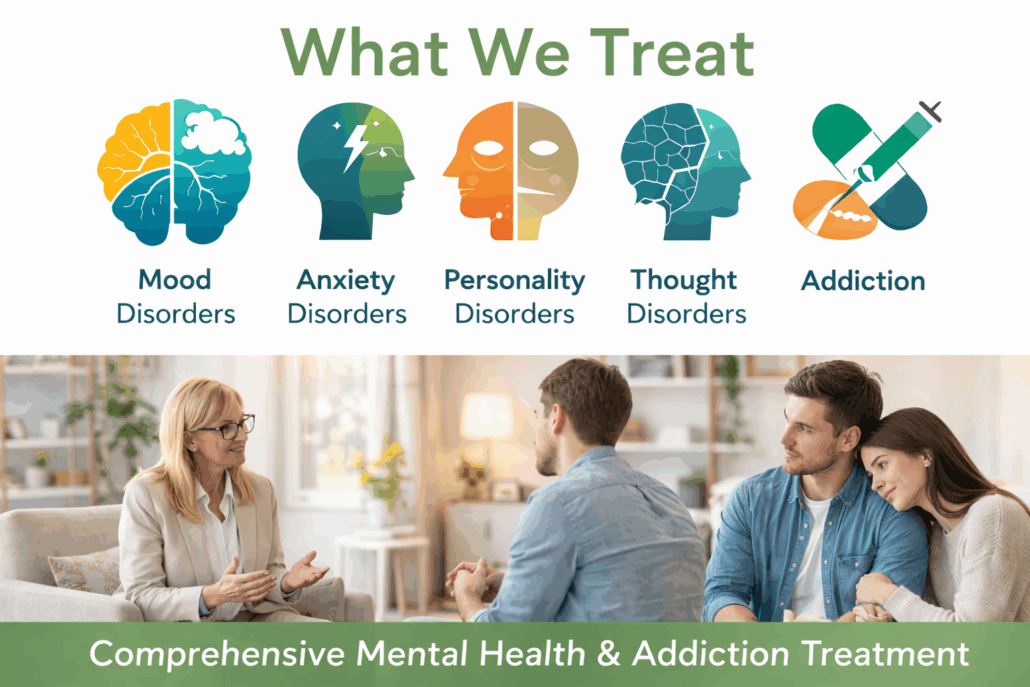
What We Treat Mental Health & Addiction Disorders
Finding the right kind of help starts with a clear understanding of what you’re experiencing—and what level of care fits your needs. At Couples Rehab, we connect individuals and couples to evidence-based treatment resources for mental health, addiction, and co-occurring disorders. This page is designed to answer the most common questions people have when they’re searching for care: What does this mean? Is it serious? What kind of treatment actually works? And where do we start?
If you’re in immediate danger, having thoughts of self-harm, or you’re worried someone may harm themselves, call 988 in the U.S. or go to the nearest emergency room.
How to Use This Page
This guide is organized by the most common categories of concerns people search for:
- Mood Disorders
- Anxiety Disorders
- Other Disorders
- Personality Disorders
- Thought Disorders
- Addiction
- Dual Diagnosis
- Other Mental Health Concerns
Each section explains typical symptoms, how it can affect daily life and relationships, and what treatment often includes. Use it as a starting point—then explore condition-specific pages (internal links) or reach out for a referral.
Mood Disorders
Mood disorders affect how you feel day to day—your emotional baseline, energy, motivation, sleep, and ability to function. Everyone has ups and downs. A mood disorder is different because symptoms are persistent, intense, and interfere with work, relationships, health, or safety.
Common Mood Disorders We Address
- Major depressive disorder (depression)
- Persistent depressive disorder (dysthymia)
- Bipolar I and Bipolar II
- Cyclothymic disorder
- Seasonal affective disorder (SAD)
Signs It May Be Time to Seek Help
- Losing interest in things you used to enjoy
- Changes in sleep or appetite that don’t resolve
- Irritability, numbness, or persistent sadness
- Periods of unusually elevated mood, impulsivity, or reduced need for sleep
- Difficulty meeting responsibilities or maintaining relationships
What Treatment Often Includes
Mood disorders respond well to structured therapy and, when appropriate, medication management. Many programs use CBT (cognitive behavioral therapy), DBT (dialectical behavior therapy), and skills-based approaches that stabilize sleep, thought patterns, and daily routines.
reference links: Depression treatment, Bipolar treatment, Mood disorder therapy, Medication management
Anxiety Disorders Treatment
Anxiety isn’t always a problem—sometimes it’s your body’s alarm system doing its job. Anxiety becomes a disorder when the alarm system stays “on” too often, too intensely, or without a clear threat—leading to avoidance, panic, compulsive behaviors, or constant worry.
Common Anxiety-Related Conditions
- Generalized anxiety disorder (GAD)
- Panic disorder and panic attacks
- Social anxiety disorder
- Phobias
- Obsessive-compulsive disorder (OCD)
- Trauma-related anxiety patterns (often overlapping with PTSD)
Signs Anxiety Is Taking Over
- Racing thoughts that don’t shut off
- Avoiding places, people, or responsibilities
- Panic symptoms: chest tightness, shortness of breath, dizziness
- Sleep disruption from worry or hypervigilance
- Reassurance-seeking or compulsive rituals to reduce anxiety
What Treatment Often Includes
Evidence-based care often centers on CBT, exposure-based strategies (when appropriate), and nervous system regulation skills. For some people, medication can support progress—especially when anxiety disrupts sleep or daily functioning.
Internal link ideas: Anxiety treatment, Panic attacks, OCD treatment, PTSD and anxiety, DBT skills
Other Disorders Treatment
Some symptoms don’t fit neatly into one label. Others are “secondary” issues that show up alongside anxiety or depression—like attention difficulties, emotional dysregulation, or chronic stress responses.
This category may include:
- ADHD and attention-related concerns (often co-occurring)
- Adjustment disorders
- Somatic symptom patterns (body symptoms intensified by stress)
- Grief-related depression or anxiety
- Stress-related burnout
Why This Matters
People often delay treatment because they’re unsure “what it is.” A comprehensive assessment can clarify what’s happening and shorten the path to relief—especially when symptoms impact work, parenting, or relationship stability.
reference links: Mental health assessment, Adult ADHD support, Stress and burnout therapy
Personality Disorders Treatment
Personality disorders are widely misunderstood. The simplest way to think about them is this: they involve longstanding patterns in how a person experiences emotions, relates to others, manages conflict, and sees themselves. These patterns are not “character flaws.” They are treatable clinical issues—often rooted in temperament, early experiences, attachment wounds, and survival strategies that became rigid over time.
Common Personality Disorders Addressed
- Borderline personality disorder (BPD)
- Avoidant personality disorder
- Narcissistic personality disorder
- Obsessive-compulsive personality disorder (OCPD)
- Dependent personality disorder
Signs It May Be Relevant
- Intense fear of abandonment or rejection
- Relationship instability (high conflict, rapid shifts, repeated breakups)
- Emotional swings that feel unmanageable
- Chronic emptiness, shame, or identity confusion
- Controlling perfectionism or rigid thinking that causes distress
What Treatment Often Includes
Many people improve significantly with DBT, trauma-informed therapy, and structured skill-building—especially around emotion regulation, boundaries, distress tolerance, and interpersonal effectiveness. Couples therapy can be helpful when both partners are committed to learning healthier patterns.
reference links: BPD treatment, DBT program, Couples therapy for high conflict
Thought Disorders Treatment
Thought disorders involve disruptions in perception, beliefs, and the ability to interpret reality accurately. They can include hallucinations, delusions, disorganized thinking, or severe paranoia. These symptoms can be frightening, but early intervention often makes a substantial difference.
Conditions Often Included
- Schizophrenia spectrum disorders
- Schizoaffective disorder
- Severe depression with psychotic features
- Severe bipolar disorder with psychosis
When to Seek Immediate Help
- Hearing or seeing things others do not
- Beliefs that cause unsafe decisions or severe fear
- Disorganized speech or behavior that impairs functioning
- Intense paranoia or inability to trust anyone
What Treatment Often Includes
Treatment typically includes psychiatric evaluation, medication support, structured therapy, family involvement, and coordinated care planning. Stability and safety are the first priorities; then therapy and skill-building help with long-term recovery.
reference links: Psychosis support, Psychiatric assessment, Family education and support
Addiction Treatment
Addiction is not a willpower problem. It is a medical and behavioral health condition that changes reward pathways, stress systems, and decision-making. People use substances for many reasons—pain relief, sleep, social anxiety, trauma, or to feel “normal.” Over time, the brain learns to rely on substances for regulation.
Substances Commonly Involved
- Alcohol
- Opioids (including prescription pain medications and illicit opioids)
- Stimulants (including cocaine and methamphetamine)
- Benzodiazepines
- Cannabis (when it interferes with functioning or mental health)
- Polysubstance use
Signs Substance Use Has Crossed the Line
- Using more than intended, or longer than intended
- Withdrawal symptoms or needing more to get the same effect
- Relationship conflict, work problems, financial strain
- Failed attempts to cut back
- Using to cope with anxiety, depression, trauma, or insomnia
What Treatment Often Includes
Evidence-based addiction care can include motivational interviewing, relapse prevention, CBT, trauma-informed therapy, peer support, and—when appropriate—MAT (medication-assisted treatment). For couples, treatment can also address trust rebuilding, boundaries, and communication patterns that keep relapse cycles going.
reference links: Alcohol treatment, Opioid treatment, MAT programs, Relapse prevention, Couples addiction recovery
Dual Diagnosis
Dual diagnosis means a person is experiencing both a substance use disorder and a mental health condition. This is common, not rare. When mental health symptoms and addiction interact, treatment must address both—otherwise people often relapse or symptoms worsen.
Why Integrated Care Matters
- Untreated anxiety or trauma can drive relapse
- Substance use can intensify depression, panic, and paranoia
- Sleep and mood instability can derail early recovery
- Shame and secrecy can block progress for couples
What Integrated Treatment Often Includes
Dual diagnosis care combines therapy for mental health with addiction treatment planning, medication evaluation when needed, stable routines, and ongoing relapse prevention. Couples may benefit from a coordinated approach that treats both partners’ needs while also repairing the relationship system.
reference links: Dual diagnosis treatment, Trauma-informed care, Co-occurring disorders program
Other Mental Health Concerns
Some challenges don’t fit cleanly into a category, but still deserve expert support. These concerns often show up as the “reason people finally reach out.”
Common examples include:
- Trauma and PTSD
- Chronic insomnia
- Grief and complicated loss
- Anger and emotional regulation difficulties
- Codependency and relationship distress
- Self-esteem and identity challenges
- Life transitions (divorce, relocation, career loss)
If you don’t see your exact concern listed, that doesn’t mean you’re not “eligible” for help. It usually means your situation needs a more personalized assessment.
reference links: PTSD treatment, Sleep and mental health, Grief counseling, Couples therapy resources
What Level of Care Is Right?
Choosing the right level of care can be confusing, especially when symptoms fluctuate. As a general guide:
- Outpatient therapy: weekly sessions for stable functioning
- IOP (Intensive Outpatient): multiple sessions per week for higher support
- PHP (Partial Hospitalization): structured day treatment while living at home
- Residential / inpatient: 24/7 structured environment (often for severe symptoms, safety concerns, or inability to function)
A quality program will recommend the least intensive level that is still clinically effective and safe.
Frequently Asked Questions
Do you treat couples and individuals?
Yes. Many programs serve individuals and offer couples-focused tracks or couples therapy when clinically appropriate.
What if we don’t know the diagnosis?
That’s common. Start with a clinical assessment. Treatment can begin by stabilizing sleep, anxiety, cravings, and daily functioning while refining the diagnosis over time.
Can treatment help if we’ve tried before?
Yes. Prior treatment doesn’t mean failure—it often provides data about what level of care, structure, or approach you need next.
Does insurance cover treatment?
Coverage varies by plan and level of care. Many providers can verify benefits and explain out-of-pocket costs before admission.
What if one partner wants help and the other doesn’t?
You can still start. One partner’s recovery work often changes the relationship system. Many facilities also offer family or partner sessions to increase readiness.
Take the Next Step
If you’re looking for help for yourself or someone you love, start with two questions:
- What symptoms are most disruptive right now?
- What level of support is needed to stay safe and consistent?
Couples Rehab can help you identify the right treatment direction—whether you need outpatient therapy, a structured program like IOP/PHP, or a higher level of care.
- Verify Insurance
- Speak With Admissions
- Take a Confidential Assessment
- Explore Couples Programs
