
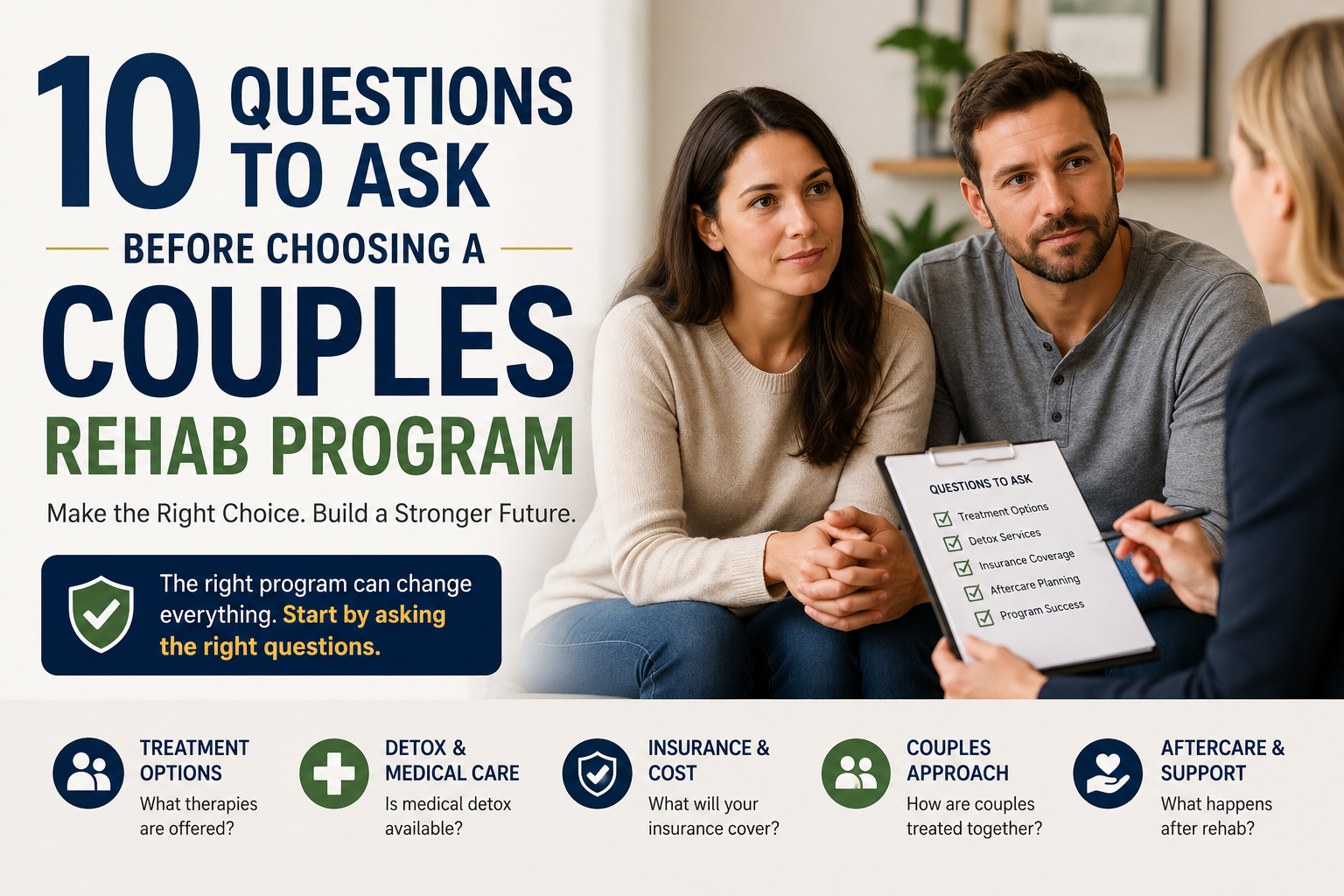
10 Questions to Ask Before Choosing a Couples Rehab Program
Clinically reviewed for medical accuracy. This guide is for educational purposes and does not replace professional medical advice. If you or your partner are experiencing a medical emergency, call 911.
Most couples have no idea what to ask when they start evaluating addiction treatment — and that is completely understandable. You are usually researching at one of the hardest moments of your life, under real pressure, trying to compare programs that all sound reassuring on the surface. The marketing language blurs together. Everyone promises compassionate, evidence-based care. So how do you tell a genuinely strong program from one that will let you down?
The answer is to ask better questions. The right questions cut through the marketing and reveal what a program actually offers: whether it truly treats couples together, whether there is real medical oversight, how it handles mental health alongside addiction, and what happens after the first phase ends. Asking these questions before you commit protects you from the outcomes that derail recovery:
- Relapse, when a program returns you to old patterns without building new ones.
- Poor treatment outcomes, when care is shallow or mismatched to your needs.
- Financial surprises, when insurance and costs were never clearly explained.
- Inadequate clinical care, when staffing or medical supervision falls short.
This guide walks through the ten most important questions to ask before choosing any couples rehab program, plus checklists of red flags and green flags you can use as you compare options. A quick note on who we are: Couples Rehab is a referral network, not a treatment facility. We connect couples to licensed, accredited programs that fit their needs — which means our only stake in your decision is helping you ask the questions that lead to the right one.
| Not Sure Where to Start? Talk It Through. Call (888) 500-2110 Free & Confidential • Verify Insurance • Take the Couples Assessment |
Question #1: Does the Program Actually Treat Couples Together?
This is the question that separates a true couples program from a facility that simply admits two people who happen to be partners. Ask directly: will my partner and I be treated together, with coordinated care and shared treatment planning — or will we be placed in entirely separate tracks and rarely see each other?
A genuine couples program is built around the relationship as part of the recovery. That typically includes coordinated treatment planning, dedicated relationship and couples therapy, and a clinical model that understands shared triggers, codependency, and the way partners’ behaviors reinforce one another. Some couples share accommodations; in other cases, clinicians may recommend partners follow separate daily schedules during the most acute phase of detox while still being treated within the same program. Both approaches can be legitimate — what matters is that the relationship is intentionally part of the treatment, not an afterthought.
Watch for these red flags: a program that says ‘yes, couples are welcome’ but cannot describe any couples-specific therapy; staff who cannot explain how the two treatment plans will be coordinated; or a facility that treats ‘couples treatment’ as simply two separate admissions in the same building. Vague answers here usually mean the couples element is marketing, not clinical reality.
If you want to see what a relationship-centered approach looks like in practice, our overview of couples rehab New York City explains how partners are treated together.
Question #2: What Levels of Care Are Available?
Recovery is a continuum, not a single setting — so ask whether the program offers the full range of care or just one slice of it. A program that only offers outpatient services, for example, may not be equipped to handle a couple who needs medical detox first.
The standard continuum of care includes:
- Detox: medically supervised withdrawal management, often the first step when physical dependence is present.
- Residential: live-in treatment offering immersive, round-the-clock support.
- Partial hospitalization (PHP): intensive daytime treatment with evenings at home or in sober living.
- Intensive outpatient (IOP): structured therapy several times a week while maintaining work and family life.
- Outpatient: flexible, lower-intensity care for ongoing support and step-down.
The reason this matters is continuity. A program that can move you smoothly from detox to residential to PHP to IOP — without forcing you to start over with a new provider at each stage — gives you a far better chance at lasting recovery. Each transition is a moment of vulnerability, and gaps in care are where relapse often happens. Ask how the program manages those transitions and whether it can support both partners through the whole arc.
Learn more about couples detox programs and couples residential rehab to understand how the levels fit together.
Question #3: Does the Program Offer Medical Detox?
If either partner is physically dependent on a substance, medically supervised detox is not optional — it is a safety issue. Ask whether the program provides medical detox on-site or coordinates it directly, and what level of medical supervision is available.
This question carries real medical weight. Withdrawal from some substances can be dangerous or even life-threatening without supervision:
- Alcohol detox: withdrawal can escalate to seizures and delirium tremens (DTs), both medical emergencies.
- Opioid detox: while rarely fatal on its own, withdrawal is severe, and post-detox overdose risk rises sharply as tolerance drops.
- Fentanyl detox: the potency of synthetic opioids makes withdrawal intense and relapse especially dangerous, with medication-assisted treatment (MAT) often part of the plan.
A program with genuine medical detox has physicians and nurses overseeing withdrawal, monitoring vital signs, and managing symptoms with medication when appropriate. If a program is vague about its medical capabilities, or suggests that detox is something you can just ‘get through’ without supervision, treat that as a serious warning sign. Attempting to detox from alcohol or benzodiazepines at home can be fatal.
See couples detox New York City and the couples detox admissions process for what medically supervised detox involves. For authoritative substance information, the National Institute on Drug Abuse (NIDA) and NIAAA are reliable resources.
Question #4: How Are Mental Health Conditions Treated?
Addiction rarely travels alone, so ask how the program handles co-occurring mental health conditions — and whether it offers true dual diagnosis treatment. If a program treats only the addiction and ignores the mental health conditions underneath it, the root causes remain in place and relapse becomes far more likely.
Common co-occurring conditions that a strong program should be equipped to treat include:
- Anxiety, which can both drive and result from substance use.
- Depression, often deepened during early withdrawal.
- PTSD and trauma, frequently linked to self-medication.
- Bipolar disorder, which requires careful psychiatric management alongside addiction care.
Dual diagnosis treatment means addiction and mental health are treated together as interrelated conditions, not in sequence or isolation. Ask whether the program has psychiatric providers on staff, how it assesses for co-occurring conditions, and how mental health care is integrated into the daily treatment plan. For couples, this also means addressing relationship trauma and codependency, which often sit at the intersection of both partners’ struggles.
Explore couples rehab for anxiety and depression and trauma therapy for couples in recovery to understand integrated care.
Question #5: What Credentials Do the Clinical Staff Have?
The quality of a program comes down to the people delivering care, so ask specifically about staff credentials and facility accreditation. Reputable programs are transparent about who provides treatment and what licenses they hold.
Look for a clinical team that includes:
- Licensed therapists and counselors (such as LMFTs, LCSWs, and licensed professional counselors) providing individual and couples therapy.
- Credentialed addiction counselors with specific training in substance use disorders.
- Psychiatrists or psychiatric providers for mental health and medication management.
- Medical providers — physicians and nurses — overseeing detox and any medical needs.
Beyond individual credentials, ask about accreditation. National accreditation from bodies such as The Joint Commission or CARF (the Commission on Accreditation of Rehabilitation Facilities) signals that a facility meets recognized standards of care and undergoes outside review. State licensing is the baseline; accreditation is a meaningful additional marker of quality. A program that is reluctant to discuss its credentials or accreditation is telling you something important.
| Want Help Vetting a Program’s Credentials? Call (888) 500-2110 — A Care Navigator Can Help |
Question #6: What Insurance Plans Are Accepted?
Cost is one of the biggest barriers to treatment, so ask early and specifically about insurance — what plans are accepted, and how coverage actually works. A trustworthy program will verify your benefits clearly and explain your real out-of-pocket cost before you commit, not after.
Key things to clarify:
- Whether the program accepts PPO plans, which generally offer the broadest choice of facilities.
- Whether out-of-network benefits apply, since many specialized couples programs are accessible through out-of-network coverage.
- What the verification process looks like, and whether it is free and obligation-free.
Commonly accepted PPO carriers include the NYSHIP Empire Plan, Aetna PPO, Cigna PPO, UnitedHealthcare PPO, and Blue Cross Blue Shield (BCBS) PPO plans. Coverage specifics always depend on your individual plan, your deductible, and whether care is in- or out-of-network — which is why a personalized verification matters far more than a general ‘yes, we take your insurance.’
If you have New York public-employee coverage, see our detailed guide to couples rehab and the NYSHIP Empire Plan in New York.
Question #7: What Happens After Detox?
Detox is the beginning of recovery, not the end — so ask what the program has planned for the weeks and months after withdrawal. Detox addresses physical dependence, but the psychological and relational drivers of addiction remain fully intact afterward.
A strong program treats the period after detox as the heart of treatment, not a discharge. Ask about:
- Residential or step-down care that continues structured treatment after stabilization.
- Ongoing individual, group, and couples therapy that addresses the roots of addiction.
- Aftercare planning, including alumni support and continued outpatient care.
- Relapse prevention strategies tailored to the couple’s specific triggers.
The gap between detox and continued care is one of the most vulnerable moments in recovery. The best programs build the next phase of treatment while a couple is still in detox, so there is no break in support. If a program treats detox as a standalone product — get clean and go home — its understanding of addiction is dangerously incomplete.
Our guide to what happens in couples rehab walks through the full arc of treatment.
Question #8: How Are Relapse Risks Addressed?
Relapse is a known risk in recovery, and good programs plan for it deliberately rather than treating it as failure. Ask how the program identifies and manages relapse risk, especially the risks unique to couples.
A thoughtful relapse-prevention approach addresses:
- Triggers: helping each partner identify the people, places, emotions, and situations that drive cravings, and building concrete strategies to navigate them.
- Family and relationship systems: recognizing how the couple’s dynamics — including enabling and codependency — can either support recovery or undermine it.
- Aftercare planning: a clear, written plan for ongoing support, with steps to take when a high-risk situation or early warning sign appears.
For couples specifically, relapse prevention has an added dimension: when one partner is struggling, the other’s response can make the difference between a near-miss and a full relapse. Programs that teach couples how to support each other through high-risk moments — without slipping back into old patterns — give them tools that last well beyond treatment. Long-term recovery is less about willpower than about systems, support, and preparation.
Question #9: What Is the Admissions Process?
When a couple is ready for treatment, the speed and clarity of admissions can matter enormously — so ask how the process works and how fast care can begin. Readiness is precious, and a complicated or slow admissions process can cause a couple to lose the moment.
A clear admissions process generally includes:
- Assessment: a clinical evaluation of each partner to determine the appropriate level of care.
- Insurance verification: confirming benefits and out-of-pocket costs before admission.
- Same-day admissions: when a couple is ready and beds are available, the ability to begin treatment immediately.
Ask whether admissions support is available around the clock, how quickly the assessment can happen, and whether same-day placement is realistic for your situation. The best programs remove practical barriers — verification, logistics, transportation — so that the path from decision to care is as short and smooth as possible. Same-day admission should never mean rushed clinical care; it means efficient logistics around a thorough assessment.
See our couples rehab admissions guide and same day couples rehab NYC for details on getting started quickly.
Question #10: What Are the Warning Signs of a Poor Program?
Finally, learn to recognize the warning signs that a program may not deliver the care a couple needs. If you notice several of these, treat them as a signal to keep looking:
✕ No medical oversight — detox or treatment offered without physicians or nurses involved.
✕ No dual diagnosis treatment — mental health conditions are ignored or treated as separate from addiction.
✕ No real couples counseling — ‘couples treatment’ that includes no relationship-focused therapy.
✕ Unclear insurance policies — vague answers about coverage, costs, or verification.
✕ Poor communication — slow responses, evasive answers, or pressure tactics during your first calls.
A program that hesitates to answer any of the ten questions in this guide directly is itself a warning sign. You are entitled to clear, specific answers about medical care, staffing, mental health treatment, and cost before you commit to anything.
| Comparing Programs? Get an Honest Second Opinion. Call (888) 500-2110 Verify Insurance • Take the Couples Assessment |
Bonus: Questions to Ask Your Insurance Company
Before admission, it helps to understand your own coverage directly. Whether you call your insurer yourself or have a care navigator verify benefits on your behalf, these are the questions that matter most:
- Is medical detox covered, and at what level?
- Is residential treatment covered, and for how long?
- Is prior authorization required before admission?
- Are out-of-network benefits available, and how do they differ from in-network coverage?
The answers determine your real options and out-of-pocket cost. Many couples are surprised, once they verify, by how much of their treatment is covered.
You can also verify insurance for couples rehab with a free, confidential benefit check.
Red Flags Checklist: Warning Signs to Avoid
Use this checklist as you compare programs. The more of these you notice, the more cautious you should be:
✕ No on-site or coordinated medical detox.
✕ No physicians or nurses overseeing withdrawal.
✕ No dual diagnosis or mental health treatment.
✕ No relationship-focused or couples therapy.
✕ Vague or evasive answers about staff credentials.
✕ No accreditation (e.g., Joint Commission or CARF) or unwillingness to discuss it.
✕ Unclear or shifting information about insurance and costs.
✕ Pressure tactics or urgency designed to rush your decision.
✕ Guarantees of a ‘cure’ — recovery is a process, not a one-time fix.
✕ No clear plan for what happens after detox.
✕ No aftercare or relapse-prevention planning.
✕ Poor, slow, or unprofessional communication from the first contact.
✕ No individualized assessment — a one-size-fits-all program.
✕ Reluctance to explain the treatment model or daily schedule.
✕ No clear answer on how both partners will be treated together.
✕ Online reviews or complaints describing billing surprises or neglect.
Green Flags Checklist: Signs of a Strong Program
These are the markers of a program worth serious consideration:
✓ Medically supervised detox with physicians and nurses on the team.
✓ A full continuum of care, from detox through outpatient and aftercare.
✓ Genuine dual diagnosis treatment integrating mental health and addiction care.
✓ Dedicated couples and relationship-focused therapy.
✓ Licensed, credentialed clinical staff who are clearly identified.
✓ National accreditation from The Joint Commission or CARF.
✓ Transparent insurance verification with clear cost explanations.
✓ Individualized assessments and treatment plans for each partner.
✓ A clear plan for the transition from detox to continued care.
✓ Robust aftercare and relapse-prevention planning.
✓ Honest, responsive, pressure-free communication.
✓ Willingness to answer every question directly and specifically.
✓ Evidence-based therapies (such as CBT, DBT, and trauma-informed care).
✓ Medication-assisted treatment (MAT) available when clinically appropriate.
✓ Safety screening to ensure treating partners together is appropriate.
✓ Realistic, compassionate messaging — no promises of a guaranteed cure.
To get started with a clinical evaluation, you can take a couples assessment or speak with a care navigator who can help you apply these checklists to specific programs.
Frequently Asked Questions
How do I choose a couples rehab?
Start by asking the ten questions in this guide: whether the program truly treats couples together, what levels of care it offers, whether it provides medical detox, how it handles mental health, what credentials its staff hold, what insurance it accepts, what happens after detox, how it addresses relapse, what admissions looks like, and what warning signs to watch for. Clear, specific answers point you toward a strong program.
What should I ask a rehab program?
Ask about medical supervision, dual diagnosis treatment, couples-specific therapy, staff credentials and accreditation, insurance and costs, and the full continuum of care from detox through aftercare. A program that answers all of these directly is demonstrating the transparency you want.
Does insurance cover couples rehab?
Often, yes. Many PPO plans cover medically necessary detox, rehab, and behavioral health treatment, and out-of-network benefits frequently apply. Coverage depends on your specific plan, so a free verification is the best way to know your real out-of-pocket cost.
Can couples stay together in treatment?
Many licensed programs allow couples to be treated together, and some offer shared accommodations. The arrangement depends on each partner’s clinical assessment and a safety screening, which ensures treating partners together is appropriate.
What happens after detox?
Detox is followed by continued treatment — residential care, PHP, IOP, therapy, and aftercare — that addresses the underlying causes of addiction and prevents relapse. Strong programs plan this transition before detox ends so there is no gap in care.
What is dual diagnosis treatment?
Dual diagnosis treatment addresses co-occurring mental health and substance use disorders together, as interrelated conditions, rather than treating one and ignoring the other. It is essential when conditions like anxiety, depression, PTSD, or bipolar disorder accompany addiction.
How long is rehab?
It varies widely by individual needs, the substances involved, and the level of care. Detox commonly lasts about a week, while residential and outpatient phases can extend over weeks or months. The right length is the one matched to clinical need, not a fixed number.
Can couples attend therapy together?
Yes. Couples therapy is a cornerstone of genuine couples treatment, addressing communication, trust, conflict, and the relationship dynamics entangled with addiction — alongside each partner’s individual therapy.
How do same-day admissions work?
When a couple is ready and a facility has availability, same-day admission allows treatment to begin immediately. Both partners still receive full assessments; the speed is in the logistics — verification, placement, and transportation — not in shortcutting clinical care.
How do I verify insurance?
You can call your insurer directly or have a care navigator verify your benefits for you. Verification confirms what your plan covers, whether prior authorization is required, and your expected out-of-pocket cost. It is free, confidential, and carries no obligation.
What are red flags in addiction treatment?
Major red flags include no medical oversight, no dual diagnosis treatment, no real couples counseling, unclear insurance policies, pressure tactics, guarantees of a cure, and no plan for care after detox. Several of these together signal a program to avoid.
What credentials should rehab staff have?
Look for licensed therapists and counselors, credentialed addiction counselors, psychiatric providers, and medical staff overseeing detox. Facility accreditation from The Joint Commission or CARF is an additional marker of quality beyond basic state licensing.
Should we choose an in-network or out-of-network program?
In-network care usually carries lower out-of-pocket costs, while out-of-network care offers broader choice — important when seeking specialized couples programs. With PPO coverage, out-of-network benefits often make a specialized program more affordable than couples expect.
What if only one partner is ready for treatment?
The partner who is ready should still pursue care. There are also strategies to encourage a reluctant partner, and a care navigator can help. Recovery for one partner can sometimes open the door for the other.
Is reaching out confidential?
Yes. Inquiries, assessments, and insurance verification are confidential and protected under federal privacy laws. Asking questions carries no cost and no obligation.
The Right Questions Lead to the Right Program
Choosing a couples rehab program is one of the most consequential decisions you and your partner will make together. The ten questions in this guide — backed by the red-flag and green-flag checklists — give you a practical framework to cut through marketing and find care that genuinely fits your needs. You deserve clear answers, real medical oversight, and a program that treats your relationship as part of the healing.
If you would like help applying these questions to specific programs, that is exactly what a care navigator does. As a referral network, our role is to listen to your situation, verify your insurance, and connect you to licensed, accredited programs that match your needs — with no cost and no obligation.
| Take the Next Step Together (888) 500-2110 Verify Insurance • Take the Couples Assessment |
Authoritative resources: SAMHSA, the SAMHSA treatment locator (FindTreatment.gov), NIDA, NIAAA, CDC Overdose Prevention, and New York State OASAS.
Disclaimer: Couples Rehab is a referral and information service, not a medical provider or treatment facility. All clinical care is provided by independent, licensed providers. This content is for educational purposes only and is not a substitute for professional medical advice, diagnosis, or treatment. Always seek the advice of a qualified healthcare provider with any questions about a medical or mental health condition. In a medical emergency, call 911.

