
Gas Station Kratom and 7-OH: What Couples Need to Know
Last updated September 30, 2026. This page will be updated as investigators release new findings.
Many products sold as “kratom” at gas stations and smoke shops are not the plant leaf at all. They are tablets, shots, and gummies built around 7-hydroxymitragynine (7-OH), a concentrated compound the U.S. Drug Enforcement Administration describes as having an opioid profile similar to morphine, and some contain synthetic relatives that became federally illegal in August 2026. If you or your partner uses these products every day, needs more to feel the same effect, or feels sick after stopping, that points to physical dependence. It is treatable, including for couples who want to get help at the same time.
This guide explains what is in these products, what is known about the recent deaths of two University of Mississippi students, where the law stands in 2026, and how couples can find detox and treatment.
If someone is unresponsive, breathing very slowly, or can’t be woken up, call 911 now. Because 7-OH acts on opioid receptors, naloxone (Narcan) may help; give it if you have it and stay with the person. For questions about a possible poisoning, call Poison Control at 1-800-222-1222. If you are thinking about harming yourself, call or text 988. See our crisis support page.
Kratom, 7-OH, and Synthetics: What’s Actually in the Package
Kratom (*Mitragyna speciosa*) is a tree native to Southeast Asia. Its leaves contain two main active alkaloids, mitragynine and 7-OH. In the natural leaf, 7-OH is a minor ingredient, making up less than 2% of the plant’s total alkaloids, according to the DEA’s July 2026 scheduling notice.
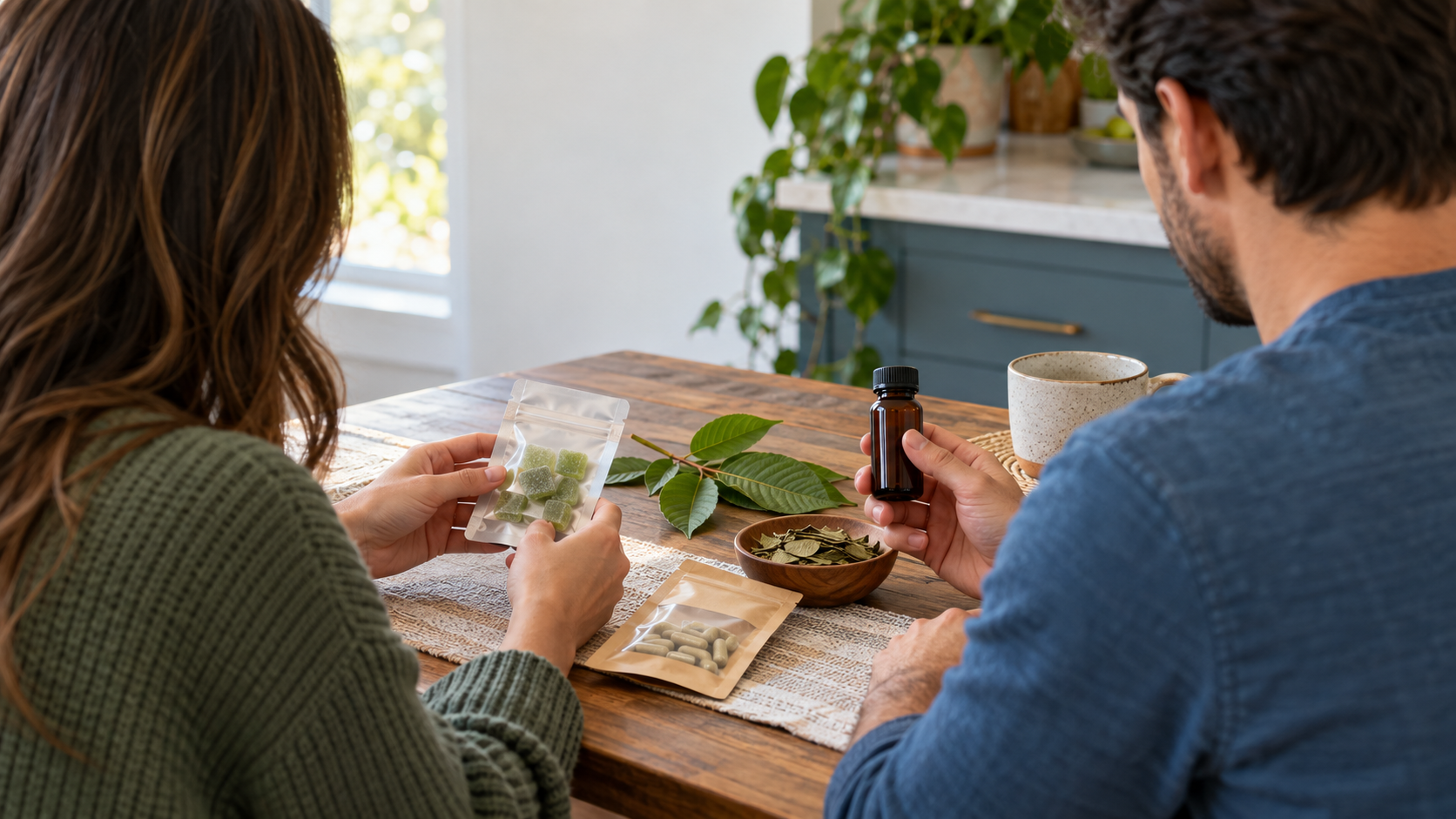
The products lining store counters today are often something different. 7-OH can be made from mitragynine in a single chemical step, and manufacturers now sell concentrated or semi-synthetic 7-OH in pressed pills, liquid shots, gummies, and dissolvable strips. The DEA notes that one review of products on the market found 7-OH doses ranging from 1 mg to 700 mg per serving, with packaging that frequently calls the contents a “natural” kratom extract. Some products also contain related compounds such as mitragynine pseudoindoxyl, which is more potent still.
| Product type | What it is | Federal status (Sept. 30, 2026) |
| Kratom leaf / powder | Dried plant material; mostly mitragynine, trace 7-OH | Not federally controlled; banned or restricted in some states and cities |
| Concentrated 7-OH (pills, shots, gummies) | Extracted or semi-synthetic 7-OH at levels far above the natural leaf | Proposed for temporary Schedule I above a set threshold; order not yet issued |
| Mitragynine pseudoindoxyl, MGM-15, MGM-16 | Synthetic or lab-altered 7-OH relatives with strong opioid effects | Schedule I since August 26, 2026 |
The practical problem for families is that the label does not reliably tell you which of these you are holding. A product described as a plant supplement can deliver an opioid-strength dose.
What We Know About the Ole Miss Investigation
On September 21, 2026, two University of Mississippi students were found dead in Oxford in separate incidents. Local narcotics investigators said packaged kratom products purchased from a retail store were recovered in both investigations. As of September 30, toxicology results were still pending, and authorities had not confirmed that kratom or any other substance contributed to either death.
A criminal affidavit filed September 28 described pills found at the scenes as kratom or synthetic kratom, and it identified two nearby stores where investigators believe the students bought products. One seized package was labeled with mitragynine pseudoindoxyl, MGM-15, and 7-OH, the first two of which are now federally controlled. Two employees of one store were arrested and charged with possessing Schedule I substances with intent to distribute; investigators said those arrests had not been officially linked to the deaths.
The local drug task force urged residents to avoid kratom and any substance not prescribed to them or obtained from a regulated source, and reminded the community that free naloxone is available in Oxford.
The cause of death in each case is still unknown. What the investigation already shows is how easily a product sold under the kratom name can contain something very different.
Is Kratom Legal? Federal and State Rules in 2026
Federal law
The kratom plant itself is not a federally controlled substance. On July 6, 2026, the DEA published two notices of intent to temporarily place kratom-derived compounds in Schedule I, the same category as heroin. The first, covering three synthetic relatives of 7-OH (mitragynine pseudoindoxyl, MGM-15, and MGM-16), took effect August 26, 2026 and lasts at least two years. The second covers 7-OH itself above a threshold: more than 0.050% by weight in plant material, or more than 0.050% or 1 mg per item in synthetic or processed products such as pressed pills. As of September 30, 2026, that second order had not been issued.
The FDA has separately warned companies that 7-OH is not a lawful dietary supplement or food ingredient and has not been proven safe or effective for any use.
Mississippi
Mississippi’s kratom law took effect July 1, 2025. It limits sales to adults 21 and older, requires products to be kept behind the counter and registered with the state, bans synthetic kratom products, and caps 7-OH at 1% of total alkaloids or 0.5 mg per container, according to the Mississippi Department of Revenue and the DEA. More than 36 Mississippi cities and counties, including Oxford, had already banned kratom outright, and the state law allowed those local bans to stay in place.
California
California has taken one of the hardest lines. Since October 24, 2025, the state health department has treated foods, supplements, and drugs containing kratom or 7-OH as illegal to sell or manufacture, and the Department of Alcoholic Beverage Control enforces that rule with licensed retailers. In September 2026, the governor’s office reported that 7,888 kratom and 7-OH products had been removed from store shelves.
Everywhere else
Rules vary widely. Some states ban kratom entirely, others ban only concentrated or synthetic 7-OH, and many regulate sales through age limits and labeling laws. Cities and counties can add their own bans, and online sellers still ship into places where store sales are prohibited. Laws in this area are changing month to month, so check your own state and city.
Whether a product is legal where you live does not tell you whether it is safe, or whether you or your partner needs help to stop using it.
Why 7-OH Dependence Looks Like Opioid Dependence
7-OH binds to the brain’s opioid receptors. The DEA’s review of the evidence found that its abuse potential in laboratory studies is comparable to classic opioid painkillers, with the same core risks: tolerance, physical dependence, and slowed breathing at high doses. Users often describe a short-lived effect and an urge to redose frequently.
Federal data cited in the DEA notice show how that plays out:
- U.S. poison centers recorded 165 exposures involving 7-OH between January and July 2025. Among people who took 7-OH alone, 35% had serious health effects and 67% were treated at a healthcare facility.
- The DEA’s overdose toxicology program has identified 7-OH in 85 cases since 2019, 55 of them fatal. Samples often also contained fentanyl, benzodiazepines, or other drugs.
- Published case reports describe a patient who needed inpatient medication to manage 7-OH withdrawal and another who was revived with naloxone after cardiopulmonary arrest.
Deaths from kratom leaf alone appear to be rare, and NIDA notes that most kratom-associated deaths involve other substances. The danger rises sharply with concentrated 7-OH, with synthetic additives, and with mixing any of these products with alcohol, benzodiazepines, sleep medications, or other opioids.
Signs Your Partner (or You) May Be Dependent on Kratom or 7-OH
Because these products are sold openly and marketed as natural, dependence can build for months before either partner names it. Watch for patterns like these:
- Daily use, or needing to take it several times a day to feel normal
- Switching from leaf powder to tablets or shots, or taking more to get the same effect
- Frequent trips to gas stations or smoke shops, or brightly packaged tablets, shots, or products labeled “7-OH” or “7-hydroxy” around the house
- Swings between energetic and talkative and heavily drowsy or “nodding off”
- Irritability, anxiety, sweating, aches, runny nose, diarrhea, or poor sleep when they go without it
- Hiding use, downplaying how much they take, or growing money strain from purchases
- Using it to manage pain, anxiety, low mood, or cravings for another substance
When both partners use, the pattern can be harder to see. Use becomes part of the daily routine, one person’s use cues the other’s, and each partner may measure “normal” against the other. That is one reason couples-focused addiction treatment assesses each person individually rather than as a unit.
Why Stopping Suddenly Is Hard, and When Detox Makes Sense
People who stop concentrated 7-OH after regular use often report opioid-like withdrawal: restlessness, muscle aches, sweating, stomach upset, insomnia, anxiety, and strong cravings. How long it lasts and how severe it gets varies with the product, the amount, how long someone has used, and whether other substances are involved.
Withdrawal is also when relapse is most likely, and tolerance drops quickly after a break, which raises overdose risk if someone goes back to their old amount. For that reason, a medical provider should evaluate each partner before either one stops, especially with heavy daily use, other substance use, mental health symptoms, or a medical condition. Depending on the situation, a prescriber may recommend supervised withdrawal management or medications used for opioid dependence.
Couples detox programs can coordinate withdrawal care for both partners, even when one person needs a higher level of care than the other. Our fentanyl withdrawal guide also covers why self-treating withdrawal with other substances, including kratom, can backfire.
How Couples Can Get Help Together
Treatment for kratom or 7-OH dependence generally follows the same path as treatment for other opioid-type substances. For couples, a few things matter most:
- Individual assessment first. Each partner gets their own medical and mental health evaluation. One may need detox and residential treatment, while the other starts in outpatient care. See treatment levels explained.
- Treat the reason behind the use. Many people start kratom to manage pain, anxiety, depression, or opioid cravings. Dual diagnosis programs address those conditions alongside substance use.
- Relationship work once each partner is stable. Couples therapy can help with communication, trust, and a shared relapse-prevention plan, but it works best alongside individual treatment, not in place of it.
- Continuing care close to home. Telehealth can make counseling and follow-up easier after an initial level of care, when clinically appropriate.
If only one of you uses, you still have a role. Learning about setting boundaries with an addicted partner and the link between codependency and addiction can help you support recovery without carrying it. And if there is violence, intimidation, or pressure in the relationship, separate treatment is the safer choice.
Steps you can take this week
- Talk when you are both sober and calm, and focus on what you have noticed and how you feel rather than on blame.
- Write down what is being used, roughly how much, and how often. That makes a medical assessment faster and more accurate.
- Keep naloxone in the home, and make sure you both know how to use it.
- Don’t stop heavy daily use abruptly without talking to a medical provider.
- Take the confidential Couples Assessment to sort out care options, insurance questions, and whether you want treatment together or separately.
Does Insurance Cover Treatment for Kratom or 7-OH Dependence?
Health insurance may cover medically necessary substance use treatment, including detox, residential, and outpatient care, whatever the substance involved. There is no separate benefit for kratom. Each partner’s coverage is checked separately, and approval for one person does not cover the other. Our insurance and coverage guide explains what to ask before choosing a program.
Frequently Asked Questions
Is kratom an opioid?
Kratom is a plant, not a prescription opioid, but its main alkaloids act on the same brain receptors that opioids do. 7-OH, the compound concentrated in many gas-station products, has a pharmacological profile the DEA compares to morphine, which is why regular use can lead to tolerance, dependence, and withdrawal.
Is 7-OH legal in 2026?
It depends on where you are and what the product contains. Three synthetic 7-OH relatives (mitragynine pseudoindoxyl, MGM-15, and MGM-16) became Schedule I federally on August 26, 2026. A separate federal order covering concentrated 7-OH above a set threshold was proposed in July 2026 but had not been issued as of September 30, 2026. Many states and cities restrict or ban 7-OH or kratom on their own, and California treats kratom and 7-OH products sold for consumption as illegal to sell.
Can you overdose on kratom or 7-OH?
Deaths involving kratom alone appear to be rare, and most involve other substances as well. Concentrated 7-OH products carry higher risk: federal data link 7-OH to serious poisonings and fatal overdoses, often alongside fentanyl, benzodiazepines, or alcohol. Mixing these products with other depressants is especially dangerous.
Can we detox from 7-OH at home together?
Some people with light use taper successfully with medical guidance, but heavy daily use of concentrated 7-OH can produce opioid-like withdrawal that is hard to get through alone, and relapse during withdrawal raises overdose risk. A medical provider should assess each partner separately before either of you stops, especially if other substances or health conditions are involved.
Did kratom cause the Ole Miss students’ deaths?
As of September 30, 2026, that had not been determined. Investigators found packaged kratom products in both cases and toxicology results were still pending. Authorities said they had not confirmed that kratom or any other substance contributed to either death.
What if only my partner uses kratom?
You can still get support. Many programs involve the non-using partner through family education and relationship-focused counseling when it is clinically appropriate, and learning about boundaries and codependency can help you support recovery without taking responsibility for it.
Find Support for Both of You
If kratom or 7-OH has become part of daily life for you or your partner, you do not have to figure out the next step alone. CouplesRehab.com helps couples understand treatment levels, insurance questions, and program policies before contacting independently operated providers. Take the confidential Couples Assessment or call a care navigator at (888) 500-2110, Monday through Friday, 9am to 6pm PT. Care navigators are not clinicians and do not provide medical advice.
For free, confidential treatment referrals any time, the SAMHSA National Helpline is available 24/7 at 1-800-662-4357.
CouplesRehab.com is an independent educational and treatment-navigation resource. We do not provide medical care, make diagnoses, or determine medical necessity. This article is for general information and is not a substitute for advice from a licensed healthcare provider. Information about the Ole Miss investigation reflects public reports as of September 30, 2026.
Sources
- Drug Enforcement Administration, Temporary Placement of 7-Hydroxymitragynine Above a Specified Threshold in Schedule I (notice of intent), 91 FR 40917, July 6, 2026
- Drug Enforcement Administration, Temporary Placement of Mitragynine Pseudoindoxyl, MGM-15, and MGM-16 in Schedule I (temporary order), effective August 26, 2026
- DEA press release, DEA to Temporarily Schedule 7-OH and Related Substances, July 1, 2026
- U.S. Food and Drug Administration, FDA Issues Warning Letters to Firms Marketing Products Containing 7-Hydroxymitragynine
- National Institute on Drug Abuse, Kratom
- Mississippi Department of Revenue, Notice 72-25-12: Kratom Products
- Office of the Governor of California, enforcement update on hemp, kratom and 7-OH products, September 2, 2026
- California Department of Alcoholic Beverage Control, Warning to Licensees Concerning Illegal Kratom and 7-OH Products
- ABC News, Ole Miss deaths may be connected to 2 stores allegedly selling kratom products, September 29, 2026
- NBC News, Kratom found at locations where two Ole Miss students were discovered dead, September 23, 2026
- SAMHSA National Helpline
- 988 Suicide & Crisis Lifeline
