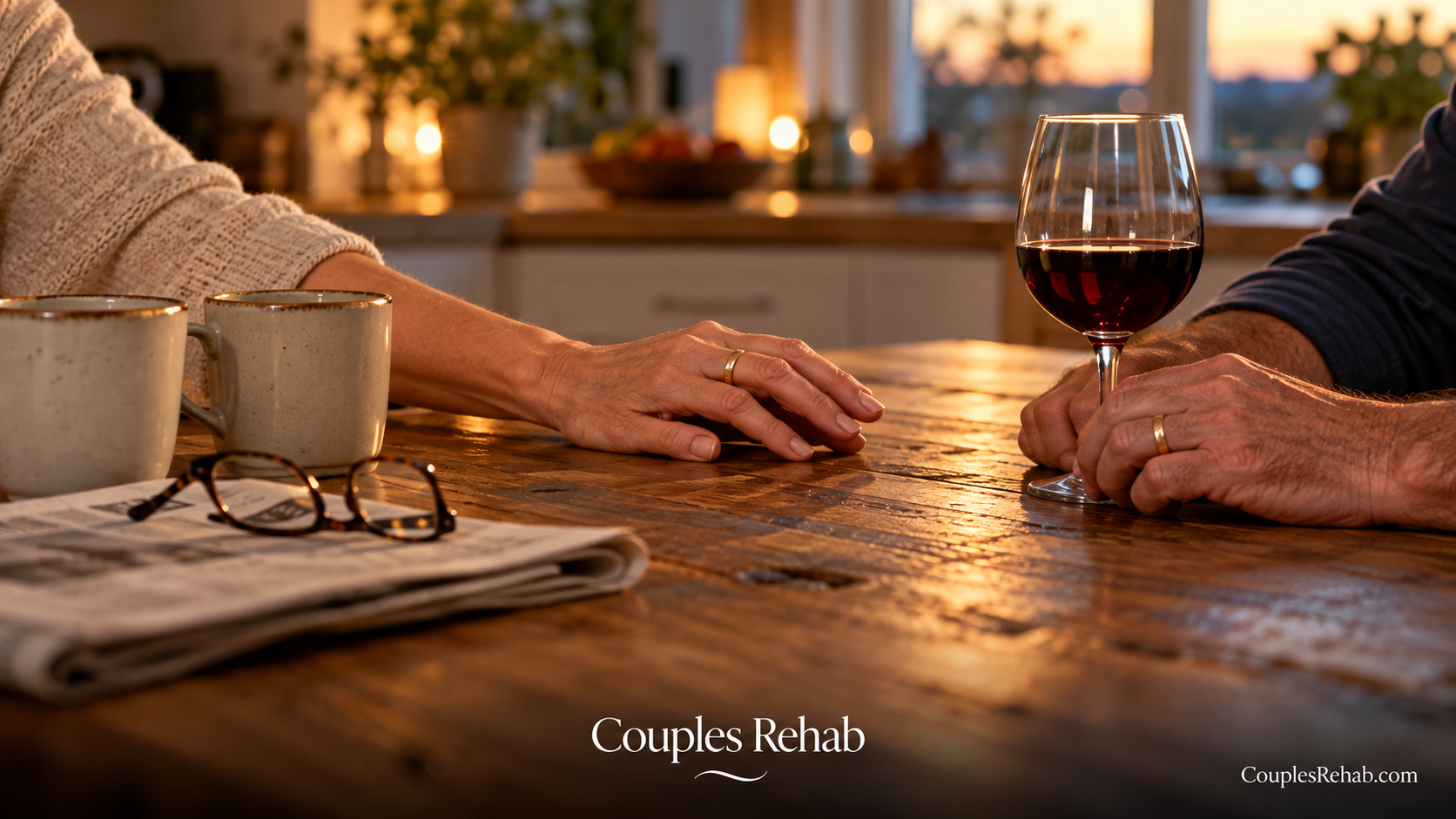
Heavy Drinking Is Falling Everywhere Except Ages 50–64. What That Means for Long Marriages
Short answer: A national study published in September found that Americans are drinking less overall, and heavy drinking fell more than 8% between 2022 and 2024. Adults 50 to 64 are the exception. In that age group, heavy drinking rose more than 36% between 2018 and 2024. The study didn’t look at why. For couples in long marriages, the practical question is whether the evening drinks in your house have quietly grown, and how to talk about it without turning 25 years together into an argument.
For most of the country, the drinking story right now is about cutting back. Gen Z is drinking less, millennials have pulled back on heavy drinking, and Sober October is everywhere this month. That story leaves out a group that is easy to overlook because it rarely looks like a problem from the outside: people in their 50s and early 60s, many of them married for decades, with careers, grown or nearly grown kids, and an evening routine that includes a few drinks.
This article looks at what the new research found, why the same amount of alcohol carries more risk at this stage of life, and how couples can bring it up when the drinking has crept up slowly enough that nobody quite noticed.
What the study found
Researchers at Keck Medicine of USC and Thomas Jefferson University analyzed National Health Interview Survey data from 114,352 U.S. adults between 2018 and 2024. Their findings were published in Annals of Internal Medicine in September 2026:
- Overall alcohol use fell nearly 2% between 2022 and 2024, the first decline since the pandemic, though it remains above 2018 levels.
- Heavy drinking fell more than 8% over the same period.
- Among adults 50 to 64, any alcohol use rose nearly 4% between 2018 and 2024, and heavy drinking rose more than 36%.
- Gen Z saw a decline of more than 5% in any alcohol use, and millennials saw a 17% drop in heavy drinking.
The study used the National Institute on Alcohol Abuse and Alcoholism’s definition of heavy drinking: five or more drinks on any day or 15 or more per week for men, and four or more on any day or eight or more per week for women.
“Heavy drinking among ages 50-64 is up by more than a third since 2018, a concerning trend because this age group faces some of the greatest risks of harm from alcohol,” the study’s principal investigator, Dr. Brian P. Lee, a hepatologist at Keck Medicine of USC, told Medical Daily.
Two limits are worth keeping in mind. The study measured trends, not causes, so it can’t say why this age group is drinking more. It also relied on self-reported drinking, which tends to undercount how much people actually drink.
Why it often doesn’t look like a problem
Heavy drinking in midlife rarely matches the picture most people have of an alcohol problem. It tends to look like this:
- It happens at home, at dinner or after it, rather than at bars.
- It’s wine or craft beer, which feels more like a lifestyle than a habit.
- Nobody is missing work, getting arrested, or making a scene.
- It grew slowly, from a glass with dinner to most of a bottle, over years rather than months.
- Friends of the same age drink about the same, so it looks normal.
- The person drinking is responsible and accomplished, and everyone around them, including their spouse, assumes they would know if it were a problem.
The pour is part of it, too. A standard drink is 5 ounces of wine, and a 750 ml bottle holds about five of them. Two generous glasses a night can easily mean four standard drinks, which over a week puts many people above the heavy-drinking threshold without anyone counting it that way. Our article on when nightly drinking becomes a disorder walks through how to count drinks the way clinicians do.
Why the same drinking carries more risk after 50
Drinking that felt harmless at 35 doesn’t affect the body the same way at 55. A few reasons:
The liver has been keeping score
Liver damage from alcohol builds up over decades, and this is the age when it tends to show. “Fibrosis accumulates over decades,” Dr. Lee explained to HCPLive, adding that people in this age group who increased their drinking during 2020 are typically adding to existing damage rather than starting fresh. His recommendation for clinicians is that people who drink heavily, particularly after age 50, should be considered for liver fibrosis screening. That’s a reasonable question to bring to a primary care doctor.
The body handles alcohol differently
As people age, lean body mass and body water decrease and metabolism slows, so the same drink produces a higher blood alcohol level and stays in the system longer. Johns Hopkins Medicine notes that alcohol can worsen conditions that become more common with age, including diabetes, high blood pressure, and ulcers, and that slower reaction times and changes in vision and hearing raise the risk of falls, fractures, and car accidents.
More prescriptions, more interactions
Midlife is also when prescription lists start to grow. Many common prescription and over-the-counter medicines interact with alcohol, and those interactions can happen even when the drink and the pill aren’t taken at the same time, because the medication is still in the bloodstream. NIAAA’s guide to harmful interactions lists common examples, including some blood pressure, sleep, pain, anxiety, and diabetes medications. If either of you takes daily medication, ask the prescribing doctor or pharmacist how alcohol fits in.
Mood and sleep
Alcohol is often used to unwind or fall asleep, but heavy drinking is linked to depression and worse sleep, and it can mask anxiety or grief that deserves attention on its own. When drinking and mood problems show up together, dual diagnosis care treats both at once.
For context on limits: NIAAA’s guidance for healthy adults over 65 who take no medications is no more than seven drinks a week and no more than three on any single day. That guideline is for people over 65 without medical conditions or medications, so it isn’t a target for everyone in their 50s. It does show how much lower the line sits later in life.
Questions worth asking about this stage of life
The study didn’t examine causes, and it would be a mistake to pretend it did. Still, many couples will recognize some of the transitions that tend to cluster in these years. Rather than assuming any of them explains the drinking in your home, it can help to look at them together and ask whether they fit:
- An emptier house. Did the evenings change when the kids left? Did a drink fill time that used to belong to homework, practices, and dinners with everyone at the table?
- Work winding down, or getting heavier. Did retirement, a layoff, or a demanding late-career role change the daily structure?
- Caregiving. Is one of you looking after an aging parent, and is the drink at night the only part of the day that feels like your own?
- Habits from 2020. Did the extra drinks that started during the pandemic simply stay?
- Health and loss. Has a diagnosis, chronic pain, or the death of a parent or friend changed how one of you copes?
- The marriage itself. Has drinking become the main thing you do together in the evening, or the way you avoid a conversation neither of you wants to have?
None of these is a diagnosis or an excuse. They are the kinds of questions a good counselor would ask, and couples can start asking them at their own kitchen table.
How it shows up in a long marriage
After decades together, couples tend to adapt to each other’s drinking so gradually that the adjustments stop feeling like adjustments. Some patterns spouses describe:
- Important conversations get scheduled for the morning because evenings aren’t reliable.
- One partner drives home from every dinner out.
- Conflicts that start after the second or third drink get repeated and never resolved.
- The non-drinking partner has started going to bed earlier, alone.
- Promises to cut back show up on Sunday and fade by Wednesday.
- Both partners drink more than they did ten years ago, and neither wants to be the one to bring it up.
If both of you drink heavily, the conversation is harder in one way, because it means looking at your own glass too. If only one of you does, the gap itself can strain the marriage. Research on couples has found that a mismatch in drinking habits is one of the more reliable sources of relationship strain. Our guide to whether a marriage can survive alcoholism looks at what research says about couples who work through it.
How to bring it up after 25 years together
The hardest part of raising drinking in a long marriage is that it can feel like rewriting history: if it’s a problem now, was it a problem all along? It helps to keep the conversation in the present and specific. Some approaches that tend to work better than others:
- Pick a sober, unhurried moment. A weekend morning works better than 9 p.m.
- Lead with the research, not a verdict. “I read that heavy drinking is going up for people our age, and it made me think about us” is easier to hear than “You drink too much.”
- Describe what you’ve noticed, not what you’ve concluded. “We used to split a bottle on Fridays. Now it’s most nights” is something you can both look at.
- Include yourself if it’s true. If you drink too, say so. A shared question is far less threatening than an accusation.
- Frame it around the next 20 years. Health, energy, grandchildren, travel, retirement plans. Most people in their 50s have reasons to protect the future that weren’t as vivid at 35.
- Suggest a low-stakes first step. A doctor’s visit with blood work, a few alcohol-free weeknights, or both of you taking NIAAA’s free Rethinking Drinking self-check.
If the conversation goes badly, that isn’t the end of it. Many partners need to hear something more than once before they can consider it. Our guides on talking with a partner about treatment and setting boundaries with a partner who drinks cover what to do next.
A word of caution before anyone stops cold
If a spouse has been drinking heavily every day for years, the well-meant decision to quit all at once can be dangerous. NIAAA notes that alcohol withdrawal is potentially life-threatening when someone who has been drinking heavily for a prolonged period suddenly stops, and that doctors can prescribe medications to make it safer. Shaking, sweating, a racing heart, or needing a drink to feel steady in the morning are reasons to talk to a doctor first. Our guide to why alcohol withdrawal can be dangerous covers the warning signs, and medically supervised alcohol detox is the safe route when physical dependence is present.
What help looks like at this stage of life
Treatment for alcohol use in midlife often looks different from what people picture. Many options fit around a career and a household:
- A conversation with a primary care doctor, including liver tests and a review of medications.
- Medication. NIAAA notes that three FDA-approved medications (naltrexone, acamprosate, and disulfiram) can help people stop or reduce drinking, and none of them are addictive.
- Outpatient or intensive outpatient care, which lets people keep working and living at home.
- Couples-based therapy. NIAAA includes couples and family therapy among evidence-based behavioral approaches for alcohol use disorder. Marriage counseling and online couples therapy with independent licensed providers can address the relationship patterns that grew up around the drinking.
- Residential care, when previous attempts haven’t held or there are medical complications.
The levels of care guide explains how these options differ, and which one fits is a decision for a licensed clinician after an assessment.
Frequently asked questions
Why is heavy drinking increasing among adults 50 to 64?
The study that found the increase, published in Annals of Internal Medicine in September 2026, tracked trends and did not examine causes. Possible factors couples may want to consider include changes in daily structure, caregiving, stress, and habits that started during the pandemic, but no single cause has been established.
How much drinking counts as heavy drinking?
NIAAA defines heavy drinking as five or more drinks on any day or 15 or more per week for men, and four or more on any day or eight or more per week for women. A standard drink is 5 ounces of wine, 12 ounces of regular beer, or 1.5 ounces of spirits, so home pours often count for more than they seem.
Does alcohol affect people differently after 50?
Yes. As people age, body water and lean mass decrease and metabolism slows, so the same drink produces a higher blood alcohol level. Alcohol can also worsen conditions that become more common with age, interact with many medications, and raise the risk of falls.
My spouse and I both drink every night. Is that a problem?
It depends on how much and what it is affecting. Drinking at or above the heavy drinking thresholds, drinking more than intended, or drinking that causes conflict or health concerns are reasons to look closer. Only a licensed clinician can assess whether alcohol use disorder is present.
How do I bring up my husband’s or wife’s drinking after decades of marriage?
Choose a calm, sober moment, describe specific things you have noticed rather than labels, include your own drinking if it is relevant, and suggest a low-stakes first step such as a doctor’s visit or a few alcohol-free nights. Many partners need more than one conversation.
Is it safe to stop drinking suddenly?
Not always. For someone who has been drinking heavily for a long time, stopping suddenly can cause withdrawal, which can be dangerous. Shaking, sweating, a racing heart, or needing a drink in the morning are reasons to talk to a doctor before stopping.
Getting help sorting out what fits
If this article describes your marriage, the Couples Assessment walks through clinical and relational needs and matches couples to verified, independent licensed providers, through telehealth or in person. It works whether one or both partners are looking for help.
You can also reach a Care Navigator at 888-500-2110, Monday through Friday, 9am to 6pm Pacific. Care Navigators are not clinicians and do not provide medical advice, diagnosis, or treatment. They help you understand options and connect with independent licensed providers. Outside those hours, SAMHSA’s National Helpline is free, confidential, and available 24/7 at 1-800-662-HELP (4357), and NIAAA’s Alcohol Treatment Navigator explains how to find quality care.
If you are in crisis, call or text the 988 Suicide & Crisis Lifeline. For a medical emergency, including a seizure, hallucinations, or severe confusion during withdrawal, call 911. More resources are on our crisis support page.
Related reading: Sober October for couples covers how to try a month off together and what a hard month can tell you.
References
- Keck Medicine of USC. U.S. alcohol use falls for first time since the COVID-19 pandemic, but remains above pre-pandemic levels. September 2026. Reporting on Lee, B. P., et al. Alcohol Use Between 2018 and 2024: A National Cross-Sectional Study. Annals of Internal Medicine. DOI: 10.7326/ANNALS-26-01824.
- HCPLive. US Alcohol Use Falls, but Not for Adults Aged 50 to 64, With Brian Lee, MD.
- Medical Daily. Heavy Drinking Among Adults 50 to 64 Rose More Than 36% Since 2018 as National Alcohol Use Fell.
- National Institute on Alcohol Abuse and Alcoholism. Drinking Levels Defined.
- National Institute on Alcohol Abuse and Alcoholism. Harmful Interactions: Mixing Alcohol With Medicines.
- National Institute on Alcohol Abuse and Alcoholism. Understanding Alcohol Use Disorder.
- Johns Hopkins Medicine. Alcohol and Older Adults.
- Substance Abuse and Mental Health Services Administration. National Helpline.
Couples Rehab is an independent educational and referral resource. We do not provide medical or clinical care directly and are not a treatment provider. All care described here is delivered by independent licensed providers. This article is for informational purposes and is not a substitute for medical advice, diagnosis, or treatment from a qualified professional. Our sourcing and review process is described in our editorial standards.