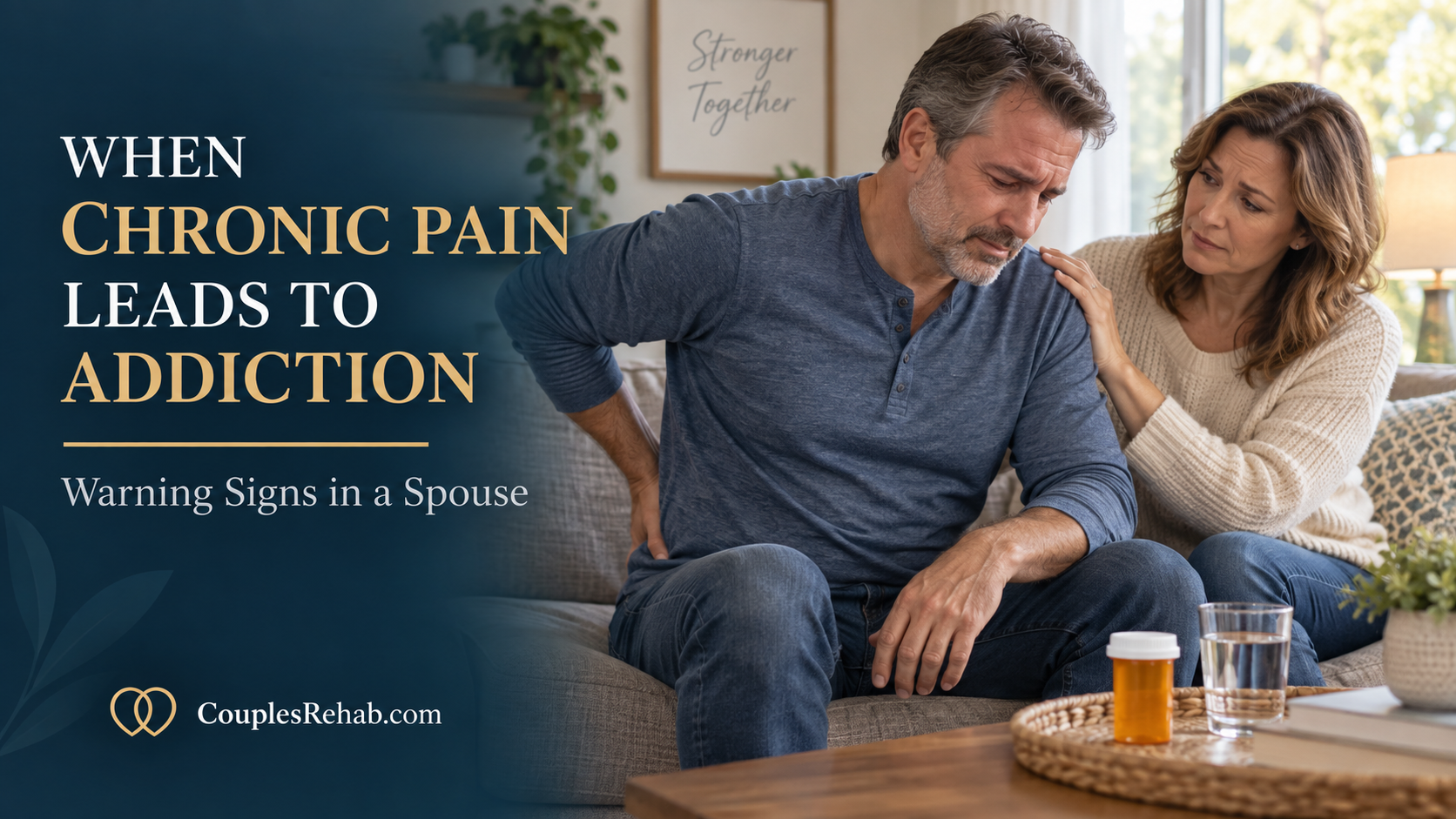
When Chronic Pain Leads to Addiction: Warning Signs a Spouse Is Relying on Pain Pills or Alcohol
If you are watching your husband or wife lean harder on pain medication — or reach for alcohol on the days the medication runs short — the earliest warning signs usually do not appear in the medicine cabinet. They appear in the calendar, in the conversation, and in the mood of the house. Refills run out sooner than they should. The first drink moves earlier. A simple question gets an answer that does not quite match what you saw with your own eyes.
Chronic pain is real, and so is the relief. That is exactly what makes this pattern so difficult for a spouse to name out loud. You are not watching someone chase a high. You are watching someone chase a functional day — a night of sleep, an hour on their feet, a shift at work. The line between treating pain and depending on the treatment moves slowly, and it moves while everyone in the house is busy coping.
This guide is written for the partner. It covers what the progression from pain management to dependence actually looks like inside a marriage, which combinations carry genuine medical danger, why abruptly stopping can be more dangerous than continuing, and how to raise the subject without turning your kitchen into a courtroom.
What Tony Romo’s Disclosure Put Back on the Table
On September 1, 2026, former Dallas Cowboys quarterback and CBS analyst Tony Romo issued a public statement after pleading no contest to an operating-while-intoxicated charge in Wisconsin. He described multiple back surgeries that ended his playing career earlier than expected, the constant and debilitating pain that followed, a dependence on pain medication, and then what he called an “over-reliance” on alcohol as he tried to get off those medications. He said he was working with doctors, and he was clear that he was explaining the path rather than excusing it.
The specific medication has not been publicly identified, and one person’s account does not diagnose anyone else. What is worth pulling out of the story is the sequence: pain, prescription, dependence, and then substitution. That third-to-fourth step — where one substance quietly replaces another — is the one families miss most often, because from the outside it can look like progress. The pills are going away. Nobody frames the wine as the new problem until much later.
If that arc sounds familiar in your own home, the rest of this article is about what to look for and what to do next.
Why Chronic Pain Is Such a Common On-Ramp
Dependence on prescribed medication is not a character failure, and it does not require anyone to have misused anything. A few things make chronic pain a particularly difficult starting point:
- Tolerance is physiological. Over time, the same amount does less. The body’s adjustment is not a decision anyone made.
- Pain is invisible and unfalsifiable. You cannot measure your spouse’s back. That means you cannot meaningfully argue about whether today is a bad day, and they know it.
- The prescription confers legitimacy. “A doctor gave it to me” ends most conversations before they start — and it is usually true, which is what makes it so effective.
- Tapering leaves a gap. When medication is reduced without a real plan for the pain underneath, something tends to move into the space. Alcohol is legal, inexpensive, requires no appointment, and is available at nine at night.
- Pain rarely travels alone. Interrupted sleep, lost income, lost identity, depression and anxiety usually arrive with it, and each one raises the pull toward anything that offers a few hours of quiet.
None of this means your spouse is beyond help or that the pain was imaginary. It means the risk is structural, and structural risks are worth watching for on purpose.
Warning Signs a Husband Is Relying on Pain Medication
No single item below proves anything. What matters is the cluster, and the direction it has been moving over the last several months.
Supply and timing
- Prescriptions run out noticeably before the refill date, with an explanation each time.
- Lost or stolen medication becomes a recurring story rather than a one-off.
- New prescribers, new urgent care visits, or appointments you only hear about afterward.
- Medication moves — from the cabinet to a car console, a jacket pocket, a bag, a drawer you were not told about.
- The dose stops matching the prescription, or you are asked, lightly, not to count.
Body and rhythm
- A predictable cycle to their mood: restless, irritable, sweaty or nauseated in the hours before the next dose, and settled shortly after it.
- Medication taken before an activity rather than in response to pain.
- Nodding off mid-conversation, mid-meal, or mid-sentence, then having no memory of it.
- Sleeping through mornings, or a sleep schedule that has quietly inverted.
- Constipation, pinpoint pupils, or slowed, shallow breathing during sleep.
Conversation
- Defensiveness that is out of proportion to the question you actually asked.
- The pain becomes the answer to every topic, including topics that were not about the pain.
- Minimizing that leans on the prescription itself: it is fine, it is prescribed, it is not the same thing.
- Fewer interests, fewer plans, fewer people — a life that has narrowed to managing the day.
Warning Signs a Wife Is Mixing Alcohol and Painkillers
This combination deserves its own section, because it is the one with the most immediate physical risk and the one most likely to be dismissed at home. A glass of wine with an evening dose does not look like a crisis. Pharmacologically, it is the piece worth taking seriously.
Opioid pain medication slows breathing. So does alcohol. So do benzodiazepines, muscle relaxants, sleep aids, and some medications prescribed for nerve pain. Taken together, their effects can compound rather than simply add — which is why a combination that felt manageable for months can become dangerous on a night when nothing obvious changed.
Signs worth paying attention to:
- Drinking that tracks the medication schedule — heavier on the days the prescription is short, or reliably alongside a dose.
- Sedation, slurred speech, or confusion that seems far out of proportion to how much they actually drank.
- Gaps in memory for ordinary evening conversations.
- Snoring that has changed character, pauses in breathing, or being very difficult to rouse.
- Drinking alone, or drinking that has moved earlier in the day and stopped being mentioned.
- Empty bottles or cans in places that suggest they were not meant to be found.
| Call 911 immediately if you see any of the following: Breathing that is very slow, shallow, gurgling, or has stopped; lips, fingertips or face turning blue or gray; unresponsiveness to a loud voice or a firm shake; or limpness and cold, clammy skin. Do not wait to see if it improves and do not leave the person alone. Naloxone reverses an opioid overdose and is available without a prescription at most pharmacies in the United States. If opioid medication is in your home, it is reasonable to ask your pharmacist for it and to learn how to use it, the same way you would keep a fire extinguisher you hope never to need. |
Chronic Pain and Marriage: The Signs That Show Up in the Relationship
Some of the clearest indicators have nothing to do with substances at all. They show up in how the two of you have been operating:
- Role drift. You became the scheduler, the driver, the pharmacist, the one who calls the insurance company, and increasingly the one earning. Partner is no longer the main word for what you do.
- Pre-emptive management. You check their state before you commit to plans, and you have started planning around a variable you cannot control.
- Covering. You explain them to family, to friends, to an employer. The explanations have gotten smoother with practice.
- The same three arguments, recycled. Different night, same script, no resolution — often because the real subject is not the one being argued about.
- Withdrawn hospitality. You stopped inviting people over, and you know why even if you have not said it.
- Financial fog. Cash withdrawals, early refills, charges you do not recognize, or a growing reluctance to look at the account together.
- Intimacy that faded, followed by the conversation about intimacy fading.
- Your own decline. Sleep, appointments you keep postponing, a resting level of dread you have started calling normal.
That last one matters more than people give it credit for. Partners in this position often arrive at help completely depleted, having spent a year absorbing the cost of someone else’s condition. If you recognize yourself there, what support can safely look like when you’re married to someone struggling and how codependency takes hold in a marriage are both worth reading before you plan a conversation.
Why “Just Stop Taking Them” Is the Wrong Plan
The instinct to flush the pills or pour out the bottles is understandable. It is also, in this specific combination, the wrong first move — and occasionally a dangerous one.
Alcohol withdrawal can be medically serious. In someone who has been drinking heavily and daily, stopping abruptly can produce seizures and delirium tremens, which is a medical emergency. This is one of the few withdrawal syndromes that can be fatal without care, and it is the reason alcohol withdrawal needs medical supervision rather than willpower and a weekend.
Withdrawal from opioid pain medication is rarely life-threatening on its own, but it is severe enough that most people return to use simply to make it stop — often after their tolerance has already dropped, which is precisely when the risk of overdose is highest.
And then there is the pain itself. If nobody has built a plan for the underlying condition, removing the medication removes the only strategy your spouse has. Relapse pressure is engineered into that situation from the start. This is the central argument for an assessment: a clinician determines the level of care, the taper, and the pain plan together, rather than any of the three being decided at the kitchen table at midnight.
If you are trying to gauge where things stand, the signs that someone needs medically supervised detox and how couples detox admissions actually work cover what an evaluation looks like and what happens after it.
How to Raise It Without an Ambush
There is no script that guarantees a good outcome. There are choices that reliably make it worse, and most of them are avoidable.
- Pick the moment deliberately. Not during peak pain, not while either of you has been drinking, not in front of the kids, not at the end of an argument about something else.
- Lead with what you saw, not what you concluded. “You fell asleep at dinner twice this week and you don’t remember it” is a fact. “You’re an addict” is a verdict, and it will be litigated instead of considered.
- Bring one ask, not five. Usually the ask is small: will you let someone look at the whole picture — the pain and the medication together. That is a far easier yes than “go to rehab.”
- Expect the pain defense, and concede it immediately. You are not arguing the pain isn’t real. Saying so out loud removes the argument they are most prepared to have.
- Know your own line before you start. Decide what you will and will not keep doing, and say it evenly rather than as a threat. A boundary you actually intend to hold is worth more than an ultimatum you will walk back by Thursday.
- Accept that the first conversation may only be the first. People rarely agree in the moment. They agree three days later, quietly, because the moment did not go badly.
If the answer is no, setting boundaries with a partner who is still using and what actually moves a partner toward treatment are the next things to read. Refusal at the first ask is common and is not the end of the process.
What Treatment Looks Like When Both the Pain and the Substance Use Are Real
The fear that keeps many people from picking up the phone is a reasonable one: that treatment will take away the medication and leave the pain untouched. A program that does that is not a good program. What a thorough process looks like:
- A full assessment first. Substance use history, pain history and diagnoses, mental health, sleep, medications, and what has already been tried. The level of care follows from that evaluation rather than preceding it.
- Medically supervised detox where it is indicated — particularly when alcohol or sedatives are involved, where an unsupervised stop carries real risk.
- Dual diagnosis care. Depression, anxiety, PTSD and chronic insomnia frequently sit underneath this pattern, and treating the substance use alone tends to leave the engine running.
- A genuine pain plan. Physical therapy, non-opioid medication options, interventional approaches, and behavioral pain treatments that change how pain is processed rather than pretending it is gone.
- A role for the relationship. Sometimes both partners are in treatment. Sometimes one is, and the other needs structured support to stop absorbing the whole load. Both are legitimate configurations.
On the site, the relevant paths are couples detox programs, dual diagnosis programs, prescription drug rehab for couples, and trauma therapy. For couples who cannot step away from work or children, telehealth is a real option when it is clinically appropriate.
On cost: most PPO plans include behavioral health benefits, and federal parity rules require that those benefits be comparable to medical and surgical coverage. How insurance coverage works for this kind of care explains verification, and what to do when a couples rehab claim is denied covers the appeal path, which is more successful than most people assume.
What a Spouse Can Do This Week
- Write down what you have actually observed, with dates. Not interpretations — observations. It steadies you, and it is useful to a clinician later.
- Ask your pharmacist about naloxone if opioid medication is in the house, and make sure one other adult knows where it is.
- Tell one person outside the house. Isolation is the condition under which this gets worse, and it is the easiest one to change today.
- Get an assessment rather than a diagnosis from the internet. You do not need your spouse’s agreement to ask questions about options.
- Put one thing back on your own calendar — the appointment you postponed, the walk, the friend. You are going to need more capacity than you currently have.
Frequently Asked Questions
Is my spouse addicted, or are they just in a lot of pain?
Both can be true at once, and you are not in a position to settle it alone — nor should you have to be. The more useful question is whether the pattern has changed: whether the medication or alcohol is being used for more than pain, whether stopping produces distress beyond the pain returning, and whether their life has narrowed around it. A clinical assessment answers this properly. Trying to reach a verdict yourself tends to produce arguments rather than answers.
Is it dangerous for my wife to drink while taking painkillers?
Opioid pain medication and alcohol both slow breathing, and their effects can compound when combined. Benzodiazepines, muscle relaxants and some sleep medications carry the same concern. That is why the risk is not predictable from the amount alone, and why a combination that seemed tolerable for months can turn dangerous on a particular night. If you see very slow or stopped breathing, blue or gray lips, or someone who cannot be woken, call 911.
Should I throw out his pills?
Not unilaterally, and not without advice. Abruptly ending medication after long-term use can trigger withdrawal, and where alcohol or sedatives are also involved that carries medical risk. Talk to the prescriber or a pharmacist about a safe approach. In the meantime, a lockbox and a shared plan accomplish more than a secret disposal, which usually costs trust without changing anything.
Can we go to treatment together, or does he have to go alone?
Both arrangements exist. Some couples enter treatment together; in other cases one partner is in a program while the other receives structured support, which is often the better clinical fit when one person’s condition is significantly more acute. An assessment is what determines which configuration makes sense.
He says the doctor prescribed it, so it isn’t a problem. How do I respond to that?
Agree with the part that is true. It was prescribed, and the pain is real. Dependence can develop on correctly prescribed medication taken as directed — that is a known physiological effect, not an accusation about his character. Framed that way, the conversation stops being about whether he did something wrong and becomes about whether the current plan is still working.
Will insurance cover treatment that addresses both pain and substance use?
Frequently, yes. Most PPO plans include behavioral health benefits, and federal parity law requires them to be comparable to medical and surgical coverage. Coverage specifics vary by plan, so verification of benefits is the practical first step, and a denial can be appealed.
If You Need Help Right Now
If you or your spouse is in immediate danger, call 911. For a mental health or substance use crisis, the 988 Suicide & Crisis Lifeline is available 24 hours a day by call or text. Additional crisis resources are collected at https://couplesrehab.com/crisis-support/.
Taking the Next Step
Figuring out what level of care fits a situation where pain and substance use are tangled together is genuinely hard to do from the inside. The Couples Assessment is a short, confidential set of questions that identifies the clinical and relational needs at play and matches couples with verified independent providers, in person or through telehealth. There is no cost to complete it and no obligation attached to the results.
Care Navigators can also be reached at 888-500-2110, Monday through Friday, 9am to 6pm PT, if you would rather talk it through with a person. Care Navigators are not clinicians and do not provide medical advice, diagnosis, or treatment.
Couples Rehab is an independent educational and referral resource. It does not provide healthcare services directly; care is delivered by independent licensed providers in its network. This article is for informational purposes only and is not a substitute for medical advice, diagnosis, or treatment from a qualified professional.