Can a Marriage Survive Alcohol Addiction? New Research Examines How a Partner’s Drinking Changes Recovery
Short answer: yes, marriages do survive alcohol use disorder — and a January 2026 study in Alcohol and Alcoholism suggests that being married is associated with a higher likelihood of sustained remission than being in some other committed relationships. But the same study found something couples rarely hear: the protection is conditional. How much the other partner drinks changes the picture substantially, and for some couples it erases the advantage entirely.
That distinction matters if you are the spouse asking whether to stay, whether to push for treatment, or whether the two of you should go together. Below is what the new research actually found, what it does not claim, and how the relationship environment factors into decisions about couples addiction treatment.
What the new study looked at
Researchers led by Christina Garasky at Washington University School of Medicine analyzed 1,494 adults who had met lifetime DSM-5 criteria for alcohol use disorder, drawn from the Collaborative Study on the Genetics of Alcoholism (COGA) Lifespan Study. Just over half the sample (54.4%) were female. The full paper is open access in Alcohol and Alcoholism.
Most earlier research on marriage and drinking lumped everyone who was not married into a single “unmarried” bucket. That obscured an obvious problem: a person in a ten-year cohabiting partnership and a person with no partner at all are not living in the same environment. This study split the categories apart — married, cohabiting, exclusively dating, and single — and then asked a second question on top of it: does the partner’s own drinking change the answer?
Remission was defined the way the DSM-5 defines it: no alcohol use disorder symptoms other than craving for at least 12 consecutive months. The models adjusted for age, race, family risk status, lifetime AUD severity, prior treatment and mutual-help attendance, childcare responsibilities, and relationship length.
Finding 1: Married adults did better — but mainly compared to one group
In the adjusted models, married participants had a predicted remission prevalence 9.2 percentage points higher than participants who were exclusively dating. That gap was statistically significant.
The comparisons to the other groups were not. Married participants edged out cohabiting participants by 4.2 points and single participants by 3.7 points, but neither difference reached significance. In the raw counts, 58.6% of married participants were in remission, versus 55.4% of single participants, 48.9% of those living as married, and 43.6% of those exclusively dating.
One number in the data is worth sitting with. Among participants who achieved remission after the relationship began, 59.8% of married people had done so, compared with 53.0% of those cohabiting and only 29.5% of those exclusively dating. Whatever marriage is supplying, it appears to matter most during the period when recovery is being built rather than after it is already established.
Finding 2: Partner drinking is the variable that moves the needle
This is the part of the paper most relevant to anyone living with relationship problems caused by addiction.
Across models, higher partner drinking was independently associated with a lower predicted likelihood of remission. Not lower relationship satisfaction. Not higher conflict. Lower odds of getting and staying well.
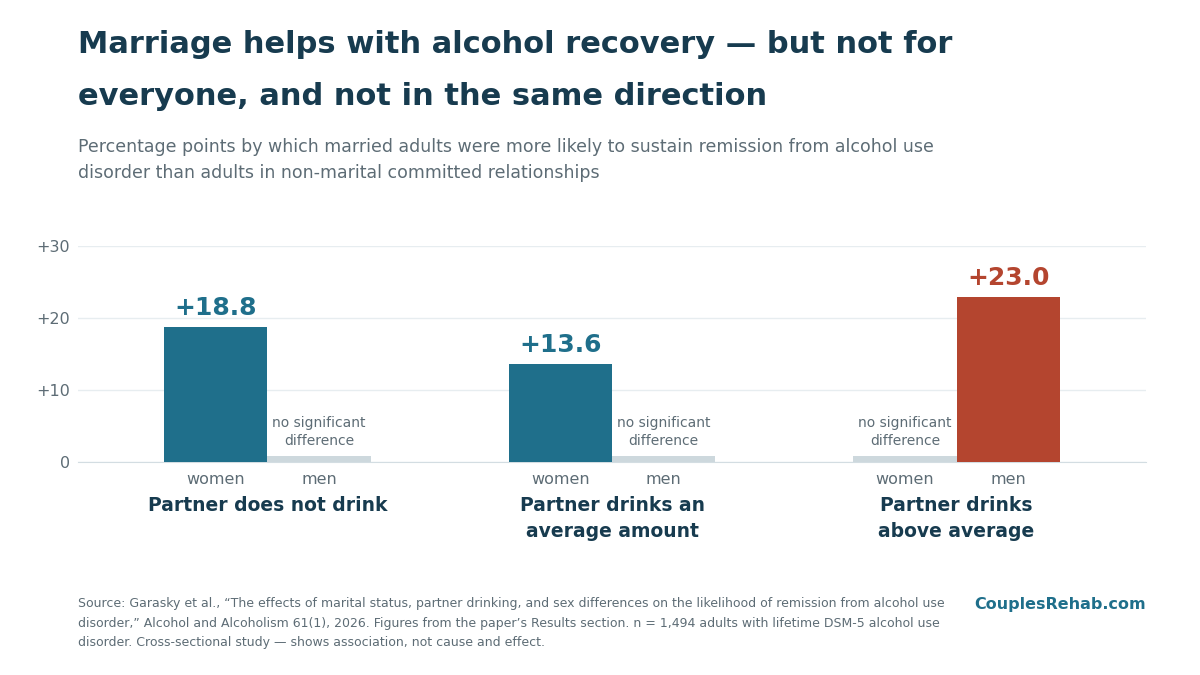
The researchers estimated outcomes at three levels of partner consumption: abstinent, average for the sample (roughly six drinks per week), and one standard deviation above average. The pattern that emerged was not uniform.
When the partner did not drink at all, married women had a predicted remission prevalence 18.8 percentage points higher than women in non-marital committed relationships. When the partner drank at average levels, that advantage narrowed to 13.6 points but remained significant. When the partner drank at above-average levels, the difference for women disappeared. Married and unmarried women alike showed similarly low predicted remission.
Read that sequence again if you are the wife of a heavy drinker. In this sample, the marriage certificate stopped conferring measurable advantage once the partner’s drinking climbed. The institution did not outrun the environment.
Finding 3: The pattern ran the opposite direction for men
For men, marital status made no significant difference when partners were abstinent or drank at average levels. But when partners drank at above-average levels, married men showed a predicted remission prevalence 23.0 percentage points higher than men in non-marital committed relationships.
The authors do not claim to know why, and neither should anyone summarizing them. One reading consistent with the broader literature is that men tend to draw a disproportionate share of their health-related support from a spouse, so the structural commitments of marriage may buffer a high-risk drinking environment for men in a way that dating or cohabiting does not. That is an interpretation, not a finding.
What the paper does establish is that sex and partner drinking interact. A blanket claim that “marriage protects against alcohol problems” does not survive contact with this data.
What did not explain the results
The team ran exploratory models replacing marital status with relationship satisfaction, relationship length, and number of divorces. None of them reproduced the effect.
That is a meaningful negative result. It suggests the difference between married and unmarried couples here is not simply that married couples have happier or longer relationships. Something about the structure of the commitment itself — legal entanglement, shared finances, social expectation, mutual investment — appears to be doing work that a self-reported satisfaction score does not capture.
What the study does not say
Responsible reporting on behavioral health research means naming the limits, and this paper names its own clearly.
- It is cross-sectional. No causal claim is possible. Getting married will not cause remission, and the study does not suggest it will.
- It is a high-risk sample. COGA recruits through families with dense histories of alcohol problems. These findings may not generalize to the broader population.
- Partner drinking was estimated by the participant, not reported by the partner. People routinely misjudge how much their spouse drinks, usually downward.
- The sample was 98.8% heterosexual. How these dynamics operate in same-sex couples is genuinely unknown.
- Selection effects are unresolved. Healthier people are more likely to marry and stay married in the first place, a confound the authors acknowledge.
One further note for anyone reading the paper directly: the printed abstract lists prevalence differences of 12.20, 17.98, and 25.30 percentage points, while the Results section reports 13.6, 18.8, and 23.0 for the corresponding comparisons. The figures used above are the ones from the Results section.
Why the relationship environment matters clinically
Strip away the statistics and the practical implication is straightforward. Alcohol use disorder is not maintained in isolation. It is maintained inside a household — inside shared routines, shared social calendars, shared grocery runs, shared coping habits after a hard day. Spouses generally drink together more often than they drink with anyone else. That means the recovery environment and the relationship are frequently the same object.
Treatment that addresses only one partner leaves that object half-treated. This is not a new idea; it is why couple-based interventions were developed in the first place. A widely cited meta-analysis of 12 randomized controlled trials found that behavioral couples therapy outperformed individual-based treatment for married or cohabiting adults seeking help for alcohol or drug dependence, with advantages across substance use frequency, consequences of use, and relationship satisfaction — and with the substance-use advantages showing most clearly at follow-up rather than immediately after treatment ended.
The 2026 findings slot neatly into that framework. If partner drinking is one of the strongest environmental predictors of whether remission holds, then a treatment plan that never asks about the partner’s drinking is missing a variable it needs.
When joint treatment could help — and when it may not fit
Couples-based care is not universally indicated, and reputable clinicians will tell you so. The general shape of the decision looks like this.
It may be a strong fit when:
- Both partners drink, or one partner’s drinking is a consistent trigger for the other’s
- The relationship is intact and both people want it to continue
- Recovery attempts have failed before at the point of returning home
- Shared routines, shared friend groups, or a shared household are central to the drinking pattern
- Both partners are willing to participate in treatment, not just attend it
Individual or separated care is often the better route when:
- There is intimate partner violence, coercion, or fear in the relationship
- One partner is medically unstable and needs detox for alcohol withdrawal before any therapy work can begin
- Only one partner is willing to engage, and pressure is being applied to the other
- Clinical severity differs so sharply that the two people need different levels of care
That last point deserves emphasis. Withdrawal from alcohol can be medically dangerous and, in some cases, life-threatening — alcohol withdrawal is not something to manage at home on the assumption that going through it together is romantic or supportive. Medical assessment comes first. Relationship work comes after stabilization.
The question of whether to enter treatment jointly is common enough that it has its own literature and its own trade-offs; if you are weighing it, couples rehab versus separate rehab walks through how clinicians typically approach the decision, and does couples rehab actually work reviews what the outcome evidence supports.
What this means if you are the sober partner
A recurring theme in the data is that the non-drinking partner is not a bystander. If your drinking is part of your spouse’s environment, changing it is a clinical intervention, not a gesture.
That does not mean the sober partner is responsible for the other’s recovery. It does mean a few things are worth examining honestly:
- Whether alcohol is present in the home, and whether it needs to be
- Whether social plans are built around drinking occasions
- Whether patterns have formed where managing, covering for, or monitoring the other person has become a full-time role — the dynamic explored in codependency and addiction in marriage
- Whether limits have been set and then quietly abandoned, a pattern addressed in setting boundaries with an addicted partner
For spouses who have been carrying this alone for a long time, resources written for that specific position — such as guidance for when a wife’s drinking has become the central problem in a marriage — can be a more useful starting point than general addiction information.
Finding care that accounts for the relationship
Not every treatment program is equipped to work with both partners, and program quality varies widely. The National Institute on Alcohol Abuse and Alcoholism maintains the Alcohol Treatment Navigator, a free federal tool that walks through how to search for providers, what to ask them, and which signs indicate higher-quality care. NIAAA’s clinician-facing guidance on evidence-based treatment options confirms that couples and family formats sit alongside individual therapy and FDA-approved medications as legitimate approaches, available in person and through telehealth.
Understanding what the different levels of treatment involve — detox, residential, intensive outpatient, outpatient therapy — makes those provider conversations considerably shorter. For couples whose schedules, childcare, or geography make in-person care difficult, online couples therapy is an option that independently licensed providers offer where clinically appropriate.
If you would rather start by describing your situation than by cold-calling programs, the couples assessment is a short set of questions about clinical and relational needs that helps identify which independently licensed providers in the network are a reasonable match, in-person or by telehealth.
Couples Rehab is an independent education and care-navigation resource. It does not provide treatment, diagnose, or deliver clinical services; it connects people with independently licensed providers. Our editorial standards explain how content like this is researched and sourced.
Frequently asked questions
Can a marriage survive alcoholism? Many do. The 2026 Alcohol and Alcoholism study found married adults with a history of alcohol use disorder had higher predicted rates of sustained remission than adults who were exclusively dating, and among people who remitted after their relationship began, married participants did so at roughly twice the rate of those who were dating exclusively. Survival is not guaranteed by marital status alone, and the study found the advantage shrinks or disappears depending on how much the other partner drinks.
Does my drinking affect my spouse’s recovery? The research says it is associated with it. Higher partner drinking predicted lower likelihood of remission across the study’s models. Spouses tend to drink together more often than with anyone else, which makes household drinking patterns part of the recovery environment rather than a separate issue.
Should we go to rehab together or separately? It depends on clinical factors that only a licensed provider can assess — severity, medical stability, whether both partners are willing, and whether the relationship is safe. Couple-based treatment has strong evidence behind it for married and cohabiting adults, but individual care is more appropriate where there is violence, coercion, or a significant mismatch in level of care needed.
What if only one of us wants help? That is common, and it is workable. Treatment can begin with one partner while the other is brought in later, and there are structured approaches designed specifically for the family member of someone who is not yet ready. Pressure applied by one partner to force the other into joint treatment tends not to hold.
Does insurance cover couples treatment for alcohol use disorder? Coverage for alcohol use disorder treatment is common under PPO and other commercial plans, but specific benefits, levels of care, and network arrangements vary by plan and by provider. Benefit questions are answered by your plan administrator and by the treatment provider directly.
Is it too late if we’ve already tried treatment before? Recurrence is a recognized feature of alcohol use disorder rather than evidence of failure. Prior treatment episodes were common in this study’s sample, and many of those participants were nonetheless in sustained remission at the time of interview. A previous attempt that ended at the point of returning home is precisely the pattern couple-based approaches were designed to address.
Sources
- Garasky C, Duncan A, Dong F, et al. The effects of marital status, partner drinking, and sex differences on the likelihood of remission from alcohol use disorder. Alcohol and Alcoholism. 2026;61(1):agaf085. https://academic.oup.com/alcalc/article/61/1/agaf085/8416696
- Powers MB, Vedel E, Emmelkamp PMG. Behavioral couples therapy (BCT) for alcohol and drug use disorders: a meta-analysis. Clinical Psychology Review. 2008;28(6):952–962. https://pubmed.ncbi.nlm.nih.gov/18374464/
- National Institute on Alcohol Abuse and Alcoholism. NIAAA Alcohol Treatment Navigator. https://alcoholtreatment.niaaa.nih.gov/
- National Institute on Alcohol Abuse and Alcoholism. Recommend Evidence-Based Treatment: Know the Options. https://www.niaaa.nih.gov/health-professionals-communities/core-resource-on-alcohol/recommend-evidence-based-treatment-know-options
This article is for general education and does not constitute medical advice, diagnosis, or treatment. Couples Rehab is an independent educational and referral resource and does not provide healthcare directly. If you or someone you love is in immediate danger, call 911. For free, confidential support at any hour, call or text 988. Additional resources are available on our crisis support page.