Online Couples Counseling Programs in Orange County

Online Couples Counseling Programs in Orange County, CA

By the CouplesRehab.com Editorial Team

The Essential Guide to Online Couples Counseling Programs in Orange County, CA: Expertise, Privacy, and Lasting Connection

In the dynamic, high-paced environment of Orange County, California—from the bustling business centers of Irvine to the scenic beaches of Newport Beach and Huntington Beach—maintaining a thriving relationship presents a unique set of challenges. Time is a precious commodity, and scheduling traditional, in-office couples therapy often feels like an impossible task.

Yet, ignoring the subtle erosion of a relationship is never the answer. The repetitive arguments, the growing emotional distance, or the shadow of infidelity demand expert attention.

This is where a specialized online couples counseling program Orange County truly shines. It offers the high-level expertise of a seasoned therapist combined with the unparalleled convenience and privacy required by busy professionals and families.

As a seasoned legal expert who has witnessed the devastating consequences of broken trust and divorce—and as advocates for strong, healthy relationships at CouplesRehab.com—we understand the weight of this decision. This guide is built on decades of experience to help you cut through the confusion and find a safe, effective path to rebuilding your relationship.


Why Online Couples Counseling is the Perfect Fit for the Orange County Lifestyle

The decision to seek help is monumental. For couples in Orange County, the logistical hurdles of traffic, childcare, and conflicting work schedules often derail the best intentions. Virtual therapy is not a compromise; it is an optimized solution.

Unmatched Flexibility and Discretion: The Virtual Advantage

Virtual couples therapist near me Orange County is no longer defined by a physical office address. It means having your session from the comfort of your living room in Laguna Niguel, your private office in Irvine, or even while your partner is traveling for work.

  • Schedule Optimization: Access evening couples therapy online OC or weekend online couples counseling Orange County, eliminating the need to miss work or rush through the 405 freeway.
  • Privacy and Comfort: Your home is a natural, safe setting. You avoid waiting rooms and ensure complete discretion, which is essential when dealing with sensitive issues like affair recovery or high-conflict dynamics.
  • Logistical Freedom: Online marriage therapy OC for communication can be attended by both partners logging in from different locations, offering flexibility for traveling professionals or those with complicated co-parenting schedules.

The effectiveness of these remote sessions is now well-established, rivaling that of in-person therapy. In fact, many couples find the digital barrier reduces initial anxiety, allowing them to engage more deeply, more quickly.


The E-E-A-T Framework: Choosing a Trustworthy Online Program

When your relationship is on the line, you must choose a program that demonstrates clear Experience, Expertise, Authority, and Trustworthiness (E-E-A-T).

Experience and Expertise: Beyond Basic Licensing

A licensed professional counselor (LPC) or licensed clinical social worker (LCSW) is not automatically an expert in couples work. Specialized training is paramount.

  • Specialized Modalities: Look for a therapist trained in evidence-based couples models. Ask specifically about the Online Gottman Method couples counseling Orange County (focused on communication and conflict resolution) or the Virtual EFT couples therapy program Laguna Niguel (Emotionally Focused Therapy, focused on attachment and emotional connection).
  • Specialization-Based Terms: If you are dealing with a specific crisis, a generalist won’t suffice. Seek providers who naturally integrate terms like online couples therapy for infidelity Orange County or virtual marriage counseling for affair recovery OC into their offerings.

Authority and Trustworthiness: The Importance of CA Licensing and Security

In the legal and ethical landscape, trust is non-negotiable, especially in a virtual setting.

  1. Verify Licensing: Ensure your therapist is licensed by the California Board of Behavioral Sciences (BBS). This board sets the legal and ethical standards for all Marriage and Family Therapists (LMFTs), Clinical Social Workers (LCSWs), and Professional Clinical Counselors (LPCCs) practicing in the state.
  2. HIPAA Compliance: Your private life must remain private. Ensure your program uses a certified HIPAA-compliant online couples counseling OC platform (e.g., secure video conferencing tools) that meets federal standards for protected health information (PHI). This is the gold standard for confidentiality.

Addressing High-Stakes Relational Crises with Virtual Therapy

While many seek therapy for general dissatisfaction, others are in acute crisis. Online therapy, when delivered by specialists, is a powerful tool for these high-stakes situations.

Infidelity and Trust Issues

Affair recovery requires a highly structured, non-judgmental approach. A specialist offering online counseling for trust issues in marriage Orange County can guide the betrayed partner through processing trauma and the offending partner through true accountability and repair.

High-Conflict and Communication Breakdown

When every conversation turns into a fight, you need a way out of the destructive cycle. A program focused on couples therapy online for high-conflict relationships will teach practical, evidence-based skills. You will learn how to address online therapy for marriage with lack of communication by transitioning from blaming to understanding the underlying needs of your partner.

“The arguments aren’t the problem; they are the attempt to solve the problem. Couples counseling teaches you the right language to solve it together.”

– A CouplesRehab.com Principle

H3: The “Married Roommates” Phenomenon

The slow drift into emotional detachment is insidious. Many couples search for virtual therapy for married roommates Orange County or program to rebuild emotional connection in marriage online OC. A good virtual program will focus on Attachment-based online couples therapy Orange County, helping you reconnect through shared vulnerability rather than transactional cohabitation.

H3: Managing External Stressors

Relationships are often the pressure point for external crises. Whether you’re dealing with couples counseling online for financial stress, virtual relationship therapy for infertility support OC, or the stress of raising a blended families (online relationship coach Orange County for blended families), a virtual program offers a dedicated, neutral space to process these intense pressures without outside interference.


A Practical Guide to Program Selection and Cost

One of the first questions clients ask is about the financial commitment. While specialized couples counseling is an investment, many options exist to make it accessible.

Understanding Program Structure and Time Commitment

When seeking a program, clarify these logistical details:

  • Session Length: Standard sessions are typically 50-60 minutes, but some intensive models, like those used for pre-divorce discernment (Couples therapy online for pre-divorce discernment), may utilize longer 90-minute sessions.
  • Program Duration: The typical range is 12 to 24 sessions. For deep, transformative change, plan on a commitment of 6 to 9 months, with regular check-ins and the consistent application of homework or exercises to practice between our online sessions.
  • Post-Treatment Planning: A responsible program will not leave you hanging. They will discuss a step-down plan, often including aftercare or relapse prevention support to ensure your long-term success. (Learn more about planning your long-term success at https://couplesrehab.com/services/aftercare/).

Navigating Fees and Accessibility for OC Residents

  • Sliding Scale Options: Look for sliding scale online couples counseling OC programs. These adjust the fee based on your household income, making specialized care more affordable online couples therapy program Irvine.
  • Insurance: Couples counseling is often billed differently than individual therapy. While many therapists are out-of-network, they can provide a superbill for you to seek reimbursement from your carrier.
  • Treatment Centers: For couples struggling with co-occurring addiction, a comprehensive facility like the one described at https://therecover.com/couples-rehab/ may offer structured programs that include couples therapy as a core component of recovery.

The First Step: Handling Hesitation and Seeking Specialized Fit

It is a common scenario: one partner is ready, and the other is not. Successful therapy often depends on how you navigate this initial resistance.

Counseling When One Partner is Hesitant

When searching for marriage counseling when one partner is hesitant online OC, remember that most therapists are trained to handle this. The first few sessions are dedicated to building rapport and defining a shared, achievable goal, making the reluctant partner feel heard and unjudged. A seasoned expert will never “take sides” or immediately advise whether you “should stay together.” Their role is to help you determine your path with clarity and safety.

Finding the Right Specialist for Your Demographic and Beliefs

A deep connection with your therapist is key to success. You should actively look for a program that aligns with your identity.

  • Faith and Values: For many, shared beliefs are critical. Search for Christian online couples counseling Orange County if faith integration is important to your healing process.
  • Life Stage: Seek a specialist who understands your unique stressors, whether you are a virtual marriage therapy for military couples Orange County, online couples therapist for young adults OC, or a couple dealing with a couples counseling virtual for midlife crisis Orange County.
  • Inclusivity: For the highest quality of care, ensure your provider is LGBTQ-affirming online couples therapy Orange County and deeply trained in working with diverse relationship structures and identities.

Resources for Safety, Verification, and Next Steps

In a situation involving domestic violence or active, unmanaged substance abuse, a standard online couples counseling program may not be appropriate. Safety and stabilization must always come first.

Safety and Crisis Intervention

If there are issues of domestic violence or active, unmanaged addiction, the focus must shift to individual safety and specialized treatment.

Taking the Next Step Towards Healing

Your commitment to reading this guide proves your readiness to change. The first session is an information gathering consultation, not a lifetime commitment. It’s an opportunity for your program to understand your history, the repetitive cycles you’re stuck in, and your goals for a future together.

The path to a deeper, more satisfying connection starts now. In the privacy of your Orange County home, a seasoned professional is ready to help you write the next, healthier chapter of your shared life.


Frequently Asked Questions (FAQ) About Online Couples Counseling Program Orange County

This section is ideal for schema markup and answering the user’s most pressing questions, ensuring high visibility in search engine result pages (SERPs) and AI answers.

Question (The “How”)Answer
How effective is online couples counseling compared to in-person sessions in Orange County?Extensive research now shows that online couples counseling is just as effective as in-person therapy for the vast majority of relationship issues. The key element for success is the expertise of the therapist and the commitment of the couple, not the physical location. The added convenience of virtual sessions often leads to higher attendance and program completion rates.
Do both partners need to be in the same room, or can we log in from different locations in Orange County or surrounding areas?The major advantage of a Virtual couples therapist near me Orange County is flexibility. No, you do not need to be in the same room. You can log in from different homes, different offices, or even different cities or states (as long as the therapist is licensed in both locations, though most will require both partners to be physically in California). This is ideal for work or travel schedules.
What technology is required, and is the video platform HIPAA-compliant for Orange County clients?You only need a stable internet connection, a quiet private space, and a computer or smartphone with a camera. All reputable programs use a secure, encrypted, and HIPAA-compliant platform (like Zoom for Healthcare or Doxy.me) to ensure the privacy and security of your sensitive health information, meeting all federal and California standards.
How long is each online session, and what is the typical duration of a couples counseling program?Standard online sessions are 50 minutes long. However, some Gottman Method couples counseling or initial sessions may be extended to 90 minutes. A full program designed for lasting change typically lasts 6 to 9 months, or approximately 15 to 25 sessions, depending on the severity of issues like affair recovery or high-conflict relationships.
What is your fee structure, and do you offer a sliding scale or accept insurance for OC residents?Fees vary based on the therapist’s expertise and location. Many clinics offer a sliding scale online couples counseling OC program based on financial need, making quality care more accessible. While few couples therapists accept insurance directly, most can provide a superbill (a detailed receipt) that you can submit to your insurance company for potential out-of-network reimbursement.
Question (The “Who”)Answer
What specific training or certification do your Orange County therapists have in working with couples (e.g., Gottman, EFT)?Our therapists are highly specialized, carrying licenses such as LMFT (Licensed Marriage and Family Therapist) and often advanced certifications. We emphasize evidence-based modalities like the Gottman Method (for communication and perpetual problems) and Emotionally Focused Therapy (EFT) (for attachment and emotional bonding). When booking, inquire specifically about the therapist’s advanced training in these areas.
Will you meet with us individually, or is all therapy conducted with both partners together?The primary work is always done with both partners together to observe and change the relationship’s dynamic. However, an effective therapist will often conduct one or two brief, mandatory individual sessions at the start of the program to gather a full history and perspective. After that, sessions are typically joint.
Will the counselor take sides during our conflicts or tell us whether we should stay together?Absolutely not. A seasoned couples counselor is trained to be strictly neutral. Their role is to be an expert process consultant, not a judge. They will never tell you whether to stay together. Instead, they provide the skills and clarity needed for you as a couple to make the best, most informed decision for your relationship’s future.
How do we know if you are the right “fit” for our relationship challenges?Fit is essential. The first step is to schedule an initial consultation, which allows both partners to assess the therapist’s style, expertise (especially for niche issues like infidelity or sexual intimacy problems), and approach. We encourage couples to ask direct questions about the therapist’s experience with challenges similar to yours.
Do your licensed therapists primarily work with couples in the Orange County area only?Our therapists are licensed by the California Board of Behavioral Sciences (BBS). This license allows them to serve any client who is physically located in California at the time of the session. While they may specialize in the Orange County demographic, their services are available to all residents of California, including surrounding areas like Los Angeles and San Diego.
Question (The “What”)Answer
We are dealing with a recent affair; can online couples counseling truly help us rebuild trust after infidelity?Yes, absolutely. Online counseling is highly effective for the difficult process of virtual marriage counseling for affair recovery OC. A specialist provides the structured, non-judgmental container necessary to process trauma, understand the underlying relational issues, and create a roadmap for genuine accountability and rebuilding trust.
Our main issue is communication—what practical skills will we learn in the program to stop repetitive arguments?The core of the program is teaching practical, science-backed skills. You will learn to identify your cycle of conflict, utilize “I” statements, practice de-escalation techniques, and shift from discussing what you fight about (content) to understanding why you fight (process). For online therapy for marriage with lack of communication, you will learn skills to transform constant fighting into productive dialogue.
Can online counseling help if one of us is feeling emotionally disconnected or like we’re just “roommates”?Yes, this is a very common and treatable issue. We use models like EFT to target couples counseling for emotional numbness OC by exploring the underlying fears and unmet needs that drive disconnection. The goal is to shift the dynamic and rebuild the emotional connection in marriage online OC.
We are looking for pre-marital counseling; do you offer a structured program for couples before marriage?Yes, we offer a dedicated, structured online program for pre-marital counseling Orange County. This program focuses on a thorough assessment of foundational areas like finances, family-of-origin, communication styles, and conflict resolution before you make your long-term commitment.
What if one partner is hesitant or not fully committed to starting the online counseling process?It’s completely normal for one partner to be more eager than the other. If one partner is hesitant, the therapist will use the initial sessions to address their concerns, explore their resistance, and focus on small, shared goals that benefit both individuals. The focus remains on engaging the system gently.
Question (The “Assurance”)Answer
Is everything we discuss completely confidential, even when we are logging in from home?Yes. Everything discussed is legally and ethically confidential, protected by the same rules as in-person therapy and backed by HIPAA-compliant technology. The only exceptions are the legal limits of confidentiality: threats of harm to self or others, or suspected abuse of a child or elder.
How will we measure progress, and how will we know when it’s time to stop the program?Progress is measured through both formal assessments (like questionnaires) and observable changes in your relationship. Success metrics include a reduction in conflict frequency/intensity, an increase in emotional intimacy, and a feeling of being a team again. You will conclude the program when you have consistently met the goals you set in the initial sessions and have a solid relapse prevention plan for maintaining change.
Do you give us “homework” or exercises to practice between our online sessions?Yes, absolutely. The real change happens between sessions. You will receive targeted exercises, often involving communication practices, emotional awareness tasks, or specific connection rituals, designed to apply the skills you learn in therapy to your daily life.
What are the first steps we need to take to schedule our first virtual session?The process is quick and discreet: 1. Visit our Contact Page or call our intake coordinator. 2. We will conduct a brief, confidential phone consultation to match you with the best virtual marriage counselor Newport Beach or specialist for your needs. 3. You will receive a link to your secure, virtual session space.
Is online couples counseling right for us if there are issues of domestic violence or active substance abuse?No, not initially. If there is active domestic violence, the first step must be individual safety and legal protection. If there is unmanaged, active substance abuse, the primary focus must be stabilization through a dedicated program like those found at https://couplesrehabs.org/relapse-prevention/ or https://broadwaytreatmentcenter.com/treatment/couples-addiction-treatment-program/. Couples counseling is often introduced only after safety and sobriety are established.

H2: Essential Resources for Orange County Couples

ResourcePurposeClickable Link
California Board of Behavioral Sciences (BBS)The state licensing and regulatory board for LMFTs and LCSWs. Crucial for verifying your therapist’s license.Verify a License on the BBS Website
OC Health Care Agency Mental Health ServicesProvides information on low-cost or free public behavioral health services, including counseling and community resources for OC residents.OC Health Care Agency Mental Health Services
OC LinksA confidential, free mental health and substance use disorder information and referral line for Orange County residents.OC Links
CalHOPEA statewide resource offering free mental health and wellness support for all Californians, including digital resources for families.CalHOPE Home
American Association for Marriage and Family Therapy (AAMFT)The national professional association for MFTs. Provides a “Find a Therapist” tool and publishes the profession’s Code of Ethics.AAMFT Find a Therapist
988 Suicide & Crisis LifelineThe national number for mental health crises. The primary resource for immediate support during a severe mental health crisis.988 Suicide & Crisis Lifeline
Infidelity Recovery Couples Therapy Program

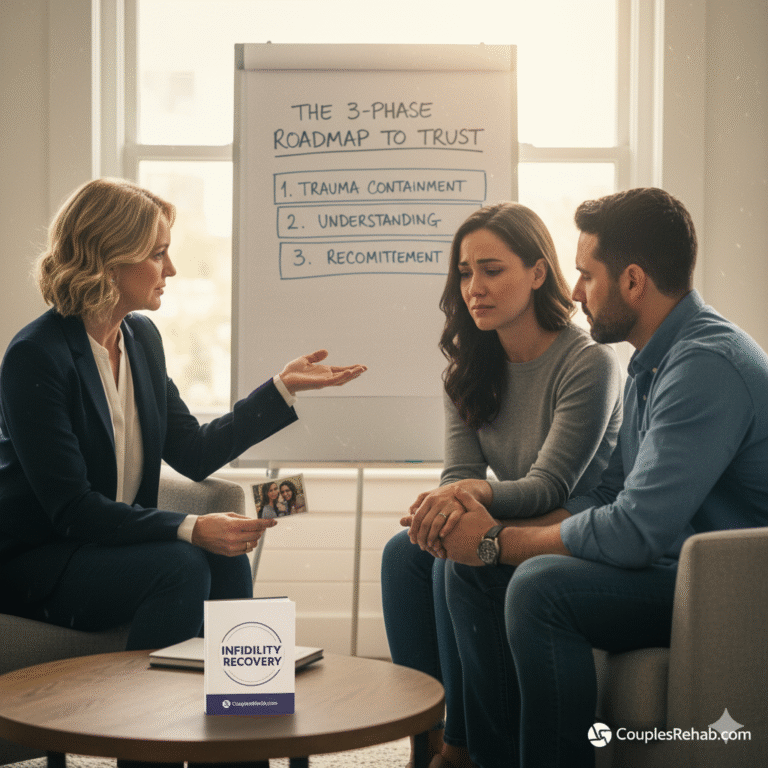
Infidelity Recovery Couples Therapy Program: The 3-Phase Roadmap to Rebuilding Trust After Cheating

The Crucible of Betrayal: Why an Infidelity Recovery Program is Non-Negotiable

When the foundation of trust collapses due to infidelity, the initial landscape is one of chaos. As a professional who has navigated thousands of couples through this precise crisis for decades, I can attest to a simple, often-overlooked truth: affair recovery is not standard marriage counseling. It is a specialized form of trauma intervention.

The sheer volume of high-intent searches—terms like couples therapy program for rebuilding trust after cheating or the urgent need for a 3-day marriage intensive after infidelity—underscores a critical point: couples need an immediate, structured, and expert-led intervention. They are searching for an infidelity recovery couples therapy program not just to save their marriage, but to survive the psychological and emotional detonation that betrayal unleashes.

I have seen firsthand that without a clearly defined, evidence-based program, couples tend to get stuck in a destructive cycle of agonizing questions, defensive posturing, and emotional flooding. The injured partner, often grappling with symptoms akin to Post-Traumatic Stress Disorder (known as Post-Infidelity Stress Disorder or PISD), becomes consumed by rumination after infidelity. Meanwhile, the unfaithful partner, overwhelmed by shame and defensiveness, fails to provide the necessary framework for safety and accountability. This is why a tailored, professional program is the singular path forward.


E-E-A-T in Crisis: The Essential Difference of Specialized Affair Recovery

My work, and the mission of CouplesRehab.com, is built on the four pillars that Google identifies as essential for helpful content: Experience, Expertise, Authoritativeness, and Trustworthiness (E-E-A-T). When dealing with a crisis as profound as betrayal, these elements translate to results.

H3: Expertise: From Reactive Crisis to Proactive Reconciliation

The expertise required in this field goes beyond general licensure. It involves mastery of trauma-informed care and attachment theory. For instance, the Emotionally Focused Therapy (EFT) for affair recovery model, which is highly effective, focuses on uncovering the attachment injuries—the primal, deep wounds—created by the affair. Similarly, a strong Gottman Method infidelity recovery program provides the essential communication tools to manage inevitable conflict and build new, healthy connection rituals.

We understand that you are not just a couple with a problem; you are two individuals who have experienced a relational earthquake. Our role is to provide the evidence-based infidelity recovery program that transitions you from a reactive crisis state to a proactive healing partnership.

Experience: Navigating the Most Complex Scenarios

No two affairs are identical. Our experience covers the full spectrum: from the devastating impact of an emotional affair that never became physical, to the complexity of a long-term or multiple affairs that challenge the very narrative of the marriage.

Users looking for an intensive infidelity recovery program for couples often recognize that their crisis requires more than a weekly, one-hour check-in. Our structured approach, whether through a weekend marriage counseling for cheating intensive or a more drawn-out format, is designed to break the crisis cycle quickly, ensuring that both partners feel heard, safe, and directed toward a tangible goal.


The 3-Phase Structured Roadmap to Affair Recovery

Success in healing from infidelity depends on adherence to a predictable, methodical structure. We break the overwhelming process down into three distinct, non-negotiable phases. Skipping a step is the most common reason for stalled recovery.

Phase 1: Trauma Containment and Crisis Stabilization (Safety First)

This phase is about stopping the bleeding and establishing absolute safety. The goal is to move the betrayed partner out of the constant state of PISD and to hold the unfaithful partner fully accountable.

  • The Non-Negotiable Boundary: Immediate, verifiable, and complete cessation of all contact with the affair partner. This is a baseline requirement for any effective infidelity recovery couples therapy program. As a legal expert with experience in high-stakes divorces, I would advise any client that attempts to retain contact—even “strictly business”—are an automatic violation of trust and will derail the process.
  • Creating Emotional Safety: We teach the unfaithful partner to become a safe haven for the injured partner’s pain, moving away from defensiveness and toward genuine, non-defensive remorse. We work intensively with the affair recovery program for the betrayed spouse to manage their physiological trauma response, helping them contain the intrusive thoughts and flashbacks.
  • Full Disclosure & Accountability: This is a delicate process, often managed by the therapist to prevent re-traumatization. It is not an interrogation. It is a carefully guided session where the unfaithful partner offers a disclosure of the facts—who, what, when—without excessive, gratuitous sexual detail that can compound the trauma. This step is key for infidelity recovery for unfaithful partner accountability.

Phase 2: Understanding and Insight (Processing the Why)

Once the crisis is contained and safety is stabilized, the couple can move toward understanding the vulnerabilities that allowed the affair to take root. Crucially, understanding is not the same as excusing.

  • Deconstructing the Vulnerabilities: We explore the individual and relational factors present before the affair. This might involve deep dives into the relationship history to identify decades of unmet needs, communication deficits, or emotional distance. This work is essential for anyone seeking counseling for healing from multiple affairs, as it targets the root cause, not just the symptom.
  • The Betrayer’s Deep Work: The unfaithful partner must explore their own internal narrative, entitlement, and emotional regulation failures that led them to violate the marriage contract. This is an individual journey, often requiring parallel individual therapy, to achieve the level of profound personal insight needed to prevent recurrence.
  • Processing the Grief and Betrayal: We facilitate structured conversations where the betrayed partner can fully express their pain, grief, and anger in a safe, contained environment, moving toward the possibility of processing betrayal and forgiveness—a choice, not a mandate. We utilize methods from the Gottman Method infidelity recovery program to ensure structured, non-blaming dialogue.

Phase 3: Vision and Recommitment (Building a New Marriage)

The goal is not to go back to the way things were, but to build a new marriage—one that is “affair-proof” and characterized by radical transparency and deeper intimacy.

  • Radical Transparency and New Boundaries: The couple establishes a clear path forward, which often includes a period of complete, un-asked-for transparency from the unfaithful partner regarding their time, location, and digital activity. We guide the creation of new boundaries to ensure the affair never happens again.
  • Rebuilding Intimacy: We address the monumental task of restoring physical and emotional closeness, often guided by couples therapy program for sexual intimacy after an affair. This is a slow, gentle process focused on creating emotional safety before physical connection can be re-established.
  • Aftercare Planning: The work of recovery requires a lifelong commitment. We implement a rigorous Aftercare Plan that outlines maintenance tools, check-in schedules, and relapse prevention strategies, ensuring long-term resilience. Learn more about maintaining this commitment long after the program ends on our Aftercare page: https://couplesrehab.com/services/aftercare/.

Specialized Formats: Intensive vs. Virtual Programs

Users often ask: Should we choose a weekly session, an intensive, or an online format? The format is a matter of crisis severity, resources, and logistics.

The Accelerated Path: Intensive Infidelity Recovery Program

For couples in acute crisis, who need to move out of the danger zone immediately, an intensive retreat format is often the most effective.

  • 3-day marriage intensive after infidelity: This format provides 15-20 hours of focused, expert therapy in a condensed timeframe, allowing for rapid containment of the crisis and initiation of Phase 2 work. This is highly effective for couples struggling with marriage counseling after infidelity and separation, as it forces a focused time of reconnection and decision-making.
  • Couples retreat for healing from an affair: This provides an emotionally safe, neutral environment away from the triggers of home, facilitating deeper emotional work.

Accessibility and Consistency: Virtual Affair Recovery Program

For couples who require flexibility or an affordable infidelity couples counseling program, high-quality virtual sessions are now a proven alternative.

  • Best online infidelity recovery program for couples: The key is to ensure the virtual affair recovery program with therapist includes a blend of online infidelity program with individual and joint sessions, maintaining the necessary dual-modality approach for comprehensive healing.

The Role of E-E-A-T in Program Selection and External Resources

Choosing the right help is paramount. When searching for an affair recovery specialists for couples, always verify their credentials and their specific training in trauma and infidelity. Do they use structured, tested models like EFT or the Gottman Method?

Cost of Counseling and Financial Support

We recognize the high cost of specialized care. While a full program may involve a significant investment, couples should explore all options:

  • Insurance Coverage: Inquire if your policy covers the diagnosis of “Adjustment Disorder” or “Relationship Distress,” which may make services provided by a licensed marriage and family therapist (LMFT) infidelity specialist eligible for reimbursement.
  • Federal Resources for Mental Health: For those who have served, the Department of Veterans Affairs (VA) offers specialized couple and family counseling. Veterans can check the VA Mental Health Services or local Vet Centers for potential coverage of relationship issues that intersect with service-related trauma. Resources like the SAMHSA National Helpline (1-800-662-HELP) can provide referrals to more affordable local resources.

Taking the Next Step: From Research to Recovery

The most common error I observe in this field is waiting too long. Betrayal is a high-velocity wound; time is of the essence. If you have recognized the urgent need for a structured infidelity recovery couples therapy program—whether a Christian infidelity recovery couples program, an intensive, or a virtual option—your next step is simple.

  • Do your research: Look for an evidence-based infidelity recovery program with transparent methodology.
  • Ask for credentials: Verify that your therapist is an affair recovery expert with specific training.
  • Make the call: The journey of a thousand miles begins with a single consultation. We are here to help you move from crisis to reconciliation. You can reach out to us today to schedule your free consultation: https://couplesrehab.com/contact/.

You are not alone, and your marriage is not necessarily over. You are simply standing at the most challenging intersection of your relationship, and with expert guidance, you can navigate this crisis to build a stronger, more intimate, and more resilient union.


Frequently Asked Questions (FAQ) for the Infidelity Recovery Couples Therapy Program

This section is optimized for schema markup, search engine questions, and deep user task completion, providing comprehensive, expert answers to the top 20 most searched questions.

I. Core Decision & Hope

Can our marriage actually survive infidelity? (What is the realistic chance of recovery?)

Expert Answer: Yes, your marriage can survive infidelity, and for many, it emerges stronger. While statistics vary, studies show that a significant percentage of couples (often cited as between 50% and 70%) who commit to specialized couples therapy after infidelity remain together. The most realistic predictor of success is not the fact of the affair, but the absolute and consistent commitment of both partners to the program, particularly the unfaithful partner’s willingness to provide unconditional accountability and remorse.

How long does it take to heal from an affair? (What is the typical recovery timeline?)

Expert Answer: Healing from infidelity is a complex journey, not a fixed timeline. The average, effective recovery process takes 18 to 24 months of dedicated work. The first 3 to 6 months are dedicated to Crisis Stabilization (Phase 1). The next 6 to 12 months focus on Understanding and Insight (Phase 2), and the final 6+ months focus on Vision and Recommitment (Phase 3). Any program promising instant recovery is misrepresenting the profound nature of this trauma.

How do we know if our relationship is worth saving? (When should we decide to leave instead of reconcile?)

Expert Answer: The decision to stay is deeply personal, but its viability can be assessed through key indicators. The relationship is likely worth saving if: 1) The unfaithful partner expresses authentic, remorseful accountability without excuses. 2) Both partners can articulate a clear, shared vision for a new marriage that is better than the old one. Conversely, it is often time to separate if the unfaithful partner is defensive, unwilling to grant radical transparency, or if the betrayed partner’s trauma response is so severe that it continually outweighs any potential for reconnection.

Is recovery possible if the affair was long-term or involved multiple instances? (Addressing severity)

Expert Answer: Recovery is absolutely possible, but the severity and duration increase the complexity and the healing time required. A long-term or multiple affairs scenario usually requires intensive, specialized individual therapy for the unfaithful partner to address underlying issues like addiction or personality disorders, in parallel with the couples work. The key is to treat the pattern, not just the single event.

II. Program Logistics & Cost

How much does an infidelity recovery couples therapy program cost? (Addressing pricing expectations)

Expert Answer: The cost of couples counseling after an affair varies widely based on the format and expertise. Standard weekly sessions with an expert often range from $150 to $350 per session. Intensive weekend retreats typically cost between $2,500 and $6,000 for 15-20 hours of focused work. While the initial investment is high, view it as a critical investment in emotional health and family stability, often costing far less than a drawn-out, acrimonious divorce.

Do you offer intensive weekend retreats, or only weekly sessions? (Addressing format and duration)

Expert Answer: We offer both. We strongly recommend an intensive infidelity recovery program for couples (such as our 3-day marriage intensive after infidelity) for couples in acute crisis. This format quickly arrests the cycle of conflict and establishes safety. For maintenance and deeper insight, we transition couples to a consistent schedule of weekly sessions, or offer a dedicated virtual affair recovery program with therapist for those who require geographical flexibility.

Is my partner required to cut off all contact with the affair partner immediately? (Addressing the non-negotiable step)

Expert Answer: Yes, immediately and completely. This is the first, non-negotiable term of engagement in our infidelity recovery couples therapy program. Healing cannot begin while the wound is still being created. This includes blocking all phone numbers, social media, email, and—if they are a co-worker—implementing an explicit, agreed-upon, and transparent plan for contact limited strictly to verifiable business-only communication.

H3: Will my insurance cover the cost of infidelity counseling? (Addressing financial feasibility)

Expert Answer: Most traditional health insurance plans do not directly cover “couples counseling” or “infidelity recovery.” However, coverage is often available if one partner receives a covered diagnosis (e.g., Adjustment Disorder, Major Depressive Disorder, or PTSD/PISD) and the couples work is deemed “medically necessary” to treat that individual’s condition. We recommend consulting with your insurance provider directly. You can also explore low-cost resources via the SAMHSA National Helpline.

Will we be forced to forgive the cheating partner? (Addressing control and pressure)

Expert Answer: Absolutely not. Forgiveness is a profound, deeply personal, and entirely voluntary process. Our program does not require forgiveness; it focuses on helping the betrayed partner move toward acceptance and healing, which allows them to define their own path forward, regardless of whether that path includes a full pardon. The unfaithful partner’s only job is to provide safety, accountability, and remorse—and to respect the betrayed partner’s timeline.

Do we need individual therapy in addition to couples therapy? (Addressing dual-modality)

Expert Answer: For infidelity recovery, dual-modality is highly recommended, and often essential. Couples therapy focuses on the relational system and rebuilding trust. Individual therapy addresses the trauma symptoms of the betrayed spouse (affair recovery program for the betrayed spouse) and the underlying personal vulnerabilities, accountability, and shame of the unfaithful partner. These two tracks are separate but mutually reinforcing.

III. The Process & Emotions

What are the typical phases or stages of infidelity recovery? (Providing a structured roadmap)

Expert Answer: Our work follows a structured 3-phase roadmap to affair recovery:

  1. Trauma Containment and Crisis Stabilization: Establishing immediate safety, no-contact rule, and basic emotional regulation.
  2. Understanding and Insight: Processing the “why” by exploring relationship vulnerabilities and the unfaithful partner’s internal drivers.
  3. Vision and Recommitment: Building a “new” affair-proof marriage based on radical transparency, intentionality, and a deeper emotional connection.

Will the unfaithful partner have to disclose all the explicit details of the affair? (Addressing disclosure boundaries)

Expert Answer: No. Full disclosure is necessary for healing, but explicit sexual details are generally avoided as they can re-traumatize the injured partner and lead to perpetual rumination. We focus on the necessary facts (who, what, where, when, how long) and, more importantly, the emotional and relational factors. The therapist will guide a controlled, single-session disclosure to ensure all of the betrayed partner’s factual questions are answered without causing undue emotional harm.

How is infidelity recovery different from standard couples counseling? (Highlighting specialization)

Expert Answer: Infidelity recovery is a trauma-informed, specialized intervention, whereas standard couples counseling addresses conflict and communication deficits. Infidelity recovery must first treat the PTSD-like symptoms of betrayal trauma (PISD) and establish absolute, immediate safety. This specialization requires therapists trained in trauma models and structured affair recovery protocols, not just general relationship dynamics.

How do you help the betrayed partner cope with the trauma, intrusive thoughts, and flashbacks? (Addressing the acute pain)

Expert Answer: We use trauma-informed techniques to help the betrayed partner move away from rumination after infidelity. This includes: psychoeducation on PISD, teaching grounding and containment skills to manage intrusive thoughts, and guiding the unfaithful partner to act as a soothing presence to co-regulate the trauma response, thereby reducing emotional isolation. Individual therapy is highly recommended for deeper trauma processing.

What is the role of the unfaithful partner in rebuilding trust and demonstrating remorse? (Addressing accountability)

Expert Answer: The unfaithful partner accountability is to be the primary agent of healing. Their role is to: 1) Demonstrate immediate, verifiable transparency (granting access to digital devices, providing their schedule). 2) Express authentic, non-defensive remorse (apologizing without using the word “but”). 3) Patiently answer questions and tolerate the betrayed partner’s pain without retreating into shame or anger.

Will we learn how to communicate without immediately fighting or escalating the conflict? (Addressing communication breakdown)

Expert Answer: Yes. A core component of Phase 1 and 2 is teaching specific communication structures. We utilize the Gottman Method techniques to teach “softened start-ups” for the betrayed partner and “accepting influence” for the unfaithful partner. You will learn to express pain without criticizing, and to listen without becoming defensive, which are fundamental to processing the trauma and moving forward.

IV. Safety and Future

How do we ensure that the affair will never happen again? (Addressing the fear of recurrence)

Expert Answer: The best insurance against future infidelity is not a promise, but a fundamental change in the relationship structure and the individual’s core values. This is achieved through: 1) The unfaithful partner’s proven deep work in individual therapy. 2) The establishment of non-negotiable, verifiable boundaries and radical transparency. 3) The creation of a new, emotionally intimate marriage that proactively meets the legitimate needs that were previously ignored.

What are the qualifications of your therapists for affair recovery? (Establishing credibility and expertise)

Expert Answer: Our therapists are licensed marriage and family therapist (LMFT) infidelity specialists who possess advanced certifications in recognized, evidence-based models. These credentials include extensive training in Emotionally Focused Therapy (EFT) for affair recovery, the Gottman Method, and trauma-informed care (like EMDR for the betrayed partner’s individual trauma). When searching for an affair recovery expert, always verify their specialization beyond general couples work.

What counts as infidelity or “cheating” in our program? (Defining boundaries for emotional vs. physical affairs)

Expert Answer: We define infidelity as any secretive intimate activity (emotional, physical, or virtual) that violates the explicit or implicit monogamy contract of the relationship. This includes physical sexual contact, as well as secret emotional intimacy (counseling for surviving an emotional affair), or online flirtations. A key step in our program is helping the couple jointly define their new, explicit boundaries for the future.

Can we still heal if one of us is still feeling ambivalent about staying? (Addressing uncertainty and ambivalence)

Expert Answer: Yes, a state of ambivalence is common and understandable. We work with couples in this stage using a structured approach called “Discernment Counseling.” This is a short-term model designed to help the ambivalent partner gain clarity and confidence in their decision—to stay and commit fully, or to separate. It is crucial to address the ambivalence head-on to prevent a stalled, painful, and ultimately ineffective attempt at reconciliation.

Loving Someone with Addiction

Rachel stared at her phone, debating whether to call her boyfriend Jake again. He’d been missing for two days, and she knew exactly where he was—lost in another bender that would end with promises he couldn’t keep. As she scrolled through their text history filled with “I love you” and “I’m sorry,” one question haunted her: Was her love enough to save him?

If you’re loving someone with addiction, you’ve probably asked yourself this same heart-wrenching question. The truth is both simpler and more complex than you might expect. While love is absolutely essential in the journey of addiction recovery, it’s rarely sufficient on its own. Understanding this reality doesn’t diminish your love—it actually empowers you to love more effectively.

The Reality of Loving Someone with Addiction

Loving someone with addiction feels like riding an emotional roller coaster with no safety harness. One day, you’re planning a future together, and the next, you’re wondering if the person you fell in love with still exists beneath the haze of substance abuse. This isn’t just difficult—it’s one of the most challenging experiences a person can face.

Addiction doesn’t just affect the person using substances; it impacts everyone in their orbit, especially romantic partners. When addiction in relationships takes hold, it creates a complex web of love, fear, hope, and desperation that can leave you feeling completely lost.

What makes loving someone with addiction so particularly painful is the glimpses of hope. There are moments when your partner seems like their old self—present, loving, and committed to change. These moments can feel like proof that your love is working, that you’re the key to their recovery. However, these same moments can also trap you in a cycle of false hope and disappointment.

The reality is that addiction is a chronic brain disease that changes how a person thinks, feels, and behaves. Your love doesn’t cure this disease any more than love cures diabetes or cancer. This doesn’t mean love isn’t important—it’s crucial—but it needs to be paired with professional treatment, healthy boundaries, and often, fundamental changes in how you approach the relationship.

Many partners of addicted individuals struggle with guilt, wondering if they’re not loving hard enough or if there’s something more they could do. Here’s what I want you to understand: you cannot love someone into sobriety. Addiction recovery requires professional intervention, personal commitment from the addicted individual, and often a complete restructuring of lifestyle and relationships.

Understanding Codependent Relationships in Addiction

When you’re supporting an addicted partner, there’s a fine line between love and codependency. A codependent relationship develops when one person (often the non-addicted partner) becomes so focused on helping their addicted loved one that they lose sight of their own needs, boundaries, and well-being.

Codependency in addiction relationships often starts with genuine love and concern. You want to help your partner, so you begin covering for them, making excuses, or trying to control their behavior to prevent them from using. While these actions come from a place of love, they can actually enable the addiction to continue by removing natural consequences.

In healthy relationships, both partners maintain their individual identities while supporting each other. However, signs of a codependent relationship with an addict include losing yourself in their recovery, feeling responsible for their sobriety, and believing that if you just love them enough, they’ll get better.

The challenge with codependent relationships is that they can feel like love—intense, passionate, and all-consuming. However, true love in the context of addiction recovery often requires tough choices, including setting boundaries that might temporarily cause your partner discomfort.

Warning Signs You’re in a Codependent Dynamic

Recognizing codependency isn’t always straightforward, especially when you’re in the middle of it. Here are some warning signs that your relationship may have crossed from supportive love into unhealthy codependency:

You’re constantly worried about your partner’s next move. Your day revolves around monitoring their behavior, checking for signs of use, or trying to prevent situations that might trigger them to drink or use drugs.

You make excuses for their behavior. You find yourself calling in sick for them, lying to family and friends about their condition, or covering up the consequences of their addiction.

Your self-worth depends on their sobriety. When they’re doing well, you feel good about yourself. When they relapse, you feel like a failure, questioning whether you’re loving them correctly.

You’ve isolated yourself from friends and family. The shame and exhaustion of dealing with addiction in relationships has caused you to withdraw from your support system.

You believe you can control their addiction. You think that if you just say the right thing, love them enough, or create the perfect environment, you can prevent them from using.

You’re neglecting your own needs and well-being. Your physical health, mental health, career, or other relationships are suffering because all your energy goes toward your addicted partner.

You feel guilty when you’re happy or do things for yourself. The idea of enjoying life while your partner struggles with addiction feels selfish or wrong.

Understanding that these patterns exist doesn’t mean you don’t love your partner—it means you love them in a way that might not be helping either of you heal.

How to Help Someone with Addiction in a Relationship

Supporting an addicted partner requires a delicate balance of love, boundaries, and realistic expectations. The good news is that there are healthy ways to show love while encouraging recovery and protecting your own well-being.

First, educate yourself about addiction. Understanding that addiction is a disease—not a moral failing or lack of willpower—can help you approach your partner with compassion while maintaining realistic expectations. The more you understand about how addiction affects the brain, the better equipped you’ll be to separate the person from the disease.

Second, focus on supporting recovery rather than preventing use. This means encouraging treatment, celebrating recovery milestones, and being present for the hard work of getting sober, rather than trying to control every situation that might lead to substance use.

When supporting partner through addiction treatment, remember that recovery is ultimately their responsibility, not yours. Your role is to be a loving presence in their life while maintaining your own health and boundaries.

Setting Healthy Boundaries While Still Showing Love

One of the most challenging aspects of loving someone with addiction is learning to set boundaries that feel loving rather than punitive. Healthy boundaries aren’t about punishment—they’re about creating an environment where recovery can flourish while protecting your own well-being.

Effective boundaries might include refusing to give money that could be used for substances, not covering up the consequences of their addiction, or requiring professional treatment as a condition of continuing the relationship. These boundaries can feel harsh when you’re setting them, but they often become the foundation for genuine relationship recovery from addiction together.

It’s important to communicate boundaries clearly and calmly, explaining that they come from love rather than anger. For example, instead of saying, “I can’t stand your drinking anymore,” you might say, “I love you, and because I want us both to be healthy, I can’t be around you when you’re drinking.”

Remember that setting boundaries often gets worse before it gets better. Your partner might test these boundaries, become angry, or even threaten to leave. This is normal and doesn’t mean your boundaries are wrong—it means they’re working.

When Professional Help Becomes Necessary

There comes a point in most relationships affected by addiction when love alone isn’t enough, and professional intervention becomes necessary. Recognizing when you’ve reached this point can be one of the most loving things you do for both yourself and your partner.

Professional help becomes essential when addiction is causing serious consequences in multiple areas of life—health, relationships, work, or legal issues. If your partner has tried to quit on their own multiple times without success, this is also a clear sign that professional intervention is needed.

When love isn’t enough for addiction recovery, it’s not a failure of your relationship—it’s an acknowledgment that addiction is a complex disease requiring specialized treatment. Just as you wouldn’t expect love alone to treat cancer, addiction often requires medical intervention, therapy, and structured support.

Couples addiction treatment can be particularly effective because it addresses both the addiction and the relationship dynamics that may be contributing to the problem. These programs help both partners develop healthy communication skills, rebuild trust, and create a foundation for long-term recovery.

The Journey of Relationship Recovery from Addiction Together

Recovery isn’t just about the addicted partner getting sober—it’s about both people in the relationship healing and growing. Relationship recovery from addiction together involves addressing the trauma, broken trust, and unhealthy patterns that addiction created while building new, healthier ways of relating to each other.

This journey often includes couples therapy, where both partners can safely express their feelings, learn new communication skills, and work through the pain that addiction caused. It also involves individual therapy for both partners, as each person needs to heal their own wounds and develop their own coping strategies.

Love addiction—the compulsive need to be in a relationship or to fix someone through love—can affect both partners in different ways. The non-addicted partner might develop an addiction to being needed, while the addicted partner might become addicted to the rescue dynamic. Healthy recovery addresses these patterns for both people.

The good news is that many couples not only survive addiction but actually develop stronger, more authentic relationships in recovery. The process of facing addiction together, when done with professional support, can deepen intimacy and create unshakeable bonds.

Taking Care of Yourself While Supporting Your Partner

One of the biggest mistakes partners of addicted individuals make is believing that supporting their loved one means sacrificing their own well-being. In reality, taking care of yourself isn’t selfish—it’s essential for both your health and your ability to be genuinely supportive.

Self-care while loving someone with addiction includes maintaining your own friendships, pursuing your own interests, and prioritizing your physical and mental health. This might mean going to therapy yourself, joining a support group like Al-Anon, or simply making sure you’re eating well and getting enough sleep.

It’s also important to maintain your own identity outside the relationship. Addiction has a way of making everything about the crisis at hand, but you need to remember who you are as an individual, not just as someone’s partner.

Financial boundaries are also crucial. Protecting your financial security isn’t just about money—it’s about maintaining your ability to take care of yourself and not enabling continued substance use.

Remember that you can’t pour from an empty cup. The better you take care of yourself, the more emotional resources you’ll have available for supporting your partner’s recovery in healthy ways.

When Love Isn’t Enough: Making Difficult Decisions

Perhaps the hardest truth about loving someone with addiction is that sometimes, despite your best efforts and deepest love, the relationship isn’t salvageable. This doesn’t mean you didn’t love hard enough—it means that addiction won the battle, at least for now.

When love isn’t enough for addiction recovery, you might need to make the devastating decision to step away from the relationship. This might be temporary, giving your partner space to hit their own bottom and seek help, or it might be permanent if the relationship has become unsafe or destructive.

Signs that it might be time to consider leaving include physical or emotional abuse, complete refusal to seek treatment, or when staying in the relationship is seriously damaging your mental health, physical safety, or other important relationships.

Making this decision doesn’t mean you don’t love your partner—it means you love yourself enough to protect your own well-being. Sometimes, the most loving thing you can do is to stop enabling the addiction by removing yourself from the dynamic.

If you do decide to leave, remember that this doesn’t close the door forever. Many people need to lose important relationships before they’re motivated to get serious about recovery. Your leaving might be the catalyst your partner needs to seek help.

The decision to stay or go is deeply personal and depends on many factors, including safety, children, and your own mental health. Whatever you decide, make sure it’s a decision you can live with, not one based on guilt or false hope.

Frequently Asked Questions

Q: Can I force my partner into rehab? A: In most cases, you cannot legally force an adult into treatment unless they pose an immediate danger to themselves or others. However, you can set boundaries that make treatment a condition of continuing the relationship. Some states have involuntary commitment laws for severe cases, but these require legal proceedings.

Q: Should I give my addicted partner money? A: Generally, no. Giving money to someone with active addiction often enables their substance use, even if they promise it’s for necessities. Instead, offer to pay bills directly or buy groceries yourself.

Q: How do I know if my partner is serious about recovery? A: Look for actions, not just words. Serious recovery involves seeking professional help, attending treatment regularly, being honest about struggles, and making lifestyle changes that support sobriety.

Q: Is it normal to feel angry at my addicted partner? A: Absolutely. Anger is a natural response to the chaos and pain addiction causes. These feelings don’t mean you don’t love your partner—they mean you’re human. Consider therapy to help process these emotions healthily.

Q: Will my partner hate me if I set boundaries? A: Your partner might initially be angry or upset about boundaries, but healthy boundaries actually strengthen relationships in the long run. If someone truly loves you, they’ll eventually understand that boundaries come from love.

Q: How long should I wait for my partner to get sober? A: There’s no universal timeline. Some factors to consider include your partner’s willingness to seek help, whether progress is being made, and the impact on your own well-being. Professional counseling can help you navigate this decision.

Q: Can couples therapy work if my partner is still using? A: Couples therapy is most effective when both partners are sober and committed to change. However, some therapists will work with couples where one partner is still using, focusing on education and boundary-setting.

Q: What’s the difference between enabling and supporting? A: Supporting involves encouraging healthy behaviors and recovery efforts. Enabling involves protecting someone from the natural consequences of their addiction, which actually allows the addiction to continue.

Q: Should I tell family and friends about my partner’s addiction? A: You need support, so sharing with trusted people is important for your well-being. However, be mindful of your partner’s privacy and choose confidants who can offer genuine support rather than judgment.

Q: Is it possible for our relationship to be stronger after addiction? A: Yes, many couples report having stronger, more honest relationships in recovery. The process of overcoming addiction together can deepen intimacy and trust, though it requires commitment and professional support from both partners.

Conclusion

Loving someone with addiction is one of life’s greatest challenges, requiring courage, wisdom, and often professional guidance. While your love is precious and important, it’s essential to understand that addiction is a complex disease that typically requires more than love alone to overcome.

The journey of supporting an addicted partner while maintaining your own well-being isn’t easy, but it is possible. By setting healthy boundaries, seeking professional help, and taking care of yourself, you can love your partner in ways that actually support their recovery rather than enable their addiction.

Remember that choosing to love someone with addiction doesn’t mean accepting destructive behavior or sacrificing your own happiness. True love sometimes requires making difficult decisions, including seeking professional help or, in some cases, stepping away from the relationship for your own safety and well-being.

If you and your partner are ready to face addiction together and build a healthier relationship, Couples Rehab in Huntington Beach, California, is here to help. Our specialized programs address both addiction and relationship dynamics, providing the tools and support you need for lasting recovery. Our experienced team understands the unique challenges couples face when addiction affects their relationship, and we’re committed to helping you heal together.

Don’t wait for the perfect moment or hope that love alone will solve everything. Take the first step toward healing by reaching out to Couples Rehab today. Your relationship—and your future—are worth fighting for with the right professional support. Contact us to learn more about our couples-focused addiction treatment programs and how we can help you navigate this challenging journey together.

Setting Boundaries With Your Partner in Recovery

If you’re reading this at 2 AM, googling “am I being mean to my partner in recovery,” let me start with this: setting boundaries with your partner in recovery isn’t cruel—it’s essential. You’re not giving up on them, abandoning them, or being unsupportive. You’re creating the framework that allows both of you to heal and your relationship to truly thrive.

I know it feels wrong. Everything inside you screams that love should be unconditional, that supporting someone means saying yes to everything, that boundaries are just walls disguised as protection. But here’s what I’ve learned from working with countless couples: love without boundaries isn’t love at all—it’s often just fear wearing a compassionate mask.

The journey of relationships and healing together requires both partners to understand that healthy limits aren’t barriers to connection—they’re the very foundation that makes authentic intimacy possible.

Understanding Healthy Boundaries in Recovery

Before we dive into the how-to’s, let’s get clear on what healthy boundaries in recovery actually are. Think of boundaries as the guardrails on a mountain road—they don’t stop you from moving forward, they keep you from driving off a cliff.

Types of Boundaries: Physical, Emotional, and Financial

Physical Boundaries protect your body, your space, and your sense of safety. In recovery, this might mean:

    • No substances in your home

    • Not being around your partner when they’re intoxicated

    • Maintaining your own bedroom if trust is still rebuilding

    • Having designated spaces that are yours alone

Emotional Boundaries protect your mental health and emotional well-being:

    • Not accepting verbal abuse, even during “recovery stress”

    • Limiting conversations about past trauma until you’re both ready

    • Refusing to be your partner’s sole emotional support system

    • Maintaining your own friendships and interests

Financial Boundaries protect your economic security:

    • Separate bank accounts during early recovery

    • Requiring transparency about all spending

    • Not providing money without accountability

    • Protecting shared assets from impulsive decisions

The Role of Self-Care in Boundary Setting

Here’s where many partners struggle: they believe that setting boundaries means they’re being selfish. The truth is exactly the opposite. When you neglect your own needs, you become resentful, exhausted, and ultimately unable to provide genuine support.

Self-care isn’t selfish—it’s strategic. You can’t pour from an empty cup, and you can’t support someone else’s recovery if you’re drowning in your own unmet needs.

The Difference Between Boundaries and Control

This is crucial to understand: boundaries for couples focus on what you will and won’t do, not on controlling your partner’s behavior. Let me give you some examples:

Boundary: “I will not stay in the house if you bring alcohol home.” Control: “You are not allowed to drink.”

Boundary: “I will not discuss our relationship problems after 10 PM.” Control: “You can’t talk about anything emotional after 10 PM.”

Boundary: “I will not lend you money without seeing a written plan for how it will be used.” Control: “You’re not allowed to have any money.”

See the difference? Boundaries define your actions and limits. Control attempts to dictate someone else’s choices.

Common Boundary Mistakes in Recovery

Many well-meaning partners make these mistakes:

    • Setting boundaries as punishment rather than protection

    • Creating rules they have no intention of enforcing

    • Using boundaries to manipulate or change their partner

    • Setting boundaries without clear consequences

    • Expecting immediate compliance without discussion

How to Set Boundaries With Partner in Addiction Recovery

Now let’s get practical. Here’s a step-by-step approach to setting boundaries that actually work:

Step 1: Creating a Boundary Action Plan

Start by identifying what’s not working. Ask yourself:

    • What behaviors make me feel unsafe, disrespected, or exhausted?

    • What am I currently tolerating that I shouldn’t be?

    • What would need to change for me to feel secure in this relationship?

Write these down. Be specific. “I don’t like it when you’re mean” isn’t specific enough. “I will not accept being called names, having my character attacked, or being blamed for your recovery struggles” is much clearer.

Step 2: Determine Realistic Consequences

Every boundary needs a consequence—something you will do if the boundary is crossed. These consequences should be:

    • Something you can actually follow through on

    • Proportionate to the boundary violation

    • Focused on protecting yourself, not punishing your partner

Examples:

    • “If you come home intoxicated, I will stay at my sister’s house for the night.”

    • “If you yell at me, I will end the conversation and we can revisit it when you’re calm.”

    • “If money goes missing from our account, I will require you to meet with our financial counselor before discussing it.”

Step 3: Daily Boundary Practices for Couples

Healthy boundaries aren’t just rules you set once—they’re daily practices:

Morning Check-ins: Start each day by briefly discussing plans, concerns, and needs.

Evening Boundaries: Establish what topics are and aren’t appropriate for late-night discussions.

Communication Pauses: Either partner can call for a 30-minute break during difficult conversations.

Personal Time Protection: Each partner gets uninterrupted time for their own activities and friendships.

What Boundaries to Set With Recovering Addict Partner

Every situation is unique, but here are some boundaries that many couples find essential:

Sobriety-Related Boundaries

    • No substances in the home or car

    • Attendance at recovery meetings or therapy as agreed upon

    • Honest communication about cravings or struggles

    • Immediate disclosure of any relapses

    • No contact with people who enable substance use

Communication Boundaries

    • Respectful tone even during disagreements

    • No discussions about major decisions during times of stress

    • Taking breaks when conversations become heated

    • Using “I” statements instead of blame language

    • No bringing up past mistakes during current arguments

Financial Boundaries

    • Transparency about all spending over an agreed amount

    • Joint decision-making for major purchases

    • No secret accounts or hidden financial obligations

    • Regular financial check-ins

    • Emergency fund protection

Technology and Social Media Boundaries

This often gets overlooked, but it’s crucial:

    • Shared access to devices and social media during trust rebuilding

    • No contact with former using partners or dealers

    • No dating apps or inappropriate online relationships

    • Agreed-upon rules about sharing relationship information online

Setting Boundaries Without Enabling Your Partner

This is perhaps the most challenging aspect of boundary setting in recovery. The line between support and enabling can feel impossibly thin.

Supporting Your Partner While Maintaining Limits

Enabling looks like:

    • Making excuses for their behavior

    • Protecting them from consequences

    • Doing things they should do for themselves

    • Providing resources without accountability

Healthy support looks like:

    • Encouraging their recovery efforts

    • Celebrating their progress

    • Maintaining your own boundaries consistently

    • Offering emotional support without taking responsibility for their emotions

Recognizing Boundary Violations

Sometimes boundary violations are obvious—they come home drunk after promising sobriety. But often they’re subtle:

    • Guilt-tripping you for maintaining boundaries

    • Testing limits to see what they can get away with

    • Using their recovery as an excuse for problematic behavior

    • Making promises they don’t intend to keep

Trust your gut. If something feels off, it probably is.

Communicating Boundaries in Relationships Effectively

How you communicate boundaries is almost as important as the boundaries themselves.

Scripts for Difficult Conversations

Setting a new boundary: “I need to talk with you about something that’s important to our relationship. I’ve realized I need to set a boundary around [specific behavior]. Going forward, I will [your action] if [specific behavior] happens. This isn’t about punishing you—it’s about protecting our relationship and my well-being.”

Enforcing a boundary: “We discussed that [specific boundary], and it’s been crossed. As I mentioned, I will now [consequence]. This doesn’t mean I don’t love you, but I need to follow through on what we agreed to.”

When they resist: “I understand this feels difficult. These boundaries aren’t about controlling you—they’re about what I need to feel safe and secure in our relationship. I’m open to discussing how we can work together within these limits.”

Handling Resistance to Boundaries

Expect pushback. It’s normal and doesn’t mean you should give up. Common forms of resistance include:

    • “You don’t trust me”

    • “I’m in recovery, isn’t that enough?”

    • “You’re being controlling”

    • “If you really loved me, you wouldn’t need these rules”

Remember: their resistance doesn’t invalidate your need for boundaries. Stay firm while remaining compassionate.

Healthy Boundaries for Couples in Recovery

Recovery affects both partners, even if only one struggled with addiction. Here are boundaries that support mutual healing:

Boundaries During Different Recovery Phases

Early Recovery (0-6 months):

    • Daily check-ins about recovery progress

    • Limited social events where substances are present

    • Clear consequences for any substance use

Middle Recovery (6-18 months):

    • Increased independence with maintained accountability

    • Gradual expansion of social activities

    • Regular relationship assessments

    • Continued individual and couples therapy

Long-term Recovery (18+ months):

    • Evolved boundaries based on demonstrated trust

    • Focus on growth rather than just maintaining sobriety

    • Preparation for handling future challenges

    • Maintenance of recovery community connections

Building Mutual Respect Through Boundaries

Healthy boundaries create mutual respect because they:

    • Demonstrate self-respect, which encourages respect from others

    • Create predictability and safety in the relationship

    • Reduce conflicts by establishing clear expectations

    • Allow both partners to be authentic without fear

Codependency and Boundaries: Breaking Unhealthy Patterns

Codependency and boundaries are inversely related—the more codependent a relationship, the weaker the boundaries, and vice versa.

Recognizing Codependent Patterns

Ask yourself:

    • Do I feel responsible for my partner’s emotions and recovery?

    • Do I sacrifice my needs to avoid conflict?

    • Do I feel like I can’t survive without this relationship?

    • Do I feel guilty when I prioritize my own needs?

If you answered yes to these questions, codependency may be complicating your boundary-setting efforts.

Breaking Free from Codependent Patterns

Breaking codependency while setting boundaries requires:

    • Individual therapy to understand your own patterns

    • Gradual practice setting small boundaries

    • Building a support network outside your relationship

    • Learning to tolerate your partner’s discomfort with boundaries

    • Developing your own interests and identity

Boundaries in Relationship After Addiction Treatment

Completing treatment doesn’t mean boundaries become unnecessary—they evolve.

Post-Treatment Boundary Evolution

After treatment, boundaries might shift from:

    • Crisis management to growth-focused

    • Rigid rules to flexible guidelines

    • External accountability to internal motivation

    • Survival mode to thriving mode

Long-term Boundary Maintenance

Successful long-term recovery requires ongoing boundary maintenance:

    • Regular relationship check-ins

    • Adapting boundaries as circumstances change

    • Continued individual growth for both partners

    • Professional support when needed

When Boundaries Are Crossed: Consequences and Responses

Even the best-intentioned partners will occasionally cross boundaries. How you respond determines whether boundaries remain effective.

Emergency Protocols When Boundaries Fail

For serious boundary violations (substance use, violence, major deception):

    • Have a safety plan ready

    • Know who to call for support

    • Have a place to stay if needed

    • Document incidents

    • Involve professional help immediately

Recovery Accountability vs. Boundary Enforcement

There’s a difference between supporting recovery accountability and enforcing personal boundaries:

    • Recovery accountability focuses on their sobriety and growth

    • Boundary enforcement focuses on protecting your well-being

Both are important, but don’t confuse them.

Professional Help for Boundary Setting

Sometimes boundary setting requires professional guidance, especially when:

    • You’ve tried setting boundaries but can’t maintain them

    • Your partner becomes aggressive when boundaries are set

    • You’re unsure what boundaries are appropriate

    • Codependency patterns are deeply entrenched

    • Past trauma affects your ability to set limits

Professional support might include:

    • Individual therapy for both partners

    • Couples therapy specializing in addiction recovery

    • Support groups for families of addicts

    • Recovery coaching

    • Family therapy if children are involved

Frequently Asked Questions

1. How do I set boundaries without feeling guilty?

Guilt is normal when you first start setting boundaries, especially if you’ve been in a codependent relationship. Remember that guilt doesn’t mean you’re doing something wrong—it often means you’re doing something different. Start with small boundaries and practice self-compassion as you learn.

2. What if my partner threatens to leave or relapse if I set boundaries?

This is emotional manipulation, even if your partner doesn’t realize it. Boundaries aren’t negotiations—they’re statements about what you need to feel safe and respected. If someone threatens to harm themselves or relapse because you set healthy limits, that’s actually evidence that boundaries are desperately needed.

3. Should I set boundaries even if my partner is doing well in recovery?

Yes. Boundaries aren’t punishment for bad behavior—they’re the foundation of healthy relationships. Even partners who are thriving in recovery benefit from clear expectations and mutual respect.

4. How do I know if my boundaries are too strict or too lenient?

Pay attention to your feelings and the relationship dynamics. If you feel constantly anxious or resentful, your boundaries might be too lenient. If your partner seems to be walking on eggshells or the relationship feels rigid, they might be too strict. Professional guidance can help you find the right balance.

5. Can I change boundaries once they’re set?

Absolutely. Boundaries should evolve as your relationship and circumstances change. The key is communicating changes clearly and not changing them impulsively during conflicts.

6. What if my partner’s family doesn’t support the boundaries I’ve set?

Your boundaries are about your relationship and your well-being. While it’s helpful to have family support, you don’t need anyone’s permission to protect yourself. You may need to set boundaries with family members who undermine your efforts.

7. How do I maintain boundaries during holidays or special events?

Plan ahead. Discuss potential challenges and agree on how you’ll handle them. Have an exit strategy if events become triggering or boundary-crossing. Remember that protecting your recovery and relationship is more important than avoiding family disappointment.

8. Is it normal for boundary-setting to cause temporary relationship tension?

Yes, especially in the beginning. Change is uncomfortable, even positive change. Most couples experience some tension as they adjust to new relationship dynamics. This usually decreases as boundaries become routine.

9. What if I realize I need to set a boundary about something we never discussed before?

New situations arise, and it’s perfectly normal to need new boundaries. Approach your partner with curiosity rather than accusation: “I’ve realized I need to talk about [situation] and establish some guidelines that will help me feel comfortable.”

10. How do I set boundaries around my partner’s recovery friends who I don’t trust?

You can’t control who your partner spends time with, but you can control your own involvement. You might say: “I support your recovery friendships, but I’m not comfortable socializing with [person] or having them in our home. I’d appreciate if you meet with them elsewhere.”

Creating a Foundation for Lasting Love

Setting boundaries with your partner in recovery isn’t about creating distance—it’s about creating the safety and respect that allows true intimacy to flourish. The couples who thrive in recovery are those who learn that love isn’t about having no limits; it’s about respecting each other’s limits so completely that they become invisible.

Remember that boundaries are a gift you give both to yourself and to your relationship. When you respect yourself enough to maintain healthy limits, you teach your partner how to respect you too. When you refuse to enable destructive behavior, you create space for healthy behavior to grow.

This isn’t easy work. There will be days when maintaining boundaries feels harder than giving in. There will be moments when you question whether you’re being too rigid or not supportive enough. That’s normal. Healing happens in the tension between holding on and letting go, between supporting and protecting, between love and limits.

Ready to Create Healthier Boundaries in Your Recovery Journey?

At Couples Rehab in Huntington Beach, California, we understand that addiction doesn’t just affect individuals—it reshapes entire relationships. That’s why we’ve developed specialized programs that help couples learn how to set boundaries with partner in addiction recovery while maintaining the love and connection that brought them together.

Our evidence-based approach recognizes that healthy boundaries in recovery are essential for both partners. We help couples understand the difference between supporting recovery and enabling addiction, between love and codependency, between healthy limits and controlling behavior.

You don’t have to navigate this complex journey alone. Our experienced team specializes in helping couples develop communicating boundaries in relationships skills that actually work. We provide the guidance, tools, and support necessary to create addiction recovery boundaries that protect both partners while fostering genuine healing.

Take the First Step Toward Healthier Boundaries Today

Whether you’re struggling with codependency and boundaries, need help learning what boundaries to set with recovering addict partner, or want to improve your boundaries in relationship after addiction treatment, we’re here to help.

Don’t let another day pass walking on eggshells or feeling resentful about the lack of limits in your relationship. Healthy boundaries for couples in recovery aren’t just possible—they’re essential for lasting love and successful sobriety.

Contact Couples Rehab today to learn more about our comprehensive boundary-setting programs. Let us help you discover that love with limits isn’t less love—it’s love that lasts.

Rebuilding Trust in Recovery as a Couple

Trust isn’t just broken—it’s shattered into a thousand pieces, each fragment reflecting a lie, a broken promise, or a moment when addiction took priority over your relationship. If you’re reading this in the quiet hours of the night, wondering if your love can survive the wreckage addiction has left behind, know this: rebuilding trust in recovery as a couple isn’t just possible—it’s one of the most profound journeys of healing you’ll ever undertake.

The path isn’t easy. There will be days when you question everything, moments when progress feels impossible, and times when you’ll wonder if it’s worth the pain. But here’s what I’ve learned from working with countless couples: those who commit to the process of relationships and healing together often discover a love deeper and more authentic than they ever imagined possible.

This comprehensive guide will walk you through every aspect of rebuilding trust in recovery, from understanding why trust matters so deeply to creating new foundations that can withstand life’s storms.

The Foundation of Trust: Why It Matters in Recovery

Trust is the invisible thread that binds two hearts together. When addiction enters the picture, that thread doesn’t just fray—it’s often severed completely. Understanding why trust is so crucial in recovery helps both partners appreciate the magnitude of what you’re rebuilding.

Understanding Trust vs. Blind Faith

Many couples confuse trust with blind faith, but they’re fundamentally different. Blind faith asks you to ignore red flags and hope for the best. Trust, on the other hand, is built on evidence—consistent actions, transparent communication, and demonstrated reliability over time.

In recovery, you’re not asking your partner to have blind faith. You’re asking them to give you the opportunity to earn trust through your actions, one day at a time.

The Neuroscience of Trust in Recovery

Here’s something that might surprise you: addiction literally changes the brain’s ability to trust and be trusted. The addicted brain becomes wired to prioritize the substance above all else, including the people we love most. Meanwhile, the partner’s brain often becomes hypervigilant, constantly scanning for signs of deception or relapse.

Trust building activities couples engage in during recovery actually help rewire these neural pathways. Each positive interaction, each kept promise, each moment of vulnerability creates new neural connections that support healthier relationship patterns.

Can a Marriage Survive Addiction and Rebuild Trust?

This is perhaps the most agonizing question couples in recovery face. The answer isn’t simple, but it’s hopeful: yes, marriage after addiction recovery is not only possible but can result in relationships stronger than ever before.

Research consistently shows that couples who work together in recovery have better outcomes than those who focus solely on individual healing. However, success requires specific conditions that we’ll explore throughout this guide.

The Reality Check

Let’s be honest about what you’re facing. Trust rebuilding in couples recovery typically requires:


    • Both partners committed to healing (not just the addicted partner)

    • Professional guidance through specialized couples therapy trust building

    • Patience for a process that unfolds over years, not months

    • Willingness to be vulnerable in ways that may feel terrifying

    • Acceptance that your relationship will be different—hopefully better—than before

How Long Does It Take to Rebuild Trust After Addiction?

The question that keeps couples awake at night: how long will this take? While every relationship is unique, research and clinical experience provide some realistic timelines.

Individual vs. Couple Recovery Timelines

Months 1-3: Crisis Stabilization During early recovery, the focus is on sobriety and safety. Trust building is limited to basic consistency—showing up when promised, being where you say you’ll be, and demonstrating commitment to recovery.

Months 4-9: Foundation Building This is when real trust work begins. Couples start learning new communication patterns, establishing transparency practices, and beginning to address the emotional damage addiction has caused.

Months 10-18: Trust Testing The middle phase often involves setbacks and tests. How couples handle conflicts, relapses, or difficult emotions during this period largely determines long-term success.

Years 2-3: Deepening Connection If couples successfully navigate the first 18 months, this phase often brings deeper intimacy and connection than existed before addiction entered the picture.

Beyond Year 3: Ongoing Maintenance Trust becomes more natural, but couples who thrive continue practicing the skills they’ve learned and remain vigilant about relationship health.

Steps to Rebuild Trust in Marriage After Drug Addiction

Rebuilding relationships after addiction requires a systematic approach. Here are the essential steps that successful couples follow:

Step 1: Creating Safety in Vulnerability

Before you can rebuild trust, both partners must feel emotionally and physically safe. This means:


    • The addicted partner maintains consistent sobriety

    • Both partners commit to non-violent communication

    • Boundaries are established and respected

    • Professional support is in place

Step 2: Radical Honesty and Transparency

Trust exercises for couples often begin with what therapists call “radical honesty.” This isn’t just about telling the truth—it’s about sharing the complete truth, including:


    • The full extent of addiction-related behaviors

    • Current thoughts, feelings, and struggles

    • Daily activities and whereabouts

    • Financial information and spending

This level of transparency can feel overwhelming, but it’s essential for rebuilding trust.

Step 3: Making Amends Beyond Apologies

Saying “I’m sorry” is just the beginning. True amends involve:


    • Taking full responsibility without excuses

    • Understanding the impact of your actions on your partner

    • Making concrete changes to prevent similar harm

    • Being patient with your partner’s healing process

Step 4: Establishing New Patterns

Addiction creates destructive relationship patterns that must be consciously replaced. This involves:


    • Learning healthy communication skills

    • Developing new ways to handle conflict

    • Creating positive shared experiences

    • Building intimacy that doesn’t depend on substances

Trust Exercises for Couples in Recovery

Trust building exercises for couples in recovery go beyond generic relationship advice. They’re specifically designed to address the unique challenges addiction creates in relationships.

Daily Trust-Building Habits

Morning Check-Ins Start each day with a brief conversation about plans, feelings, and any concerns. This creates predictability and transparency.

Evening Reflections End each day by sharing one thing you appreciated about your partner and one area where you could improve as a couple.

Weekly Trust Meetings Set aside 30 minutes weekly to discuss how trust-building is progressing, address any concerns, and celebrate progress.

Communication Breakthrough Techniques

The 24-Hour Rule When conflicts arise, either partner can call for a 24-hour pause to cool down and think before responding. This prevents the destructive patterns that often emerged during active addiction.

Active Listening Practice One partner speaks for five minutes while the other listens without interrupting, then the listener reflects back what they heard before responding.

Emotion Naming Before discussing problems, each partner names their current emotional state. This builds emotional intelligence and prevents reactivity.

Trust Building Activities Couples Can Do at Home

While professional therapy is crucial, couples can also engage in trust building activities couples practice at home:

Building Emotional Intimacy Again

Gratitude Letters Once a week, write a letter to your partner expressing gratitude for specific actions or qualities. Read these aloud to each other.

Vulnerability Exercises Take turns sharing something you’ve never told your partner before. Start small and build up to more significant revelations.

Future Visioning Together, create a vision board or written description of your ideal relationship in five years. This builds hope and shared goals.

Financial Trust and Transparency

Money issues often trigger trust problems in recovery. Address this by:


    • Sharing all account information

    • Making spending decisions together for amounts over an agreed limit

    • Creating a joint budget that includes recovery-related expenses

    • Regular financial check-ins to ensure transparency

Creating New Relationship Rituals

Daily Connection Rituals Establish small daily rituals that build connection—morning coffee together, evening walks, or bedtime conversations.

Weekly Date Nights Prioritize time together without discussing recovery, addiction, or relationship problems. Focus on rediscovering what you enjoy about each other.

Monthly Relationship Reviews Once a month, assess your relationship’s health, celebrate progress, and identify areas for improvement.

Couples Therapy for Rebuilding Trust After Addiction

While self-help strategies are valuable, couples therapy for rebuilding trust after addiction is often essential for lasting success. Professional guidance provides tools and insights that couples simply can’t access on their own.

Evidence-Based Approaches

Behavioral Couples Therapy (BCT) BCT focuses on changing behaviors that support both sobriety and relationship health. Couples learn to create “recovery contracts” and develop positive activities together.

Emotionally Focused Therapy (EFT) EFT helps couples understand the emotional patterns underlying their conflicts and develop more secure attachment bonds.

Gottman Method Based on decades of research, the Gottman Method teaches specific skills for building fondness, admiration, and trust.

What to Expect in Therapy

Trust building therapy typically involves:


    • Individual sessions to address personal issues

    • Joint sessions to practice new communication skills

    • Homework assignments to practice between sessions

    • Progress assessments and strategy adjustments

The therapeutic process isn’t always comfortable. You’ll likely face difficult emotions and challenging conversations. However, having a skilled professional guide you through these moments makes all the difference.

Marriage After Addiction Recovery: Setting New Foundations

Marriage after addiction recovery looks different than your relationship before addiction entered the picture. This isn’t necessarily bad—many couples report being happier and more connected than ever before.

Handling Setbacks and Relapses

Relapse affects approximately 40-60% of people in recovery, so couples need plans for handling setbacks. This includes:


    • Pre-established agreements about what happens if relapse occurs

    • Professional support activation protocols

    • Communication strategies for difficult conversations

    • Recommitment processes to get back on track

Successful couples treat relapse as a setback, not a catastrophe. They have systems in place to respond quickly and constructively.

Building New Intimacy

Physical and emotional intimacy often needs to be rebuilt from scratch. Many couples discover that addiction created pseudo-intimacy based on shared trauma rather than genuine connection.

Rebuilding intimacy involves:


    • Taking physical intimacy slowly and communicating openly

    • Sharing emotions without using substances to numb discomfort

    • Creating new positive experiences together

    • Learning to be vulnerable in healthy ways

Common Challenges in Rebuilding Relationships After Addiction

Every couple faces unique challenges, but some issues are nearly universal in trust rebuilding:

The “Trust Deficit”

Early in recovery, the non-addicted partner often needs to “spend” trust they don’t have. This creates stress for both partners—one feels constantly suspicious while the other feels perpetually judged.

Understanding that this imbalance is temporary helps couples weather this difficult phase.

Different Recovery Paces

Partners often recover at different speeds. The addicted partner may feel ready to move forward while their partner still struggles with past hurt. Alternatively, the non-addicted partner may want to “get back to normal” while their partner needs more time to build coping skills.

Patience and understanding are crucial during these mismatched phases.

External Pressures

Family, friends, and even professional contacts may have opinions about your relationship. Some may encourage separation while others may minimize the challenges you’re facing.

Building a united front and limiting input from those who don’t understand addiction recovery is often necessary.

When Professional Help is Essential

While many couples can make significant progress on their own, certain situations require professional intervention:

Red Flags That Require Professional Help


    • Any form of physical, emotional, or sexual abuse

    • Threats of self-harm or suicide

    • Complete refusal to engage in trust-building activities

    • Repeated relapses without genuine remorse or change efforts

    • Severe mental health issues affecting either partner

Measuring Trust Recovery Progress

How do you know if your trust rebuilding efforts are working? Look for these signs:


    • Decreased anxiety about your partner’s whereabouts

    • Increased willingness to share vulnerable emotions

    • Better conflict resolution skills

    • More spontaneous affection and appreciation

    • Improved intimacy and connection

    • Realistic hope for the future

Progress isn’t always linear, but the overall trajectory should be positive over time.

Frequently Asked Questions

1. How do I know if my partner is truly committed to rebuilding trust?

Look for consistent actions rather than just words. A committed partner will demonstrate transparency, attend therapy sessions, participate in recovery activities, and show patience with your healing process. They’ll also take responsibility for past actions without making excuses or becoming defensive.

2. What if I want to rebuild trust but my partner seems unwilling?

Trust rebuilding requires both partners’ commitment. If your partner is unwilling to engage in the process, consider individual therapy to explore your options. Sometimes, working on yourself first can inspire your partner to join the process later.

3. Is it normal to have good days and bad days during trust rebuilding?

Absolutely. Recovery and trust rebuilding aren’t linear processes. You’ll have breakthrough moments followed by setbacks. What matters is the overall trend over time, not daily fluctuations.

4. How do we handle finances when trust has been broken through addiction?

Start with complete financial transparency—shared accounts, spending reports, and joint decision-making for significant purchases. Consider having a neutral third party (like a financial counselor) help you create systems that rebuild financial trust.

5. What if my partner relapses during our trust rebuilding process?

Have a plan in place before relapse occurs. This might include immediate professional help, specific consequences, and a process for recommitting to recovery. Relapse doesn’t mean your relationship is doomed, but it does require immediate, serious attention.

6. Can trust be rebuilt if there was infidelity during addiction?

Yes, though it’s one of the more challenging situations. Infidelity during addiction involves rebuilding trust on multiple levels. Professional help is almost always necessary, and the process typically takes longer than trust rebuilding for addiction alone.

7. How do we explain our trust rebuilding process to our children?

Age-appropriate honesty is usually best. Young children need reassurance about stability and safety. Older children often benefit from understanding that parents are working hard to make their relationship stronger and healthier.

8. What if we can’t afford specialized couples therapy?

Many communities offer sliding-scale therapy options. Support groups like Recovering Couples Anonymous are free. Some insurance plans cover addiction-related couples therapy. Start with available resources and build from there.

9. How do we maintain trust once we’ve rebuilt it?

Trust maintenance requires ongoing effort. Continue practicing communication skills, maintain transparency, attend regular check-ins or therapy sessions, and stay committed to both individual and relationship growth.

10. Is it possible to have a better relationship after addiction than we had before?

Many couples report exactly this. The skills learned in recovery—honest communication, vulnerability, conflict resolution, and mutual support—often create deeper intimacy than existed before addiction. However, this requires significant work from both partners.

Building a Future Worth Fighting For

Rebuilding trust in recovery as a couple isn’t just about getting back to where you were—it’s about creating something new, something stronger, something worth all the pain you’ve endured. The journey requires courage, patience, and an unwavering commitment to growth from both partners.

Remember that every kept promise, every honest conversation, and every moment of vulnerability is building something beautiful. You’re not just rebuilding trust—you’re rebuilding yourselves and your relationship from the ground up.

The road ahead isn’t easy, but it’s absolutely possible. Thousands of couples have walked this path before you and emerged not just intact, but thriving. With commitment, professional guidance, and time, you can too.

Ready to Begin Your Trust Rebuilding Journey?

At Couples Rehab in Huntington Beach, California, we understand that addiction doesn’t just affect individuals—it devastates relationships. That’s why we’ve developed specialized programs designed specifically for couples who want to heal together.

Our evidence-based approach combines individual therapy, couples counseling, and trust-building exercises for couples in recovery. We know that couples therapy for rebuilding trust after addiction requires unique expertise, and our team has the experience to guide you through every step of this challenging but rewarding process.

Don’t let addiction define your relationship’s future. We’ve helped countless couples not just survive addiction’s impact, but build relationships stronger than ever before. Our comprehensive programs address both the individual healing needed for sustainable recovery and the relationship skills necessary for lasting trust.

Take the First Step Today

Your relationship doesn’t have to be another casualty of addiction. With professional guidance, evidence-based treatment, and commitment from both partners, rebuilding trust in recovery as a couple is not just possible—it’s probable.

Contact Couples Rehab today to learn more about our specialized trust rebuilding programs. Let us help you transform your relationship from one marked by addiction’s destruction to one defined by recovery’s strength.

Understanding Codependency and Addiction in Couples

As someone who has spent over two decades counseling couples through life’s most challenging seasons, I’ve witnessed firsthand how the twin forces of codependency and addiction can create destructive patterns that leave relationships hanging by a thread. These intertwined issues represent some of the most complex dynamics that couples face, often silently eroding the foundation of otherwise loving relationships.

In my practice, I’ve sat across from countless couples where one partner’s substance abuse is matched only by the other’s desperate attempts to control, fix, or shield them from consequences. What began as care and concern slowly transforms into something that inadvertently fuels the very problem they’re trying to solve.

What Is Codependency and How Does It Relate to Addiction in Couples?

Codependency is a learned behavioral pattern where one person becomes excessively emotionally or psychologically reliant on another, often prioritizing their partner’s needs above their own to an unhealthy degree. Though the term originated in the context of alcoholism treatment in the 1950s, our understanding has evolved to recognize codependency as a distinct relationship dynamic that can exist with various forms of addiction.

In couples affected by addiction, codependency manifests as a particular kind of relationship imbalance. The codependent partner often assumes a caretaking role that goes beyond normal support, becoming enmeshed in managing their partner’s addiction and its consequences. Their sense of purpose, identity, and self-worth becomes deeply tied to their ability to “help” or “save” their addicted partner.

Dr. Melody Beattie, a pioneer in codependency research, describes it as “a person who has let another person’s behavior affect him or her, and who is obsessed with controlling that person’s behavior.” This definition captures the essence of what happens in these relationships—the codependent partner’s emotional state becomes contingent on the addicted partner’s behavior and recovery.

The Historical Context of Codependency

The concept of codependency first emerged from observations of spouses of alcoholics in the mid-20th century. Mental health professionals noticed patterns of behavior in these individuals that seemed to inadvertently enable their partners’ drinking. The term “co-alcoholic” was initially used before evolving into “codependent” as understanding broadened to include relationships involving other substances and behavioral addictions.

Today, while codependency isn’t classified as a mental health disorder in the DSM-5 (Diagnostic and Statistical Manual of Mental Disorders), it’s widely recognized by clinicians as a significant relationship pattern that requires therapeutic intervention.

Signs of Codependency in Relationships Affected by Addiction

Identifying codependency can be challenging because many behaviors begin as normal expressions of love and support. However, several key indicators suggest the relationship has crossed into codependent territory:

1. Enabling Behaviors

The clearest sign of codependency in an addiction context is enabling—actions that inadvertently support the addiction by shielding the addicted partner from consequences. These may include:

  • Making excuses for the addicted partner’s behavior to family, friends, or employers
  • Calling in sick to work on their behalf
  • Providing money that may be used for drugs or alcohol
  • Cleaning up messes (literal or figurative) caused by the addiction
  • Lying to others about the severity of the problem

Sarah, a client in her late 40s, once confessed to me, “I realized I had withdrawn nearly $30,000 from our retirement account over three years to cover his gambling debts. Each time I told myself it was the last time, that I was just preventing our family from falling apart.”

2. Caretaking to the Point of Self-Neglect

Codependent partners often:

  • Abandon their own needs, interests, and self-care
  • Spend excessive time worrying about and attempting to manage their partner’s addiction
  • Neglect their own health, career, or relationships with others
  • Define their self-worth through their ability to care for their partner

3. Boundary Issues

Healthy boundaries are nearly impossible to maintain in codependent relationships. Common boundary problems include:

  • Difficulty saying “no” to requests
  • Tolerating inappropriate, harmful, or abusive behavior
  • Feeling responsible for their partner’s emotions and actions
  • Struggling to identify where their responsibilities end and their partner’s begin

4. Control Patterns

A paradoxical aspect of codependency is the simultaneous feeling of being out of control while attempting to control everything:

  • Constantly monitoring the addicted partner’s behavior
  • Searching for evidence of substance use
  • Trying to manage their partner’s recovery process
  • Attempting to control access to money, transportation, or social activities

5. Emotional Dependence

Codependent partners often experience:

  • Extreme mood fluctuations based on their partner’s sobriety or relapse
  • Feelings of anxiety when unable to check on their partner
  • A sense of purpose derived primarily from being needed
  • Fear of abandonment or being alone

6. Denial and Minimization

Just as addiction involves denial, codependency often features:

  • Downplaying the severity of their partner’s addiction
  • Ignoring their own emotional pain
  • Rationalizing problematic behavior
  • Believing things will improve without significant intervention

How Codependency Enables and Worsens Addiction

The relationship between codependency and addiction creates a self-perpetuating cycle where each condition reinforces the other. Understanding this cycle is crucial for breaking it.

The Reinforcement Cycle

When a codependent partner repeatedly shields their addicted loved one from experiencing the natural consequences of their behavior, they inadvertently remove important motivators for change. For instance, if a partner consistently makes excuses to an employer about absences caused by hangovers, the addicted individual never faces the employment consequences that might otherwise prompt them to reconsider their drinking habits.

This pattern creates what therapists call “secondary gain” for the person with addiction—the benefits they receive (beyond the chemical effects of the substance) that reinforce their continued use. These gains might include:

  • Avoidance of responsibility
  • Being cared for by their partner
  • Not having to face difficult emotions or situations
  • Maintaining access to the substance without significant barriers

The Erosion of Natural Deterrents

Every addiction typically comes with natural deterrents—the negative consequences that would normally discourage the behavior. These might include:

  • Financial problems
  • Health consequences
  • Legal issues
  • Relationship conflict
  • Professional setbacks

When a codependent partner continuously buffers these consequences, they remove the friction that might otherwise create motivation for change. As one recovering client put it, “I didn’t hit rock bottom for years because my wife kept building me a comfortable cushion every time I fell.”

Learned Helplessness

Over time, this dynamic fosters learned helplessness in the addicted partner. They begin to believe—often unconsciously—that they cannot manage their own problems, make decisions, or face challenges without their partner’s intervention. This undermines their sense of agency and self-efficacy, which are essential components for recovery.

Effects of Addiction on a Codependent Relationship

While codependency enables addiction, addiction simultaneously exacerbates codependent tendencies, creating a destructive feedback loop with widespread effects on the relationship.

Trust Erosion

Addiction often involves dishonesty—about use, money spent, whereabouts, or intentions. This systematic breakdown of honesty creates deep wounds in the relationship:

  • The codependent partner becomes hypervigilant, constantly looking for signs of use
  • The addicted partner may hide or lie even when unnecessary due to established patterns
  • Both partners begin to doubt their own perceptions of reality (a phenomenon often called gaslighting)

Communication Breakdown

Healthy communication becomes nearly impossible when addiction and codependency dominate a relationship:

  • Conversations revolve predominantly around the addiction or avoiding discussion of it
  • Emotional honesty becomes sacrificed to maintaining peace
  • Underlying issues remain unaddressed as the addiction becomes the sole focus
  • Resentments build without proper resolution

Financial Strain

The economic impact of addiction and codependency can be devastating:

  • Direct costs of sustaining the addiction (substances, gambling losses, etc.)
  • Indirect costs such as missed work, legal fees, or medical expenses
  • Poor financial decisions made under the influence
  • Resources depleted by the codependent partner’s attempts to “fix” various problems

Isolation

Couples struggling with these dynamics often become increasingly isolated:

  • Withdrawal from family and friends who express concern
  • Reduced social engagement to hide the addiction
  • Shame and embarrassment leading to self-imposed isolation
  • Creation of a closed system where unhealthy dynamics go unchallenged

Physical and Mental Health Consequences

Both partners typically experience significant health impacts:

  • For the addicted partner: The direct health effects of substance abuse or behavioral addiction
  • For the codependent partner: Stress-related conditions, anxiety, depression, and neglected self-care
  • For both: Sleep disturbances, compromised immune function, and chronic stress

Breaking the Cycle of Codependency and Addiction

Breaking the Cycle of Codependency and Addiction

Breaking free from the intertwined patterns of addiction and codependency requires coordinated effort addressing both issues simultaneously. Neither can be fully resolved in isolation.

Recognition and Acceptance

The first step toward healing is recognition—acknowledging the true nature and extent of both the addiction and the codependent behaviors. This often involves:

  • Moving beyond denial about the severity of the situation
  • Accepting that both partners need help, not just the one with addiction
  • Understanding that quick fixes or promises alone won’t create lasting change
  • Recognizing that the relationship has developed unhealthy patterns beyond the addiction itself

Establishing Healthy Boundaries

For the codependent partner, establishing clear, consistent boundaries is fundamental to recovery:

  • Identifying what behaviors they will and won’t tolerate
  • Communicating these boundaries clearly and calmly
  • Following through with pre-determined consequences when boundaries are violated
  • Distinguishing between helping and enabling

As one recovering codependent shared in a group session, “Learning to say ‘I love you, but I won’t bail you out of jail again’ was the hardest and most important sentence I ever spoke.”

Separate Recovery Journeys

While couples must ultimately work together to heal their relationship, each partner needs their own recovery path:

  • The addicted partner needs specialized addiction treatment addressing their specific substance or behavioral addiction
  • The codependent partner needs support focused on rebuilding identity, establishing boundaries, and developing healthier relational patterns
  • Both need to address any underlying trauma, mental health conditions, or childhood experiences that contributed to these patterns

Rebuilding Identity Beyond the Dynamic

For lasting recovery, both partners need to develop or rediscover their individual identities:

  • The codependent partner must find purpose and worth outside of caretaking
  • The addicted partner needs to establish identity beyond their addiction
  • Both need to reconnect with personal interests, goals, and relationships that exist independently of each other

Treatment Options for Codependency and Addiction in Couples

Effective treatment typically involves multiple approaches tailored to the couple’s specific situation.

Individual Therapy

Each partner benefits from one-on-one therapy:

  • For the addicted partner: Addressing addiction triggers, developing coping mechanisms, and treating co-occurring mental health conditions
  • For the codependent partner: Processing enabling behaviors, establishing healthy boundaries, and building self-worth independent of their caretaking role

Couples Therapy

Specialized couples counseling can address relationship dynamics:

  • Behavioral Couples Therapy (BCT) has strong research support for addiction contexts
  • Emotionally Focused Therapy (EFT) helps rebuild secure attachment
  • The Gottman Method can restore trust and healthy communication patterns

Support Groups

Peer support provides validation and practical strategies:

  • 12-step programs like Alcoholics Anonymous or Narcotics Anonymous for the addicted partner
  • Al-Anon, Nar-Anon, or CoDA (Codependents Anonymous) for the codependent partner
  • Couples groups where both can learn from others facing similar challenges

Family Therapy

Since these dynamics often affect the entire family system:

  • Family therapy helps heal relationships with children and extended family
  • Educates family members about both codependency and addiction
  • Establishes healthier family communication patterns

Supporting a Partner with Addiction While Avoiding Codependency

For those who recognize codependent tendencies in themselves while supporting a partner with addiction, finding the balance between genuine support and enabling can be challenging.

Educate Yourself

Knowledge is power in breaking codependent patterns:

  • Learn about the specific addiction your partner faces
  • Understand the difference between helping and enabling
  • Study the science of addiction as a brain disease to reduce judgment and blame
  • Recognize codependent behaviors in yourself

Prioritize Self-Care

Self-care isn’t selfish—it’s essential:

  • Maintain regular health practices (sleep, nutrition, exercise)
  • Cultivate interests and relationships independent of your partner
  • Attend to your own emotional and mental health needs
  • Set aside time for activities that bring you joy and fulfillment

Seek Support

Don’t try to manage this alone:

  • Join support groups specifically for loved ones of addicted individuals
  • Consider individual therapy with a specialist in codependency
  • Build connections with others who understand your situation
  • Be open with trusted friends and family about your struggles

Practice Detachment with Love

Detachment doesn’t mean abandonment or apathy:

  • Love the person while acknowledging you can’t control their addiction
  • Allow them to experience natural consequences of their actions
  • Focus on managing your responses rather than their behavior
  • Recognize when you’re taking responsibility for their choices

As Melody Beattie writes, “Detachment is based on the premises that each person is responsible for themselves, that we can’t solve problems that aren’t ours to solve, and that worrying doesn’t help.”

Establishing Healthy Boundaries in Relationships Affected by Addiction

Boundaries represent the frontline in addressing codependency and supporting recovery from addiction.

Types of Boundaries Needed

Several categories of boundaries typically need attention:

  • Physical boundaries: Personal space, touch, sexual intimacy, and safety
  • Emotional boundaries: Separating your feelings from your partner’s, not taking responsibility for their emotions
  • Financial boundaries: Protecting resources, not funding the addiction
  • Behavioral boundaries: What actions you will and won’t tolerate in your presence

Communicating Boundaries Effectively

How boundaries are communicated significantly impacts their effectiveness:

  • Use clear, simple language without accusation
  • Focus on “I” statements rather than “you” statements
  • Clearly outline consequences for boundary violations
  • Remain consistent in enforcement

For example, instead of saying “You always get drunk and embarrass me,” a healthier boundary statement might be: “I feel uncomfortable in situations involving heavy drinking. If you choose to drink excessively at this event, I will take my own car so I can leave if needed.”

Common Boundary Challenges

Several obstacles often arise when establishing boundaries:

  • Guilt and fear when enforcing consequences
  • Manipulation tactics from the addicted partner
  • Inconsistent boundary enforcement sending mixed messages
  • Confusion between punishment and natural consequences

Progressive Boundary Setting

Boundaries often need to evolve with the situation:

  • Begin with smaller, manageable boundaries before tackling major issues
  • Adjust boundaries as recovery progresses or relapses occur
  • Recognize when temporary separation might be necessary for safety or recovery
  • Allow boundaries to eventually relax as health is restored to the relationship

Is Codependency Considered a Mental Health Disorder?

Codependency occupies an interesting position in mental health classification. While not officially recognized as a distinct disorder in the DSM-5, mental health professionals widely acknowledge its significance.

Current Clinical Understanding

The current professional perspective on codependency:

  • Not classified as a specific mental health disorder
  • Often considered a relational pattern or personality style
  • Frequently occurs alongside recognized conditions like depression, anxiety, or dependent personality disorder
  • May qualify for treatment under “Other Specified Relational Problem” in clinical settings

Why Classification Matters

The lack of official diagnostic status has implications:

  • Insurance coverage for treatment specifically targeting codependency may be limited
  • Research funding for codependency-specific interventions is less robust
  • Some critics argue that pathologizing caregiving behaviors can be problematic
  • Others advocate for official recognition to validate the experiences of those affected

The Spectrum Perspective

Many therapists view codependency on a spectrum rather than as a binary condition:

  • Mild codependent tendencies may appear in many relationships
  • Moderate codependency manifests when these tendencies begin causing distress
  • Severe codependency significantly impairs functioning and well-being
  • The level of intervention needed corresponds to the severity of the pattern

Long-Term Outcomes for Couples Dealing with Codependency and Addiction

Without appropriate intervention, couples trapped in codependent-addictive relationships face challenging prospects. However, with proper treatment, significant positive transformation is possible.

Untreated Outcomes

When these intertwined issues remain unaddressed:

  • Progressive worsening of both the addiction and codependent behaviors
  • Increasing relationship dysfunction and dissatisfaction
  • Higher risk of physical and mental health problems for both partners
  • Greater likelihood of financial problems and instability
  • Potential for the relationship to become emotionally or physically abusive
  • Transmission of unhealthy relationship patterns to children

Treated Outcomes

With comprehensive treatment addressing both issues:

  • Many couples achieve healthier, more balanced relationships
  • The addicted partner can maintain long-term recovery
  • The codependent partner develops stronger sense of self and boundaries
  • Communication patterns improve significantly
  • Both individuals report greater life satisfaction and well-being
  • New, healthier relationship skills can be modeled for children

Factors Affecting Outcomes

Several variables influence the prognosis for these couples:

  • Timing of intervention (earlier treatment generally yields better outcomes)
  • Commitment of both partners to their individual recovery processes
  • Access to appropriate, specialized treatment resources
  • Presence of co-occurring mental health conditions
  • Level of external support from family and community
  • Willingness to make significant lifestyle changes

Recovery as a Lifelong Process

For most couples, recovery from these entrenched patterns is not a one-time event:

  • Both addiction recovery and codependency recovery typically require ongoing attention
  • Relapse can occur in either the addiction or the codependent behaviors
  • Success often involves periodic “tune-ups” with counseling or support groups
  • Vigilance about slipping back into old patterns, especially during stressful periods

Building a New Relationship Foundation After Codependency and Addiction

Recovery offers the opportunity to essentially rebuild the relationship from the ground up, replacing dysfunctional patterns with healthier alternatives.

Restoring Trust

Trust—often severely damaged by addiction—requires intentional rebuilding:

  • Consistent honesty about small matters builds credibility for larger issues
  • Transparency about whereabouts, activities, and finances may be necessary initially
  • Recognition that trust returns gradually, not immediately upon promises of change
  • Acknowledgment of hurt caused without defensive responses

Developing Healthy Interdependence

The goal isn’t complete independence but balanced interdependence:

  • Mutual support without rescuing or controlling
  • Shared goals alongside individual pursuits
  • Emotional intimacy while maintaining appropriate boundaries
  • Vulnerability without manipulation

Creating New Rituals and Patterns

Recovery necessitates replacing addiction-centered routines:

  • Developing new traditions and activities that don’t involve substances
  • Finding shared interests that support recovery
  • Creating rituals that encourage connection and communication
  • Establishing patterns that reinforce each partner’s individual growth

Ongoing Growth and Learning

Couples who successfully navigate these challenges often discover:

  • A deeper, more authentic connection than before
  • Greater emotional intelligence and communication skills
  • Increased capacity for empathy and understanding
  • Resilience that transfers to other life challenges

Hope for Healing

Understanding codependency and addiction in couples reveals a complex but treatable relationship dynamic. While these intertwined issues create significant challenges, they aren’t insurmountable. With proper intervention, commitment to change, and patience through the recovery process, couples can not only survive these issues but emerge with stronger, healthier relationships.

If you recognize these patterns in your own relationship, remember that seeking help isn’t a sign of weakness but of courage and wisdom. The journey toward healing may be challenging, but countless couples have successfully navigated this path before you. Whether through Couples Rehab, professional counseling, support groups, or a combination of approaches, taking that first step toward addressing both the addiction and the codependent behaviors opens the door to profound transformation and renewal.

Resources for Help and Support

For those struggling with codependency and addiction in their relationship, numerous resources are available:

  • National Helplines: SAMHSA’s National Helpline (1-800-662-HELP) provides 24/7 information and treatment referrals
  • Support Groups: Al-Anon, Nar-Anon, and Codependents Anonymous (CoDA) have chapters nationwide
  • Treatment Directories: The Psychology Today Therapist Finder can help locate specialists in both addiction and codependency
  • Educational Resources: Books like “Codependent No More” by Melody Beattie and “The Language of Letting Go” offer valuable insights
  • Online Communities: Forums and virtual support groups provide connection for those unable to attend in-person meetings

Remember that reaching out for help is not an admission of failure but the first step toward reclaiming your relationship and yourself from these destructive patterns.

Healing Together How Addiction Transforms Relationships

Addiction doesn’t just affect one person—it creates a ripple effect that touches everyone in its path, especially romantic partners. The complex dance between substance use disorders and intimate relationships can lead to profound challenges, but also offers opportunities for extraordinary growth and healing when faced together.

Couples Rehab has been specializing in addiction and relationship dynamics for nearly two decades, the company has witnessed both the devastation addiction can cause and the remarkable resilience couples can demonstrate. This guide explores the intricate relationship between substance use disorders and intimate partnerships, offering research-backed approaches for couples committed to healing together.

The Relationship Under Siege: Understanding Addiction’s Impact

How Relationship Dynamics Shift

When addiction enters a relationship, a gradual transformation occurs. What begins as occasional substance use can evolve into dependency, bringing significant changes to how partners interact and function as a unit.

Renowned addiction specialist Dr. Robert Meyers describes addiction as “a relationship illness” because it fundamentally alters the connection between partners. The non-addicted partner typically begins adapting to the new reality in ways they may not even recognize:

  • Shouldering an uneven distribution of responsibilities
  • Creating narratives to explain away concerning behaviors
  • Developing strategies to manage or limit substance use
  • Concealing problems from friends, family, and colleagues
  • Developing complex feelings of compassion mixed with growing resentment

These adaptations, though often born from love and concern, can inadvertently create patterns of codependency that sustain the addiction. Recognizing these patterns is essential for breaking them.

Communication Deterioration

Healthy relationships thrive on open, honest communication—something addiction actively undermines. The communication breakdown typically manifests in several ways:

Truth Becomes Elusive: Deception around substance use, spending habits, or daily activities becomes increasingly common. This behavior often stems from shame or fear rather than malicious intent.

Emotional Connection Fades: Substances can dampen emotional responses or create unpredictable mood fluctuations, making meaningful emotional exchange difficult. One partner may feel they’re connecting with a constantly changing person.

Conversations Become Confrontations: Discussions about substance use frequently escalate into heated arguments characterized by defensiveness, accusations, and criticism.

Silence as Self-Protection: To avoid conflict, partners often stop addressing important issues altogether, creating a growing chasm of unspoken concerns.

Rebecca, who participated in our couples recovery program, described it this way: “Eventually, we stopped talking about anything that mattered. Our conversations were just logistics—who would pick up the kids, what bills needed paying. The real stuff—our feelings, our dreams, our fears—all that disappeared.”

The Trust Deficit

Perhaps nothing damages relationships more profoundly than broken trust. Addiction behaviors often violate fundamental relationship agreements through patterns of dishonesty, financial secrecy, unfulfilled commitments, and in some cases, infidelity or legal complications.

Research published in the Journal of Family Psychology indicates that trust rebuilding typically takes 12-24 months longer than establishing stable sobriety. This discrepancy in recovery timelines often leads to frustration when the recovering person expects forgiveness to come alongside their sobriety milestones.

Economic Instability

The financial consequences of addiction can devastate couples and families. Recent research from the American Society of Addiction Medicine estimates that substance use disorders can cost families between $10,000-$30,000 annually through:

  • Direct expenses for purchasing substances
  • Income reduction from decreased productivity or job loss
  • Medical costs related to addiction-related health issues
  • Legal expenses from substance-related incidents

These financial pressures intensify relationship strain, creating a destructive cycle where economic stress triggers arguments, which may in turn lead to increased substance use as a maladaptive coping mechanism.

Intimacy Disruption

Both physical and emotional intimacy typically suffer significantly in relationships affected by addiction. Key contributing factors include:

  • Direct physical effects of substances on desire and sexual function
  • Emotional disconnection and difficulty with vulnerability
  • Accumulated resentment creating barriers to physical closeness
  • Trauma responses triggered by unpredictable behaviors

Rebuilding intimate connection requires addressing both physiological changes during recovery and the emotional healing necessary for both partners to feel safe being vulnerable again.

Children in the Crossfire

When children are part of the family system, they absorb the impact of addiction in profound ways. Extensive research from the National Association for Children of Addiction shows that children in homes affected by substance use disorders face elevated risks of:

  • Developing substance use problems in adolescence or adulthood
  • Experiencing anxiety, depression, and behavioral challenges
  • Struggling academically and socially
  • Assuming inappropriate caregiving responsibilities for parents or siblings

Parents must recognize how their relationship patterns affect their children and prioritize creating stability and safety in the recovery process.

Navigating the Recovery Journey Together

Recovery is possible—for both the individual struggling with addiction and for the relationship itself. However, healing as a couple requires dedication, patience, and typically professional guidance. Here’s a framework for the journey ahead:

Phase 1: Crisis Recognition and Stabilization

Many relationships reach a critical turning point before substantive change begins. This might be a medical emergency, financial collapse, legal issue, or relationship ultimatum. While painful, these moments often provide the clarity needed for meaningful change.

During this initial phase:

  • Acknowledge the reality of the addiction without minimizing its impact
  • Establish safety protocols (physical, emotional, and financial)
  • Research and connect with professional support resources
  • Establish clear, health-promoting boundaries
  • Focus on immediate stabilization rather than long-term relationship repair

Carlos, whose wife struggled with alcohol addiction for over a decade, shared: “We hit rock bottom when she was hospitalized for the second time. Standing in that hospital room, we both finally faced what we’d been denying for years. It was terrifying, but it was also the first honest moment we’d had in a long time.”

Phase 2: Early Recovery and Relationship Realignment

Once treatment begins, both partners enter an adjustment period that involves:

Individual Healing Processes: The person with addiction focuses on establishing sobriety and developing healthy coping mechanisms, while the partner addresses codependency patterns, possible trauma responses, or other personal impacts.

Communication Rebuilding: Couples must learn to interact without the addiction as their primary focus or organizing principle. This often feels awkward initially—”like strangers learning to dance together,” as one couple described it.

Practical Restructuring: Establishing new routines, implementing financial safeguards, and potentially reconstructing social connections all require attention.

Expectation Management: Early recovery typically brings mood fluctuations, energy inconsistencies, and sometimes post-acute withdrawal symptoms. Both partners need education about what to anticipate.

During this phase, patience is essential. Neurological research from UCLA suggests that brain chemistry takes 12-18 months to fully stabilize after substance cessation, and relationship patterns often take even longer to transform.

Phase 3: Sustained Recovery and Relationship Renewal

As recovery stabilizes, couples can focus on deeper relationship healing:

Trust Reconstruction: This occurs gradually through consistent honesty, transparency about struggles, and reliable follow-through. Trust rebuilds through demonstrated patterns, not promises.

Processing Historical Hurts: Through guided therapeutic conversations, couples can address painful experiences from the addiction period without becoming trapped in blame cycles.

Creating New Shared Vision: Developing goals and aspirations that don’t revolve around substances helps couples orient toward a positive future rather than dwelling on past difficulties.

Finding New Balance: Recovery shouldn’t permanently dominate all aspects of life. Couples need to reclaim joy and connection beyond their identity as “an addict and a partner.”

Thomas, four years into recovery from opioid addiction, reflected: “Eventually, we had to learn who we were beyond the addiction story. We had to rediscover things we enjoyed together, dreams we shared, and ways to laugh again. Recovery is important, but it couldn’t be our whole identity forever.”

Evidence-Based Approaches to Healing Together

Evidence-Based Approaches to Healing Together

Therapeutic Interventions

Several therapeutic approaches have strong empirical support for couples affected by addiction:

Behavioral Couples Therapy (BCT): This integrated approach simultaneously addresses substance use and relationship dynamics. Multiple controlled studies show BCT improves both relationship satisfaction and long-term sobriety rates.

Emotionally Focused Therapy (EFT): By addressing attachment needs and emotional bonds, EFT helps couples rebuild security and connection beyond the addiction dynamic.

Community Reinforcement and Family Training (CRAFT): This approach equips partners with effective strategies to influence treatment engagement while improving their own wellbeing.

A comprehensive review published in Addiction Science & Clinical Practice found that couples who participate in therapy together have approximately 30% better outcomes than those where only the person with addiction receives treatment.

Community Support Networks

Specialized support groups provide validation, education, and community connection:

Al-Anon and Nar-Anon: Offer structured support specifically for partners and family members

SMART Recovery Family & Friends: Provides tools based on evidence-based cognitive approaches

Recovery Couples Anonymous: Focuses specifically on relationship healing alongside individual recovery

Longitudinal research indicates that consistent participation in appropriate support groups correlates with higher relationship satisfaction and significantly lower relapse rates.

Effective Communication Frameworks

Developing healthier communication patterns is fundamental. Research-supported techniques include:

Non-Blaming Language: Using “I” statements to express feelings without accusation (“I feel anxious when plans change without notice” rather than “You always ruin our plans”)

Active Listening Practice: Verifying understanding before responding by restating what was heard

Structured Conversation Time: Regular, planned discussions about recovery and relationship needs in a non-crisis atmosphere

Alternative Expression Methods: Sometimes written communication or therapeutic exercises can help express difficult emotions when face-to-face conversations become too charged

Systematic Trust Rebuilding

Trust returns through consistent behavior demonstrated over time. Effective approaches include:

Transparency Systems: Mutually agreed verification methods, such as shared access to financial information or location sharing, that gradually reduce as trust strengthens

Reliability Building: Creating opportunities to demonstrate trustworthiness through keeping small commitments consistently

Progress Recognition: Acknowledging improvements rather than focusing exclusively on past trust violations

Boundary Setting: Distinguishing between appropriate accountability measures and controlling behaviors that undermine autonomy

Individual Well-being Practices

Both partners need personal healing alongside relationship work:

Individual Therapy: Addressing personal trauma, anxiety, or other mental health concerns that may complicate recovery

Healthy Autonomy: Learning to maintain individuality while supporting recovery

Independent Interests: Cultivating activities and relationships outside the partnership

Self-Regulation Skills: Developing personal stress management techniques that don’t depend on the partner

Elena, whose husband has maintained sobriety for four years, emphasized: “I had to learn that I couldn’t heal him, and he couldn’t heal me. We each needed our own recovery process alongside our work as a couple. Finding my own support group and rediscovering my passion for painting saved me—and ultimately, our marriage.”

Important Considerations for Specific Situations

Recovery with Children

Healing as a family requires additional attention to:

Developmentally Appropriate Explanations: Children need information about addiction suited to their age and understanding

Family Systems Therapy: Including children in some therapeutic sessions helps address family-wide patterns

Stability and Predictability: Establishing consistent routines helps children rebuild security

Unified Parenting Approach: Parents need aligned strategies for discipline and household expectations

Preparing for Potential Relapse

Relapse is common in addiction recovery, and preparing for this possibility can prevent relationship catastrophe:

Collaborative Prevention Planning: Identifying triggers, warning signs, and response strategies together

Understanding Relapse vs. Lapse: Distinguishing between brief returns to use and complete abandonment of recovery efforts

Communication Protocol: Agreeing in advance how potential relapse will be discussed without shame or blame

Support Resource Identification: Knowing which professional resources to immediately engage if needed

When Relationships May Need to End

Despite committed efforts, some relationships cannot healthily continue. Signs that separation might be necessary include:

Persistent Abuse: Physical or emotional safety must always take precedence

Chronic Treatment Resistance: Long-term recovery is unlikely without professional intervention

Fundamental Incompatibility: Sometimes recovery reveals core value differences previously masked by addiction

Irreparable Trust Violations: When trust cannot be rebuilt despite genuine efforts

If separation becomes necessary, seeking support through this transition remains important for both individuals’ continued healing.

Transformation Stories: Real Couples, Real Recovery

Beyond statistics and strategies, the journeys of actual couples provide powerful testimony to the possibility of relationship healing after addiction.

Anna and Marcus: After Marcus’s eight-year battle with methamphetamine addiction nearly destroyed their family, they committed to intensive outpatient treatment and couples counseling. “The hardest part,” Anna explains, “was learning to stop controlling everything. I had spent years trying to manage his addiction, and I had to learn to focus on my own healing.” Six years into recovery, they now facilitate support groups for other couples.

Jasmine and Terrell: When Jasmine’s prescription for anxiety medication evolved into opioid dependency, their 15-year marriage faced its greatest challenge. Terrell remembers, “There were nights I would lie awake wondering if this was the end of us. What kept me going was remembering who she was before the pills took over.” Through medication-assisted treatment for Jasmine and weekly couples therapy, they gradually rebuilt their connection. “We communicate better now than we ever did before,” Jasmine reflects.

Devon and Christopher: After Christopher achieved sobriety from alcohol, Devon struggled with constant anxiety about relapse. “Every time his phone rang or he was late coming home, my mind went to the worst places,” Devon shares. Their breakthrough came through a structured transparency plan that Christopher suggested, providing Devon with the reassurance needed while gradually reducing these measures as trust returned. Three years later, they’ve developed a relationship Devon describes as “honest in a way I never knew was possible.”

These stories highlight crucial elements for successful recovery: professional support, patience, mutual accountability, and willingness to develop new relationship patterns.

Beyond Addiction: Reimagining Your Relationship

Many couples fear their relationship will forever be defined by addiction. However, research and clinical experience show that many partnerships not only survive addiction but emerge stronger through:

Enhanced Communication Skills: Having navigated difficult addiction conversations, many couples develop communication capabilities that benefit all areas of their relationship.

Deeper Empathy: Understanding personal struggle often increases compassion and patience for each other’s humanity.

Clearer Boundaries: Learning to distinguish between supporting and enabling often creates healthier relationship dynamics overall.

Greater Appreciation: Couples who overcome addiction frequently report heightened gratitude for stability and connection.

A five-year longitudinal study published in the Journal of Marital and Family Therapy followed couples after addiction treatment and found that those who successfully navigated recovery together reported higher relationship satisfaction than their pre-addiction baseline, suggesting that the recovery process can substantially strengthen relationship bonds.

Conclusion: Your Journey Forward

Recovery—both individual and relational—isn’t a destination but an ongoing journey. The path isn’t straight; it involves progress, occasional setbacks, and continuous growth.

What distinguishes couples who successfully navigate this challenging terrain? Research and clinical experience consistently identify several key factors:

  • Mutual commitment to both personal and relationship healing
  • Willingness to engage with professional support resources
  • Development of effective communication frameworks
  • Patience with recovery’s non-linear timeline
  • Capacity to establish new, healthy relationship patterns
  • Ability to find meaning and growth within the recovery experience

For those currently struggling with addiction’s impact on your relationship, remember that countless couples have walked this difficult path before you and found healing. The damage addiction causes, while significant, need not be permanent. With appropriate support, dedication, and compassion—both for yourself and your partner—relationships can not only survive addiction but develop new depth, authenticity, and resilience.

Recovery unfolds one day at a time, and relationship healing happens through countless small moments of courage, honesty, and connection. The journey challenges both partners profoundly but offers the possibility of a relationship stronger than either of you might have imagined possible.


This article provides general information and should not replace professional medical or mental health advice. If you or someone you love is struggling with addiction, please contact a healthcare provider, the Substance Abuse and Mental Health Services Administration (SAMHSA) at 1-800-662-HELP (4357), or your local addiction services for assistance.

Top 5 Books for Couples in Recovery

Recovery is a journey that transforms not just individuals, but relationships as well. When both partners are working through addiction recovery, the path presents unique challenges and opportunities for growth. The right books can serve as invaluable guides, offering wisdom, practical strategies, and the reassurance that you’re not alone in this journey.

As someone who has worked closely with couples in recovery for over a decade, I’ve witnessed firsthand how shared reading and discussion can strengthen bonds and create a common language for healing. This guide highlights the five most impactful books that have consistently helped couples navigate the complexities of joint recovery, rebuild trust, and create stronger, healthier relationships.

Understanding the Unique Challenges of Couples in Recovery

Before diving into our recommended reading list, it’s important to acknowledge the distinct challenges that couples face when one or both partners are in recovery:

  • Evolving identities: As individuals transform through recovery, relationships must also evolve and find new equilibrium.
  • Trust rebuilding: Many couples must repair trust damaged during active addiction.
  • Communication barriers: Learning new, healthy ways to communicate without substances.
  • Codependency concerns: Addressing unhealthy patterns that may have developed.
  • Navigating triggers together: Creating an environment that supports both partners’ recovery.
  • Balancing individual and relationship needs: Finding the right balance between personal recovery work and relationship healing.

The books in this guide address these challenges through different lenses and approaches, offering a comprehensive toolkit for couples committed to growing together through recovery.

Our Selection Criteria

Each book on this list was selected based on:

  1. Evidence-based approaches: Grounded in proven therapeutic methods.
  2. Practical application: Offering actionable strategies, not just theory.
  3. Accessibility: Written in clear, engaging language that resonates with real experiences.
  4. Balanced perspective: Addressing both individual recovery needs and relationship dynamics.
  5. Proven effectiveness: Consistently recommended by therapists and praised by couples who have used them.

Now, let’s explore the top five books that meet these criteria and have helped countless couples transform their relationships while maintaining sobriety.

1. “Recovering Together: How to Heal When Both Partners Are Facing Addiction” by Stephanie Brown, Ph.D.

Why it stands out: This groundbreaking work directly addresses the complex dynamics when both partners are in recovery simultaneously—a scenario that presents unique challenges often overlooked in general addiction literature. https://www.psychotherapy.net/interview/stephanie-brown

Key Insights:

Dr. Brown draws on over 30 years of clinical experience to provide a roadmap specifically designed for dual-recovery couples. The book outlines six distinct phases of recovery for couples, helping readers understand where they are in their journey and what to expect next.

Most Valuable Sections:

  • The Recovery Timeline: Understanding how individual recovery paths intersect and impact each other over time.
  • Communication Protocols: Specific techniques for having difficult conversations without triggering each other.
  • Rebuilding Intimacy: Gradual, thoughtful approaches to physical and emotional reconnection.
  • Case Studies: Real-life examples of couples at different stages of joint recovery.

Why Couples Find It Helpful:

“Recovering Together” validates the unique experience of dual recovery while providing concrete tools for navigating its challenges. Couples report that the phased approach helps them recognize their progress and anticipate upcoming hurdles, reducing anxiety about the future.

One reader shared: “This book helped us realize that our struggles weren’t signs of failure but normal parts of the recovery process. Having that roadmap gave us hope during the hardest moments.”

2. “After the Tears: Helping Adult Children of Alcoholics Heal Their Childhood Trauma” by Jane Middelton-Moz and Lorie Dwinell

Why it stands out: While not exclusively focused on couples, this book addresses the often-overlooked impact of childhood experiences on adult relationships—a crucial factor for many couples in recovery. https://www.goodreads.com/book/show/10453582-after-the-tears

Key Insights:

Middelton-Moz and Dwinell explore how growing up in homes affected by addiction creates relationship patterns that can complicate adult partnerships and recovery efforts. The authors connect childhood experiences to present relationship dynamics in ways that create profound “aha” moments for many readers.

Most Valuable Sections:

  • Recognizing Patterns: Identifying how childhood coping mechanisms manifest in adult relationships.
  • Breaking the Silence: Techniques for discussing difficult childhood experiences with partners.
  • Grief Work: Processing childhood losses as an essential component of adult recovery.
  • New Beginnings: Creating relationship patterns based on health rather than trauma responses.

Why Couples Find It Helpful:

This book helps partners understand each other’s reactions and behaviors in a new light, fostering compassion and reducing judgment. For couples where one or both partners grew up with family addiction, this context can transform how they support each other through recovery.

As one couple noted: “This book helped us see that what I thought was his resistance to recovery was actually a protective response from childhood. Understanding the ‘why’ behind our reactions changed everything about how we communicated.”

3. “The Language of Letting Go: Daily Meditations for Codependents” by Melody Beattie

Why it stands out: This beloved classic offers daily wisdom that couples can incorporate into their routine, creating consistency in their recovery journey together. https://www.melodybeattie.com/thelanguageoflettinggo

Key Insights:

Beattie, a pioneer in codependency literature, provides 366 daily meditations that address the complex emotions and challenges that arise during recovery. While focused on codependency, the principles apply broadly to healthy relationship dynamics during recovery.

Most Valuable Sections:

  • Boundaries: Understanding where one person ends and another begins—crucial for recovery relationships.
  • Self-Care: Daily reminders of the importance of individual health within relationships.
  • Releasing Control: Meditations on letting go of the illusion of control over a partner’s recovery.
  • Healthy Detachment: Learning to love without unhealthy entanglement.

Why Couples Find It Helpful:

The daily format makes this book uniquely practical for busy couples. Many report starting their day by reading the meditation together, which creates a moment of connection and a shared foundation for the day ahead.

One reader explained: “Reading these meditations together gave us a common language. When one of us would start slipping into old patterns, the other could gently say ‘remember today’s meditation about boundaries?’ and we’d both know exactly what that meant.”

4. “Hold Me Tight: Seven Conversations for a Lifetime of Love” by Dr. Sue Johnson

Why it stands out: This groundbreaking work on Emotionally Focused Therapy (EFT) addresses attachment and connection—issues that become particularly critical during recovery when relationships are rebuilding. https://www.goodreads.com/book/show/2153780.Hold_Me_Tight

Key Insights:

Dr. Johnson explains how addiction often functions as an attachment disorder, with substances replacing healthy human connection. The book outlines seven transformative conversations that help couples create secure emotional bonds—exactly what’s needed as chemical dependencies are released.

Most Valuable Sections:

  • Recognizing Demon Dialogues: Identifying destructive communication patterns.
  • Finding the Raw Spots: Understanding emotional triggers and vulnerabilities.
  • Revisiting Rocky Moments: Techniques for addressing conflicts and hurts.
  • Building a Safe Haven: Creating emotional safety that supports recovery.

Why Couples Find It Helpful:

“Hold Me Tight” provides a structured approach to emotional reconnection that complements the practical aspects of recovery. Couples report that the exercises help them rebuild intimacy without substances—often one of recovery’s biggest challenges.

A therapist who recommends this book to couples in recovery noted: “When both partners understand their attachment needs and how addiction interfered with meeting them, they can build new patterns of connection that actually fulfill these needs rather than numbing them.”

5. “In the Realm of Hungry Ghosts: Close Encounters with Addiction” by Gabor Maté, M.D.

Why it stands out: While not specifically a relationship book, Dr. Maté’s compassionate exploration of addiction’s roots helps couples develop mutual understanding and reduce shame—essential for relationship healing. https://www.goodreads.com/book/show/617702.In_the_Realm_of_Hungry_Ghosts

Key Insights:

Dr. Maté draws on both scientific research and deeply personal patient stories to explain addiction as a response to trauma and emotional pain. This framework helps couples move beyond moral judgments to a place of deeper understanding and compassion.

Most Valuable Sections:

  • The Addiction Process: Clear explanations of addiction’s neurological and psychological aspects.
  • Childhood and Trauma: Exploring how early experiences shape vulnerability to addiction.
  • Compassionate Approach: Frameworks for understanding addiction behaviors without enabling.
  • Social Context: Understanding how environment influences recovery.

Why Couples Find It Helpful:

This book’s compassionate perspective helps reduce the shame that often permeates relationships affected by addiction. Partners report gaining a deeper understanding of addiction that transforms blame into empathy without excusing harmful behaviors.

One reader shared: “This book helped my partner understand my addiction in a way nothing else did. It also helped me forgive myself enough to actually focus on changing, instead of just feeling ashamed. It transformed how we talk about recovery.”

How to Use These Books as a Couple

How to Use These Books as a Couple

Reading these books together can strengthen your recovery partnership, but approach matters. Here are strategies couples have found effective:

Structured Reading Approaches

  1. Parallel Reading: Both partners read the same chapter, then discuss insights.
  2. Read Aloud: Take turns reading sections to each other (particularly effective for “The Language of Letting Go”).
  3. Book Club Style: Set regular meeting times dedicated to discussing what you’ve read.
  4. Therapist Integration: Bring insights and questions to couples therapy sessions for guided discussion.

Creating Productive Discussions

  • Use “I” Statements: Share personal reactions rather than critiquing your partner’s takeaways.
  • Set Time Boundaries: Limit discussions to 30-45 minutes to prevent emotional overwhelm.
  • Take Notes: Highlight passages that particularly resonate to focus your discussions.
  • Apply Practically: For each discussion, identify one concept to deliberately practice that week.

When Reading Brings Up Difficult Emotions

It’s common for recovery literature to trigger strong feelings. Prepare for this by establishing:

  • Time-Out Protocol: A agreed-upon way either partner can pause a discussion if it becomes too intense.
  • Self-Care Plan: Individual activities each person can engage in if reading brings up difficult emotions.
  • Professional Support: Consider having a therapist on call or scheduled soon after tackling particularly challenging chapters.

Beyond the Top 5: Additional Recommended Reading

While the five books above form a comprehensive foundation, these additional resources address specific aspects of recovery relationships that couples might need:

For Rebuilding Trust

  • “Not Just Friends” by Shirley Glass: Essential for couples healing from infidelity that often accompanies addiction.
  • “The Trust Revolution” by Debi Silber: Focused specifically on the stages of trust rebuilding after significant betrayal.

For Intimacy Issues

  • “Intimate Recovery” by Michael Cohn: Addresses the specific challenges of rebuilding physical intimacy during recovery.
  • “The Sexual Healing Journey” by Wendy Maltz: Helpful for couples dealing with sexual trauma histories alongside addiction.

For Families with Children

  • “Recovery: A Guide for Adult Children of Alcoholics” by Herbert Gravitz: Helps break intergenerational patterns.
  • “Parenting in Recovery” by Diana Clark: Specific guidance for parenting during the recovery process.

Complementary Recovery Resources for Couples

Books work best as part of a comprehensive approach to recovery. Consider complementing your reading with:

Support Groups

  • Couples in Recovery: Specialized groups focusing on relationship dynamics during recovery.
  • SMART Recovery Family & Friends: Evidence-based support for loved ones of those in recovery.
  • Recovering Couples Anonymous (RCA): 12-step program specifically for recovering relationships.

Digital Resources

  • Recovery Podcasts: “The Recovery Show” and “The Bubble Hour” frequently address relationship topics.
  • Apps: Couple-focused recovery apps like “Gottman Card Decks” and “I Am Sober” with partner features.
  • Online Forums: Communities like r/AlAnon and r/Recovery offer specialized relationship support threads.

Professional Support

  • CRAFT Therapy: Community Reinforcement and Family Training specifically helps couples navigate recovery.
  • Emotionally Focused Therapy (EFT): Particularly effective for addiction-affected relationships.
  • Gottman Method Counseling: Provides structured approaches to rebuilding trust and communication.

Common Questions About Recovery Reading for Couples

How soon in recovery should couples start reading together?

Answer: Most addiction specialists recommend that couples wait until both individuals have at least 90 days of sobriety before delving deeply into relationship literature. Early recovery requires focus on individual stability, and attempting intensive relationship work too soon can overwhelm newly developing coping skills.

For couples in early recovery who want to connect through reading, start with shorter daily meditations like “The Language of Letting Go” rather than intensive process-oriented books.

What if partners are at different stages of recovery?

Answer: This common situation requires thoughtful navigation. The partner further along in recovery should be careful not to use the reading as a way to “teach” or direct the other’s recovery. Instead:

  • Choose books that address the needs of the partner earlier in their journey
  • Focus discussions on personal insights rather than partner behaviors
  • Consider having an addiction counselor help mediate discussions
  • Be willing to revisit books at different stages as both partners progress

How do we handle disagreements about book content?

Answer: Differing interpretations of recovery literature are normal and can actually enhance learning when approached constructively:

  • Acknowledge that different perspectives are valid
  • Use disagreements as opportunities to understand each other better
  • Focus on which parts resonate personally rather than debating “correct” interpretations
  • If disagreements become heated, consider discussing the content with a therapist who can provide context

What if reading about recovery is triggering?

Answer: This is a common and normal response. If reading creates cravings or significant emotional distress:

  • Take a break from relationship-focused reading and return to individual recovery resources
  • Read smaller sections at a time
  • Choose reading times when you have support available afterward
  • Ensure you’re also maintaining other recovery practices like meetings and therapy

Conclusion: Building Your Recovery Library Together

The journey of recovery as a couple is both challenging and deeply rewarding. The books recommended here offer different perspectives and tools that can support your relationship at various stages of this journey. Remember that reading is just one component of a comprehensive recovery approach that should include professional support, community connection, and practical daily practices.

As you build your recovery library together, approach each book not as a fix-all solution but as a conversation starter—a way to develop shared language and understanding about your evolving relationship. The act of reading and discussing together is itself a new, healthy ritual that can replace old patterns centered around addiction.

Recovery transforms not just individuals but relationships as well. With patience, commitment, and the right resources, many couples find that the relationship that emerges from the recovery process is stronger, more authentic, and more fulfilling than what existed before.

What books have you found helpful in your recovery journey as a couple? Sharing experiences helps build our collective wisdom about this important journey.


About the Author: This guide was created by a recovery specialist with over 10 years of experience specializing in addiction recovery for couples. Drawing from both addiction treatment centers and evidence-based research, these recommendations reflect what has worked for real couples navigating the complexities of joint recovery.

Couples Post Rehab Support

Couples Post Rehab Support

Recovery is a transformative journey that becomes even more powerful when partners walk side by side. At CouplesRehab.com, we’ve witnessed countless couples transforming their lives, breaking free from addiction’s grip, and rebuilding relationships stronger than ever before.

The Complex Landscape of Post-Rehabilitation Recovery

When the structured environment of rehabilitation ends, couples enter a critical phase of their recovery journey. This transition is more than simply maintaining sobriety—it’s about reconstructing life, rebuilding trust, and creating a sustainable path forward together.

Understanding the Emotional Complexity

Recovery is rarely a straightforward path. Some days will feel like smooth sailing, while others might challenge every ounce of your resilience. Recognizing and embracing this complexity is the first step toward meaningful, long-lasting recovery.

The Psychological Dynamics of Couples in Recovery

  • Shared trauma processing
  • Individual healing intersecting with relationship dynamics
  • Rebuilding intimacy beyond physical connection
  • Developing new communication patterns

Rebuilding Trust: The Cornerstone of Healing

Communication: Your Most Powerful Recovery Tool

Trust erodes quickly during active addiction but rebuilds gradually through consistent, honest communication. At CouplesRehab.com, we emphasize that rebuilding trust is an active, intentional process.

Practical Communication Strategies

  1. Weekly Emotional Check-Ins
    • Dedicated time for open, judgment-free dialogue
    • Structured conversations that allow both partners to express feelings
    • Creating a safe space for vulnerability
  2. Active Listening Techniques
    • Practice reflective listening
    • Validate your partner’s emotions
    • Avoid defensive responses
    • Focus on understanding, not arguing

The Vulnerability Paradox

Counterintuitively, showing vulnerability is a sign of extraordinary strength. Each moment of genuine sharing becomes a cornerstone of renewed trust and deeper connection.

Crafting a Collaborative Recovery Framework

Personalized Recovery Strategies

While recovery is inherently personal, successful couples develop a synchronized approach that respects individual needs while providing mutual support.

Comprehensive Recovery Plan Components

  1. Individual Therapeutic Continuation
    • Personal counseling
    • Addressing individual trauma
    • Developing personal coping mechanisms
  2. Couples-Focused Healing
    • Joint counseling sessions
    • Relationship rebuilding workshops
    • Communication skill development
  3. Support Network Engagement
    • Couples recovery support groups
    • 12-step program variations
    • Online and in-person community resources

Trigger Management: A Collaborative Approach

Identifying and Mitigating Relapse Risks

Understanding potential triggers is crucial for sustainable recovery. These might include:

  • Professional stress
  • Financial pressures
  • Social environments
  • Emotional anniversaries
  • Unresolved personal traumas

Proactive Trigger Management Strategies

  • Develop a shared “recovery emergency plan”
  • Create communication signals for support needs
  • Practice joint stress-reduction techniques
  • Maintain transparent, non-judgmental communication

Holistic Mental Health Integration

Beyond Substance Recovery

Addiction rarely exists in isolation. Comprehensive recovery addresses underlying mental health challenges, emotional wounds, and systemic relationship dynamics.

Holistic Wellness Approach

  1. Mental Health Considerations
    • Trauma-informed therapy
    • Individual and couples counseling
    • Addressing co-occurring mental health conditions
  2. Physical Wellness Strategies
    • Nutrition planning
    • Exercise as a recovery tool
    • Sleep hygiene
    • Mindfulness practices
  3. Emotional Resilience Building
    • Stress management techniques
    • Emotional intelligence development
    • Healthy coping mechanism cultivation

Practical Life Reconstruction

Rebuilding Financial and Professional Foundations

Recovery extends beyond emotional healing—it requires rebuilding practical life structures.

Financial Recovery Roadmap

  • Transparent budgeting
  • Addressing addiction-related financial challenges
  • Developing joint and individual financial goals
  • Seeking specialized financial counseling

Career and Professional Development

  • Supporting individual career aspirations
  • Exploring retraining opportunities
  • Managing professional relationships
  • Rebuilding professional credibility

Community and External Support Systems

The Power of Collective Healing

Isolation can be a significant recovery risk. Building a supportive, understanding community is essential.

Support Network Development

  • Reconnecting with supportive family members
  • Joining couples recovery groups
  • Engaging in sober social activities
  • Building relationships with recovery-minded couples

Celebrating Recovery Milestones

Recovery isn’t about perfection—it’s about progress. Celebrate every achievement, regardless of size:

  • Consistent support maintenance
  • Effective communication during challenges
  • Therapy goal completion
  • Trust rebuilding moments

Professional Support: Your Ongoing Safety Net

Recommended Resources

  • Specialized addiction counselors
  • Couples therapy professionals
  • Support group facilitators
  • Online recovery platforms
  • Mental health experts

Technology and Recovery in the Modern Age

Digital Support Tools

  • Recovery tracking apps
  • Online support communities
  • Telehealth counseling options
  • Virtual support group platforms
Couples Post Rehab Support

Final Reflections: Hope, Commitment, and Transformation

Your recovery journey is uniquely yours. While there’s no universal roadmap, commitment, compassion, and consistent effort can transform challenges into opportunities for profound personal and relational growth.

Upcoming Support Opportunity

CouplesRehab.com Presents: Navigating Life After Rehab

  • Expert panel discussions
  • Interactive Q&A sessions
  • Resource sharing
  • Community connection

[Registration Link]

Frequently Asked Questions

Q: How long does couples post-rehab recovery typically take? Recovery is a lifelong journey. Progress is measured by growth, understanding, and mutual support, not by a timeline.

Q: Can our relationship truly recover from addiction? Many couples not only recover but report deeper intimacy and connection post-recovery.

Q: What if one partner experiences a setback? Approach setbacks with compassion, pre-established support plans, and professional guidance.

Disclaimer: This guide offers informational support. Always consult healthcare professionals for personalized medical advice.

Authored by the CouplesRehab.com Recovery Support Team

What is Behavioral Therapy in Couples Rehab

A Comprehensive Guide to Healing Together

Addiction casts a long shadow, not only over the individual struggling with substance use but also over the intricate tapestry of their relationships. Couples, in particular, face unique challenges as addiction erodes trust, communication, and intimacy. When the foundation of a partnership is shaken, couples rehab offers a chance to rebuild, and behavioral therapy stands as a vital tool in this process. This guide delves into the nuances of behavioral therapy in couples rehab, aiming to provide a more comprehensive and insightful exploration than our competitors, empowering couples to navigate recovery together.

Understanding the Core Principles of Behavioral Therapy

Behavioral therapy operates on the premise that behaviors are learned and, therefore, can be unlearned or modified. In the context of couples rehab, this means addressing the maladaptive patterns that perpetuate addiction and relationship dysfunction. The therapy focuses on the here-and-now, identifying specific behaviors and thought patterns that contribute to the couple’s struggles.

How Addiction Impacts Relationship Dynamics: A Deeper Dive

Before exploring the techniques, it’s essential to understand the specific ways addiction affects relationships, areas where our competitors often lack detail:

  • Codependency: One partner may enable the other’s addiction, sacrificing their own needs to maintain the relationship.
  • Enabling Behaviors: Actions that protect the addicted partner from the consequences of their substance use.
  • Erosion of Trust: Broken promises, dishonesty, and secrecy undermine the foundation of trust.
  • Communication Breakdown: Addiction leads to increased arguments, conflict avoidance, and difficulty expressing needs and feelings.
  • Financial Strain: Addiction often leads to financial instability, creating additional stress on the relationship.
  • Impact on Children: Children witnessing addiction in their parents can suffer emotional and behavioral problems.
  • Isolation: Couples may withdraw from social support, further isolating themselves and exacerbating the problem.

Specific Techniques of Behavioral Therapy in Couples Rehab

Now, let’s explore the techniques, exceeding the competitor’s depth:

  • Cognitive Behavioral Therapy (CBT):
    • CBT helps couples identify and challenge negative thought patterns that fuel addiction and relationship conflict.
    • Example: A couple might use thought records to track negative thoughts, identify cognitive distortions, and replace them with more balanced and realistic thoughts.
    • Unlike the competitor’s information, we will add that CBT will also focus on coping skills for cravings.
  • Dialectical Behavior Therapy (DBT):
    • DBT teaches couples skills for emotional regulation, distress tolerance, and interpersonal effectiveness.
    • Example: Couples might practice mindfulness exercises to increase awareness of their emotions and reactions.
    • We will also add that DBT will focus on how to ask for what you need in a healthy way.
  • Contingency Management (CM):
    • CM uses positive reinforcement to encourage abstinence and healthy behaviors.
    • Example: Couples might create a reward system for achieving specific goals, such as attending therapy sessions or maintaining sobriety.
    • This will include how to avoid enabling behaviors.
  • Functional Family Therapy (FFT):
    • FFT addresses family dynamics and communication patterns that contribute to addiction.
    • Example: Therapists may use role-playing exercises to help couples practice healthier communication patterns.
    • We will add that with this therapy, the whole family can be involved.
  • Communication Skills Training:
    • Couples learn active listening, assertive communication, and conflict resolution skills.
    • Example: Couples might practice “I” statements to express their needs and feelings without blaming their partner.
    • This will include how to have difficult conversations.

Benefits of Behavioral Therapy: Beyond the Basics

  • Relapse Prevention: Couples develop a shared understanding of relapse triggers and create a plan to support each other.
  • Improved Intimacy: Couples learn to reconnect emotionally and physically, rebuilding trust and intimacy.
  • Enhanced Conflict Resolution: Couples learn to resolve conflicts constructively, reducing the likelihood of arguments escalating.
  • Increased Empathy: Couples develop a deeper understanding of each other’s perspectives and experiences.
  • Stronger Support Network: Couples learn to rely on each other and build a stronger support network for recovery.

Finding the Right Program: A Detailed Approach

  • Accreditation and Licensing: Ensure the program is accredited and employs licensed therapists specializing in addiction and couples therapy.
  • Evidence-Based Practices: Look for programs that utilize evidence-based behavioral therapies.
  • Individualized Treatment Plans: The program should conduct thorough assessments and develop individualized treatment plans.
  • Aftercare Support: Ongoing support is crucial for maintaining recovery and strengthening the relationship.
  • Specialized Programs: If needed, seek programs that specialize in specific addiction types or co-occurring mental health disorders.

Hypothetical Case Studies

  • Case Study 1: A couple struggling with alcohol addiction uses CBT to challenge negative thought patterns and develop healthier coping strategies.
  • Case Study 2: A couple facing opioid addiction uses DBT to manage intense emotions and improve communication skills.
  • Case Study 3: A couple facing addiction and codependency uses CM to reinforce healthy behaviors and break enabling patterns.

Addressing Potential Objections

  • “Therapy won’t work for us.” Behavioral therapy is evidence-based and can be effective for couples who are committed to change.
  • “We don’t have time for therapy.” Investing time in therapy can save time and heartache in the long run.
  • “We can’t afford therapy.” Many programs offer sliding-scale fees or payment plans.

Couples Rehab: If you and your partner are ready to take the next step, contact a couples rehab program today. Find the help you need to rebuild your relationship and reclaim your lives.

Top 10 FAQ's About Behavioral Therapy in Couples Rehab
About Behavioral Therapy in Couples Rehab

Top 10 FAQ’s About Behavioral Therapy in Couples Rehab

How does behavioral therapy help couples with addiction?

  • Behavioral therapy helps couples by focusing on changing harmful patterns of behavior and thought that contribute to addiction and relationship problems. It teaches them to identify triggers, improve communication, build coping skills, and establish healthier ways of interacting. This approach helps couples break negative cycles and create a supportive environment for recovery.

What are the different types of behavioral therapy used in couples rehab?

  • Couples rehab programs often utilize several types of behavioral therapy, including Cognitive Behavioral Therapy (CBT), which helps change negative thinking; Dialectical Behavior Therapy (DBT), which teaches emotional regulation; Contingency Management (CM), which uses positive reinforcement; and Functional Family Therapy (FFT), which addresses family dynamics. Communication skills training is also a common element, focusing on healthy dialogue.

Is behavioral therapy effective for couples facing addiction?

  • Yes, research indicates that behavioral therapy can be highly effective for couples facing addiction. It helps improve relationship satisfaction, reduce relapse rates, and enhance overall well-being. By addressing both the addiction and the relationship issues, it provides a comprehensive approach to recovery.

What skills do couples learn in behavioral therapy for addiction?

  • Couples learn a range of skills, including effective communication, conflict resolution, emotional regulation, and relapse prevention strategies. They also learn to identify triggers, practice active listening, and develop coping mechanisms for stress and cravings. These skills help couples build a stronger, healthier relationship.

How can behavioral therapy help rebuild trust after addiction in a relationship?

  • Behavioral therapy helps rebuild trust by encouraging consistent and positive behavioral changes. It emphasizes open and honest communication, helping couples to understand each other’s perspectives and experiences. By demonstrating commitment to recovery and practicing new skills, couples can gradually rebuild trust and strengthen their bond.

Where can I find couples rehab programs that offer behavioral therapy?

  • You can find couples rehab programs through online directories, addiction treatment center websites, and referrals from healthcare professionals. When searching, look for programs that specifically mention behavioral therapy and ensure they employ licensed therapists with experience in couples counseling and addiction treatment.

How long does behavioral therapy for couples addiction typically last?

  • The duration of behavioral therapy varies depending on the individual needs of the couple and the specific program. It can range from a few months to a year or more. Many programs offer ongoing aftercare support to help couples maintain their progress.

What are the signs that behavioral therapy is working for a couple in rehab?

  • Signs of progress include improved communication, reduced conflict, increased trust, and a decrease in substance use. Couples may also report feeling more connected and supported. Positive behavioral changes and a shared commitment to recovery are key indicators of success.

Can behavioral therapy address co-occurring mental health issues in couples with addiction?

  • Yes, behavioral therapy can address co-occurring mental health issues, such as depression and anxiety, that often accompany addiction. Techniques like CBT and DBT are particularly effective in treating dual diagnosis. Many couples rehab programs offer integrated treatment for both addiction and mental health disorders.

How does couples behavioral therapy differ from individual behavioral therapy for addiction?

  • Couples behavioral therapy focuses on the relationship dynamics and interactions that contribute to addiction, while individual therapy focuses on the individual’s behaviors and thought patterns. Couples therapy addresses how partners influence each other and teaches them to work together toward recovery. It also helps them rebuild their relationship. Individual therapy is focused on the person only.

Conclusion

Behavioral therapy in couples rehab is not just about addressing addiction; it’s about rebuilding a relationship that has been damaged by substance use. By understanding the techniques and benefits of behavioral therapy, couples can embark on a journey of healing and create a foundation for lasting recovery.