When a Spouse’s Sports Betting Becomes a Problem: Warning Signs, Hidden Money, and Where to Get Help
Short answer: Sports betting becomes a problem when it starts to control the money, the time, or the truth in a marriage. Common signs include betting more to feel the same rush, chasing losses, hiding accounts or debt, and promising to stop without being able to. Gambling disorder is a recognized, treatable condition. National Problem Gambling Helpline: call or text 1-800-MY-RESET (1-800-697-3738), or chat at 1800myreset.org. Free, confidential, and available 24/7.
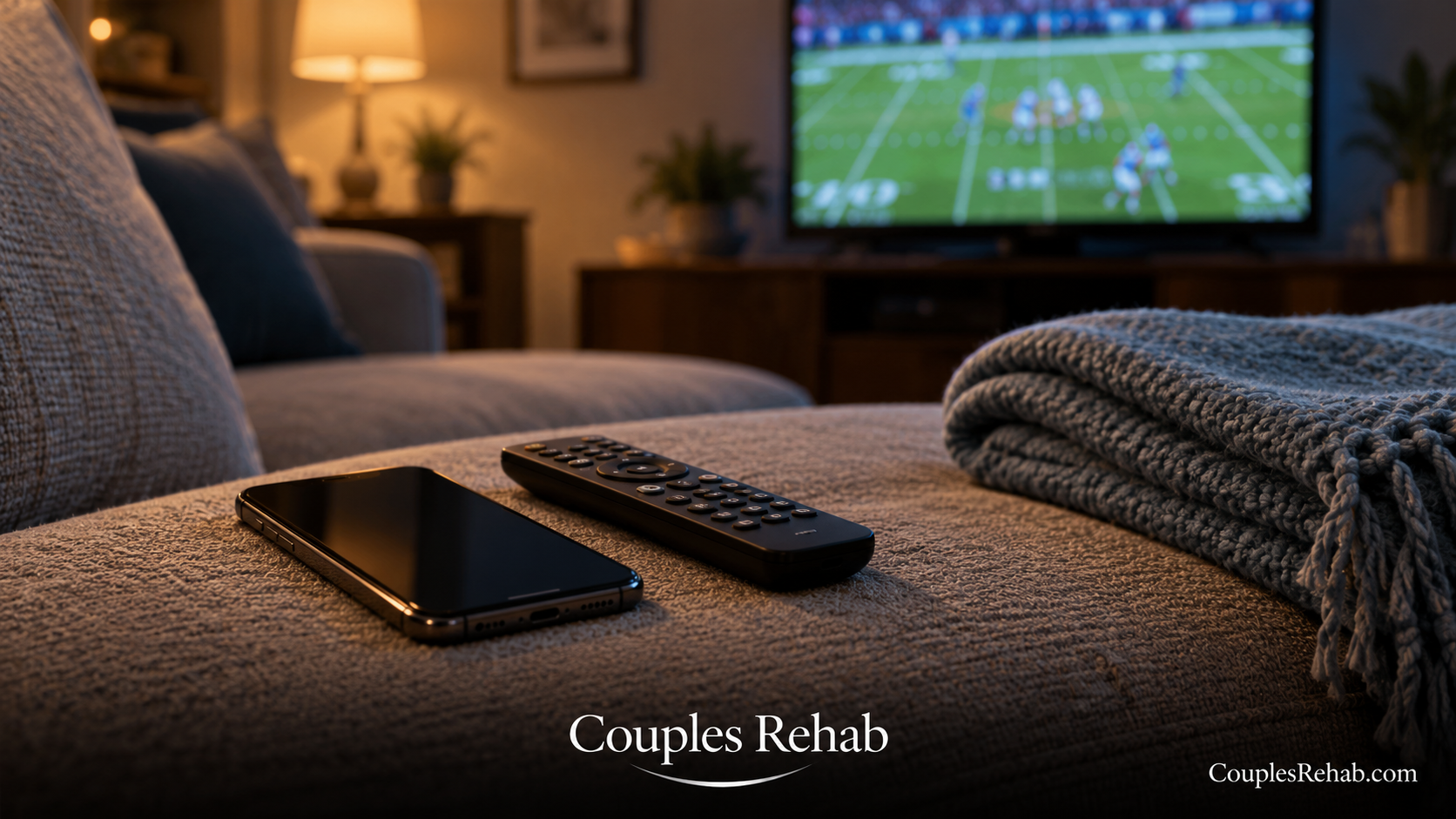
Sunday used to mean a game on TV. For a lot of households now, it also means a phone in someone’s hand all afternoon: a parlay on the early game, a live bet in the third quarter, another one to make back what the last one lost. Legal sports betting has spread to most of the country in just a few years, and for most people who bet, it stays a hobby. For some, it doesn’t.
This article is for the partner who has started to notice something is off: money that doesn’t add up, a spouse who can’t look away from the score updates, promises that don’t hold. It covers what the research shows, the signs that betting has become a problem, how gambling and drinking feed each other, how to protect your household finances, and where to get help.
What the new data shows
In June 2026, Epic Research analyzed health records from more than 197 million adult patients between 2018 and early 2026. It found that gambling disorder diagnoses rose about 61% in states that legalized sports betting, from 3.0 to 4.8 per 100,000 patients. In states without legal sports betting, diagnoses fell about 29% over the same period. Among adults 18 to 29 in legalizing states, rates more than doubled. Adults 30 to 49 had the highest rates throughout, and men were diagnosed more often than women at every age.
The researchers are careful to note the limits. These are diagnoses, not a count of everyone with a gambling problem, since many people never see a doctor about it. Some of the rise may reflect clinicians recognizing gambling disorder more often. They also note that the trend can’t be tied to any single law, especially with unregulated prediction markets now in the mix.
Other data points the same way. In a March 2026 survey by the National Council on Problem Gambling, 79% of Americans said they consider gambling addiction as serious as or more serious than alcohol or drug addiction, yet only 15% said a primary care provider had ever asked them about gambling. That gap is one reason the person most likely to notice a problem first is often a spouse.
Why sports betting is different from the old office pool
Betting on games isn’t new. What’s changed is how it works:
- It’s always available. A sportsbook app is on the phone, in the bathroom at work, at the dinner table, and in bed at 1 a.m.
- It’s fast. Live, in-game betting means a new wager can be placed every few minutes instead of once a week.
- It feels like skill. Knowing the teams and following the stats can make betting feel more like an investment than a gamble, which makes losses easier to rationalize.
- It blends in. Watching sports is normal and social. A spouse glued to a game doesn’t look unusual, even when the real attention is on the bet slip.
- It’s private. Deposits move through apps and cards, so losses can grow without cash ever leaving a wallet.
Warning signs in a spouse
Clinicians diagnose gambling disorder using criteria from the DSM-5. A person must meet at least four of nine criteria within 12 months, and severity is rated mild (4–5), moderate (6–7), or severe (8–9). In everyday terms, the criteria look like this:
- Needing to bet larger amounts to get the same excitement
- Being restless or irritable when trying to cut back or stop
- Trying to cut back or stop, repeatedly, without success
- Being preoccupied with betting: planning the next bet, reliving wins, looking for money to wager
- Betting more when stressed, anxious, guilty, or down
- Chasing losses, or betting again to win back what was lost
- Lying to hide how much they bet
- Risking or losing a relationship, job, or opportunity because of betting
- Relying on others for money to cover gambling losses
From the other side of the couch, those criteria often show up as:
- Checking scores and odds constantly, including during family time, meals, or in bed
- Mood that rises and falls with game results, sometimes for games they have no personal connection to
- Defensiveness or anger when asked about money or the phone
- Unexplained withdrawals, transfers, new credit cards, or cash advances
- Bills that are suddenly late, or money missing from savings or a child’s account
- Asking to borrow money from you, family, or friends, sometimes with vague explanations
- Big wins mentioned, losses never
Only a licensed clinician can diagnose gambling disorder. But if several of these sound familiar, it’s reasonable to take it seriously. The NCPG offers free problem gambling self-assessments that a spouse can take privately.
Hidden accounts and money secrecy
Secrecy is often what does the most damage to a marriage, more than the money itself. A partner may open sportsbook accounts in their own name, link a card the other spouse doesn’t know about, take out personal loans, or move money between accounts to cover gaps. When it comes out, the betrayal can feel similar to discovering an affair, and many spouses describe it that way.
Lying to hide betting is one of the nine diagnostic criteria for a reason: concealment tends to grow with the problem. Our article on why financial secrecy can become a relationship issue looks at how hidden money erodes trust and what rebuilding it involves.
How betting and drinking feed each other
Gambling and substance use often show up together. A study in PLOS ONE found that hazardous alcohol use was more common among people with gambling problems, and daily tobacco use had the strongest link. The overlap makes practical sense on game day:
- Drinking lowers inhibitions, so bets get bigger and riskier as the afternoon goes on.
- Losses lead to drinking to cope, and drinking leads to chasing losses.
- Watching games is often social and built around alcohol, which normalizes both.
- Someone cutting back on one may lean harder on the other.
If both are part of the picture, treatment should address both. Dual diagnosis care is designed for situations where addiction and mental health concerns overlap. If you’re trying to figure out whether your spouse’s drinking is also a problem, our guide on when nightly drinking becomes a disorder walks through the criteria.
Protecting your household finances
Protecting money isn’t a punishment or a sign you’ve given up on the marriage. It keeps the household stable while your spouse gets help. Guidance for family members from the Pennsylvania Gaming Control Board and other problem gambling programs includes:
- Review statements. Look at bank and credit card statements, along with savings, college, and retirement accounts.
- Pull credit reports from all three major credit bureaus to check for accounts or debt you don’t know about. A credit freeze can stop new accounts from being opened in your name.
- Take over day-to-day finances, at least for now, and consider separating essential money (mortgage, rent, utilities, childcare) into an account only you control.
- Don’t pay off gambling debts without a plan. Bailing someone out can remove the consequences that prompt change. Talk to a counselor or financial advisor first.
- Block gambling sites and apps on shared devices using blocking software.
- Get advice from a financial counselor, and consider talking to an attorney about joint debt and your legal exposure.
Your spouse can take steps too. Most legal sportsbooks offer deposit limits, cool-off periods, and self-exclusion, and many states run self-exclusion programs that ban a person from licensed betting. Asking your spouse to self-exclude is a concrete, reasonable request.
If your spouse controls the money in ways that make you afraid, threatens you, or pressures you for money you don’t want to give, that is more than a gambling problem. Our article on substance use and domestic violence explains where to get confidential help.
How to bring it up
The conversation is hard because gambling problems usually come with shame, and shame tends to come out as denial or anger. Some approaches that help:
- Pick a calm moment, not right after a loss or during a game.
- Start with what you’ve seen, not a label. “I noticed $1,200 went to an account I don’t recognize last month” is easier to hear than “You have a gambling problem.”
- Say how it affects you. “I’m worried, and I don’t feel like I can trust the numbers anymore” keeps the focus on the relationship.
- Have specific asks ready: a visit with a counselor, self-exclusion, a call to the helpline, or full access to accounts.
- Expect pushback. Minimizing (“Everyone bets”) and promises to win it back are common. You may need more than one conversation.
For more on approaching a partner who isn’t ready, see how to talk to a partner about treatment and setting boundaries with a partner.
Treatment and support
Gambling disorder is treatable, and help exists for both the person who gambles and the people around them:
- The National Problem Gambling Helpline (1-800-MY-RESET) connects callers to local counselors, treatment programs, and support, 24/7.
- Counseling with a gambling-informed therapist. Cognitive behavioral therapy is commonly used for gambling problems. The NCPG has a counselor directory and treatment listings by state.
- Treatment for co-occurring issues, such as drinking, depression, or anxiety, which often travel with gambling problems.
- Gamblers Anonymous for the person who gambles, and Gam-Anon for spouses and family members.
- Couples counseling once the betting has stopped and finances are stable, to rebuild trust. Marriage counseling and online couples therapy with independent licensed providers can help with that work.
- Financial and credit counseling to address debt and set up a recovery budget.
Spouses deserve support even if the person gambling isn’t ready for help. Gam-Anon, a counselor of your own, or a call to the helpline can make a hard situation more manageable.
Frequently asked questions
How do I know if my spouse’s sports betting is a problem?
Warning signs include betting larger amounts to feel the same excitement, chasing losses, being unable to cut back, lying about how much they bet, hiding accounts or debt, and borrowing money to cover losses. Clinicians diagnose gambling disorder when at least four of nine DSM-5 criteria are present within 12 months.
Is sports betting addiction a real addiction?
Yes. Gambling disorder is a recognized condition in the DSM-5, the manual clinicians use to diagnose mental health conditions, and it is treatable with counseling, support groups, and care for co-occurring issues.
Are gambling problems increasing with legal sports betting?
Epic Research found gambling disorder diagnoses rose about 61% between 2018 and early 2026 in states that legalized sports betting, while they fell about 29% in states that did not. The researchers note these are diagnoses rather than total prevalence and that better recognition may account for part of the rise.
How can I protect our money from my spouse’s gambling?
Review bank, credit card, and retirement statements, pull credit reports from all three bureaus, consider a credit freeze, move essential bill money into an account you control, block gambling sites on shared devices, and talk with a financial counselor or attorney about joint debt.
Is there a hotline for gambling problems?
Yes. The National Problem Gambling Helpline is available 24/7 by call or text at 1-800-MY-RESET (1-800-697-3738) and by chat. It is free and confidential, and family members can call too.
Is there support for spouses of people with gambling problems?
Yes. Gam-Anon is a support group for family members and friends of people with gambling problems. Spouses can also call the National Problem Gambling Helpline or see a counselor of their own, even if the person who gambles is not ready for help.
Getting help
National Problem Gambling Helpline: call or text 1-800-MY-RESET (1-800-697-3738), or chat at 1800myreset.org. Free, confidential, and available 24/7.
If gambling is showing up alongside drinking, drugs, or other strain in your relationship, the Couples Assessment walks through clinical and relational needs and matches couples to verified, independent licensed providers, through telehealth or in person. You can also reach a Care Navigator at 888-500-2110, Monday through Friday, 9am to 6pm Pacific. Care Navigators are not clinicians and do not provide medical advice, diagnosis, or treatment.
If you or your spouse is feeling hopeless or thinking about suicide, call or text the 988 Suicide & Crisis Lifeline at any hour. More resources are on our crisis support page.
References
- Epic Research. Gambling Disorder Diagnoses Have Risen More Than 60% in States That Legalized Sports Betting. June 26, 2026.
- National Council on Problem Gambling. National Survey Finds Widespread Gambling Participation Before Age 21. March 2, 2026.
- National Council on Problem Gambling. Help & Treatment.
- Nevada Council on Problem Gambling. Diagnostic Criteria: Gambling Disorder (DSM-5).
- Ford, M., & Håkansson, A. (2020). Problem gambling, associations with comorbid health conditions, substance use, and behavioural addictions. PLOS ONE.
- Pennsylvania Gaming Control Board. How to Protect Yourself.
Couples Rehab is an independent educational and referral resource. We do not provide medical or clinical care directly and are not a treatment provider. All care described here is delivered by independent licensed providers. This article is for informational purposes and is not a substitute for medical, financial, or legal advice from a qualified professional. Our sourcing and review process is described in our editorial standards.